Question: 1 2 3 4 5 6 7 8 9 10 11 12 13 14 15 16 17 18 19 20 China's Milk Adulteration (CMA) Scenario
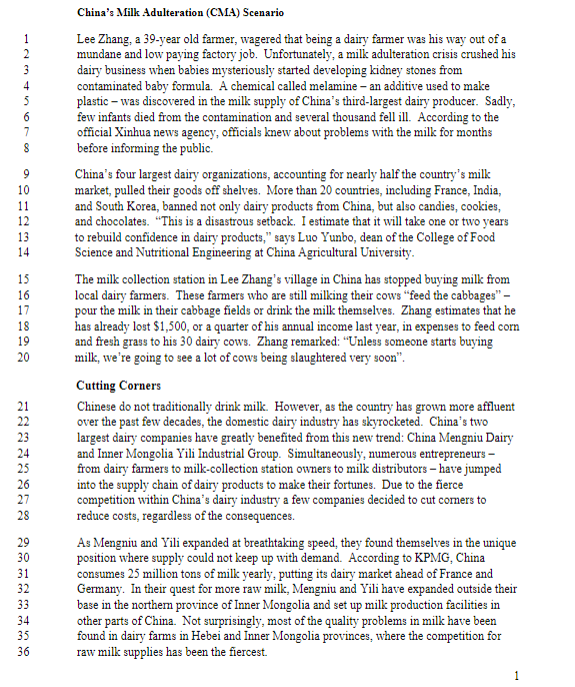
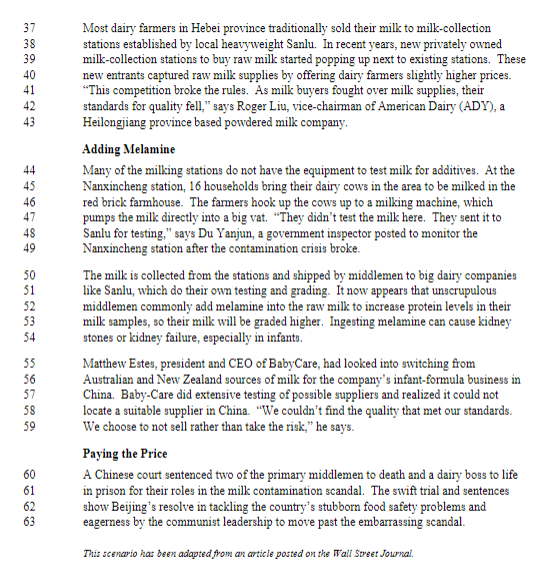
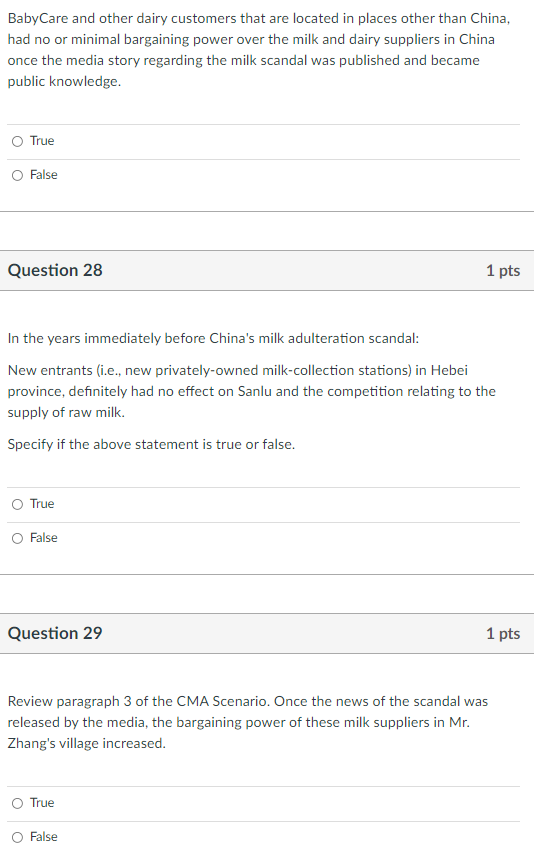
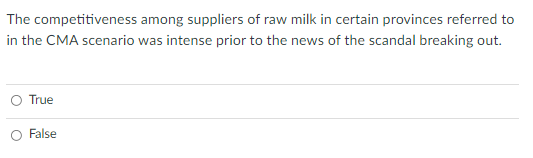
1 2 3 4 5 6 7 8 9 10 11 12 13 14 15 16 17 18 19 20 China's Milk Adulteration (CMA) Scenario Lee Zhang, a 39-year old farmer, wagered that being a dairy farmer was his way out of a mundane and low paying factory job. Unfortunately, a milk adulteration crisis crushed his dairy business when babies mysteriously started developing kidney stones from contaminated baby formula. A chemical called melamine - an additive used to make plastic was discovered in the milk supply of China's third-largest dairy producer. Sadly, few infants died from the contamination and several thousand fell ill. According to the official Xinhua news agency, officials knew about problems with the milk for months before informing the public China's four largest dairy organizations, accounting for nearly half the country's milk market, pulled their goods off shelves. More than 20 countries, including France, India, and South Korea, banned not only dairy products from China, but also candies, cookies, and chocolates. "This is a disastrous setback. I estimate that it will take one or two years to rebuild confidence in dairy products," says Luo Yunbo, dean of the College of Food Science and Nutritional Engineering at China Agricultural University. The milk collection station in Lee Zhang's village in China has stopped buying milk from local dairy farmers. These farmers who are still milking their cows "feed the cabbages" - pour the milk in their cabbage fields or drink the milk themselves. Zhang estimates that he has already lost $1,500, or a quarter of his annual income last year, in expenses to feed corn and fresh grass to his 30 dairy cows. Zhang remarked: "Unless someone starts buying milk, we're going to see a lot of cows being slaughtered very soon". Cutting Corners Chinese do not traditionally drink milk. However, as the country has grown more affluent over the past few decades, the domestic dairy industry has skyrocketed. China's two largest dairy companies have greatly benefited from this new trend: China Mengniu Dairy and Inner Mongolia Yili Industrial Group. Simultaneously, numerous entrepreneurs - from dairy farmers to milk-collection station owners to milk distributors - have jumped into the supply chain of dairy products to make their fortunes. Due to the fierce competition within China's dairy industry a few companies decided to cut comers to reduce costs, regardless of the consequences. As Mengniu and Yili expanded at breathtaking speed, they found themselves in the unique position where supply could not keep up with demand. According to KPMG, China consumes 25 million tons of milk yearly, putting its dairy market ahead of France and Germany. In their quest for more raw milk, Mengniu and Yili have expanded outside their base in the northern province of Inner Mongolia and set up milk production facilities in other parts of China. Not surprisingly, most of the quality problems in milk have been found in dairy farms in Hebei and Inner Mongolia provinces, where the competition for raw milk supplies has been the fiercest. 21 22 23 24 25 26 27 28 29 30 31 32 33 34 35 36 37 38 39 40 41 42 43 44 45 46 47 48 49 50 51 52 53 54 Most dairy farmers in Hebei province traditionally sold their milk to milk-collection stations established by local heavyweight Sanlu. In recent years, new privately owned milk-collection stations to buy raw milk started popping up next to existing stations. These new entrants captured raw milk supplies by offering dairy farmers slightly higher prices. "This competition broke the rules. As milk buyers fought over milk supplies, their standards for quality fell," says Roger Liu, vice-chairman of American Dairy (ADY), a Heilongjiang province based powdered milk company. Adding Melamine Many of the milking stations do not have the equipment to test milk for additives. At the Nanxincheng station, 16 households bring their dairy cows in the area to be milked in the red brick farmhouse. The farmers hook up the cows up to a milking machine, which pumps the milk directly into a big vat. "They didn't test the milk here. They sent it to Sanlu for testing," says Du Yanjun, a government inspector posted to monitor the Nanxincheng station after the contamination crisis broke. The milk is collected from the stations and shipped by middlemen to big dairy companies like Sanlu, which do their own testing and grading. It now appears that unscrupulous middlemen commonly add melamine into the raw milk to increase protein levels in their milk samples, so their milk will be graded higher. Ingesting melamine can cause kidney stones or kidney failure, especially in infants. Matthew Estes, president and CEO of BabyCare, had looked into switching from Australian and New Zealand sources of milk for the company's infant-formula business in China. Baby-Care did extensive testing of possible suppliers and realized it could not locate a suitable supplier in China. "We couldn't find the quality that met our standards. We choose to not sell rather than take the risk," he says. Paying the Price A Chinese court sentenced two of the primary middlemen to death and a dairy boss to life in prison for their roles in the milk contamination scandal. The swift trial and sentences show Beijing's resolve in tackling the country's stubborn food safety problems and eagerness by the communist leadership to move past the embarrassing scandal. 55 56 57 58 59 60 61 62 63 This scenario has been adapted from an article posted on the Wall Street Journal Baby Care and other dairy customers that are located in places other than China, had no or minimal bargaining power over the milk and dairy suppliers in China once the media story regarding the milk scandal was published and became public knowledge. True O False Question 28 1 pts In the years immediately before China's milk adulteration scandal: New entrants (i.e., new privately-owned milk-collection stations) in Hebei province, definitely had no effect on Sanlu and the competition relating to the supply of raw milk. Specify if the above statement is true or false. True O False Question 29 1 pts Review paragraph 3 of the CMA Scenario. Once the news of the scandal was released by the media, the bargaining power of these milk suppliers in Mr. Zhang's village increased. O True False The competitiveness among suppliers of raw milk in certain provinces referred to in the CMA scenario was intense prior to the news of the scandal breaking out. True O False









 Study Help