







Question: 1) 2) 3) 4) 5) 6) Compare and contrast human capital, H, physical capital, K and labour, L. What are main differences between these variables?
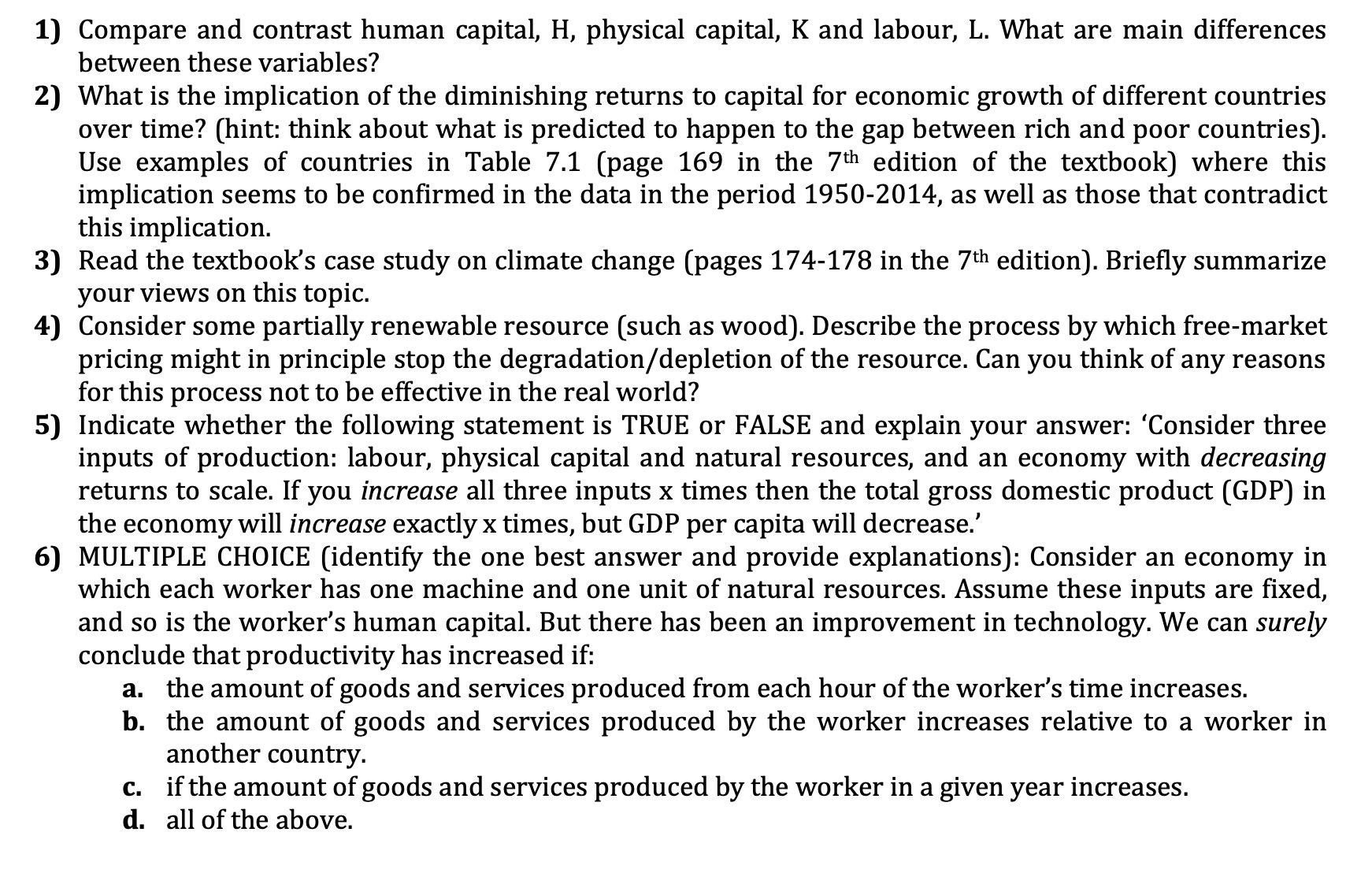
1) 2) 3) 4) 5) 6) Compare and contrast human capital, H, physical capital, K and labour, L. What are main differences between these variables? What is the implication of the diminishing returns to capital for economic growth of different countries over time? (hint: think about what is predicted to happen to the gap between rich and poor countries). Use examples of countries in Table 7.1 (page 169 in the 7th edition of the textbook) where this implication seems to be confirmed in the data in the period 1950-2014, as well as those that contradict this implication. Read the textbooks case study on climate change (pages 174-178 in the 7th edition). Briey summarize your views on this topic. Consider some partially renewable resource (such as wood). Describe the process by which free-market pricing might in principle stop the degradation/depletion of the resource. Can you think of any reasons for this process not to be effective in the real world? Indicate whether the following statement is TRUE or FALSE and explain your answer: 'Consider three inputs of production: labour, physical capital and natural resources, and an economy with decreasing returns to scale. If you increase all three inputs x times then the total gross domestic product (GDP) in the economy will increase exactly x times, but GDP per capita will decrease.' MULTIPLE CHOICE (identify the one best answer and provide explanations): Consider an economy in which each worker has one machine and one unit of natural resources. Assume these inputs are fixed, and so is the worker's human capital. But there has been an improvement in technology. We can surely conclude that productivity has increased if: a. the amount of goods and services produced from each hour of the worker's time increases. b. the amount of goods and services produced by the worker increases relative to a worker in another country. c. if the amount of goods and services produced by the worker in a given year increases. d. all of the above
Step by Step Solution
There are 3 Steps involved in it

Get step-by-step solutions from verified subject matter experts
 Study Help