







Question: 1. 2. 3. 4. 5. 6. The first one is select all apply. Others would only have one correct answer. Which of the following should
1. 2.
2.
 3.
3.
 4.
4.
 5.
5.
 6.
6.
 The first one is select all apply. Others would only have one correct answer.
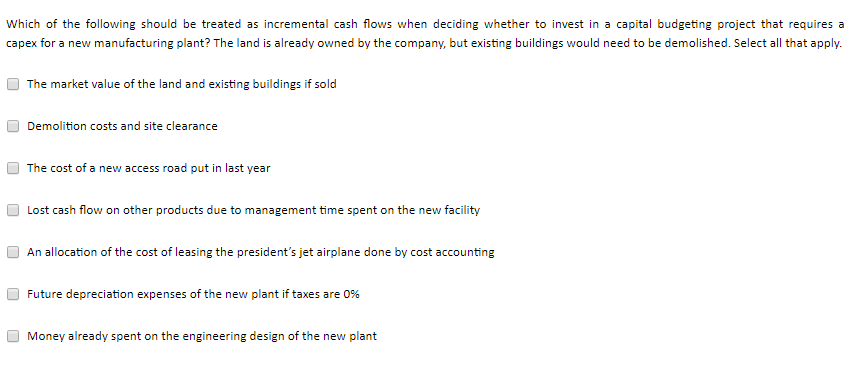
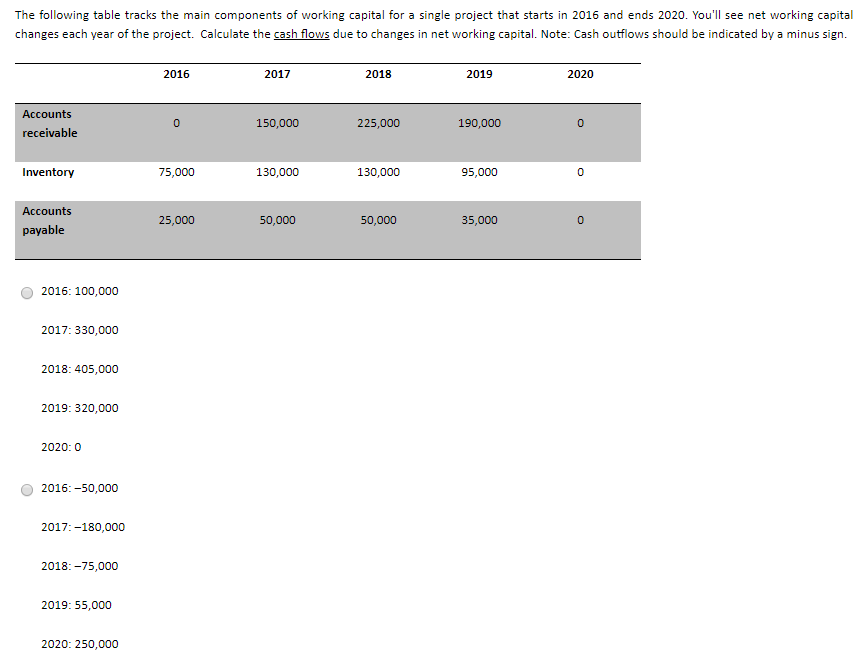
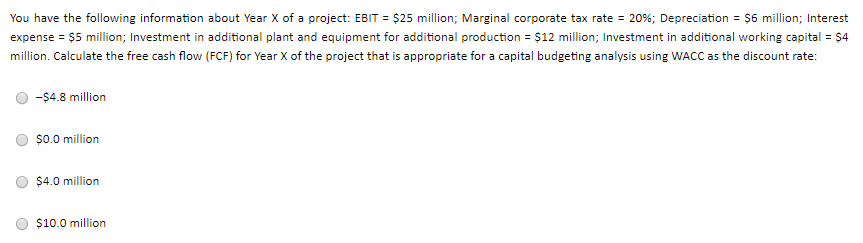
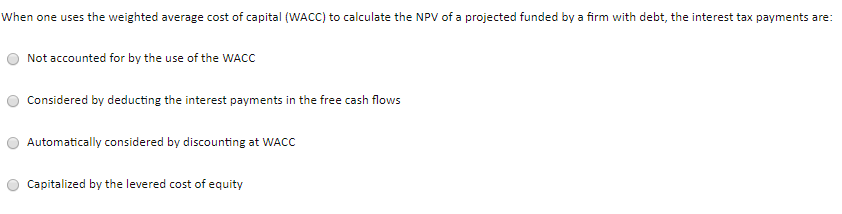
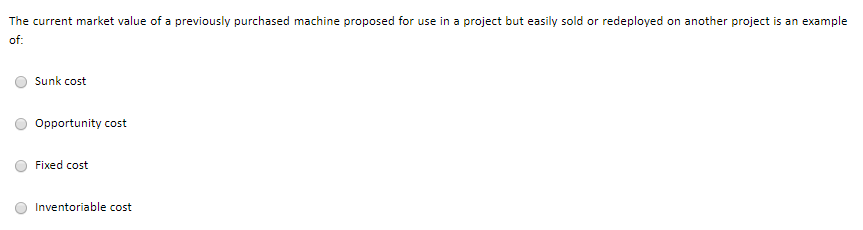
Which of the following should be treated as incremental cash flows when deciding whether to invest in a capital budgeting project that requires a manufacturing plant? The land is already owned by the company, but existing buildings would need to be demolished. Select all that apply. capex for a new The market value of the land and existing buildings if sold Demolition costs and site clearance The cost of a new access road put in last year Lost cash flow on other products due to management time spent on the new facility An allocation of the cost of leasing the president's jet airplane done by cost accounting Future depreciation expenses of the new plant if taxes are 0% Money already spent on the engineering design of the new plant The following table tracks the main components of working capital for a single project that starts in 2016 and ends 2020. You'll see net working capital changes each year of the project. Calculate the cash flows due to changes in net working capital. Note: Cash outflows should be indicated by a minus sign 2016 2017 2018 2019 2020 Accounts 225,000 0 150,000 190,000 0 receivable Inventory 75,000 130,000 130,000 95,000 0 Accounts 25,000 50,000 50,000 35,000 0 payable 2016: 100,000 2017: 330,000 2018: 405,000 2019: 320,000 2020: 0 2016: -50,000 2017:-180,000 2018: -75,000 2019: 55,000 2020: 250,000 2016: -75,000 2017: -130,000 2018: -130,000 2019: -95,000 2020: 0 2016: 50,000 2017: 230,000 2018: 305,000 2019: 250,000 2020: 0 You have the following information about Year X of a project: EBIT $25 million; Marginal corporate tax rate 20 %; Depreciation $6 million; Interest expense $5 million; Investment in additional plant and equipment for additional production $12 million; Investment in additional working capital $4 million. Calculate the free cash flow (FCF) for Year X of the project that is appropriate for a capital budgeting analysis using WACC as the discount rate: -$4.8 million $0.0 million $4.0 million $10.0 million When one uses the weighted average cost of capital (WACC) to calculate the NPV of a projected funded by a firm with debt, the interest tax payments are: Not accounted for by the use of the WACC Considered by deducting the interest payments in the free cash flows Automatically considered by discounting at WACC Capitalized by the levered cost of equity The current market value of a previously purchased machine proposed for use in a project but easily sold or redeployed on another project is an example of Sunk cost Opportunity cost Fixed cost Inventoriable cost Money that a firm has already spent, or committed to spend regardless of whether a project is funded, is called: Fixed cost Opportunity cost Sunk cost Inventoriable cost
Step by Step Solution
There are 3 Steps involved in it

Get step-by-step solutions from verified subject matter experts
 Study Help