







Question: 1) 2) 3) 4) 5) GUIDE TO OPTIMIZATION PROBLEMS 1 - 4: Read the problem carefully. Draw a diagram if possible. DEFINE IN WORDS a
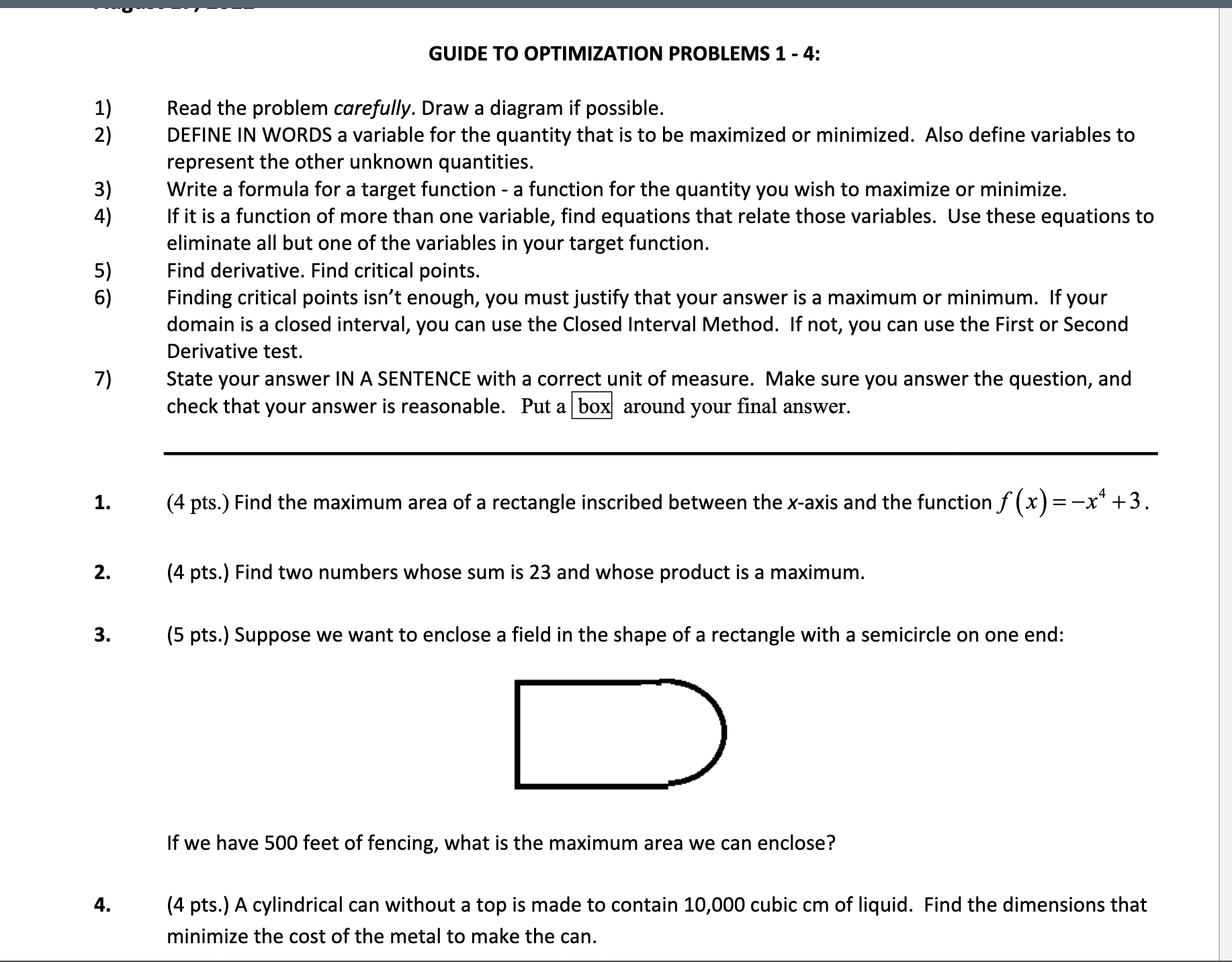
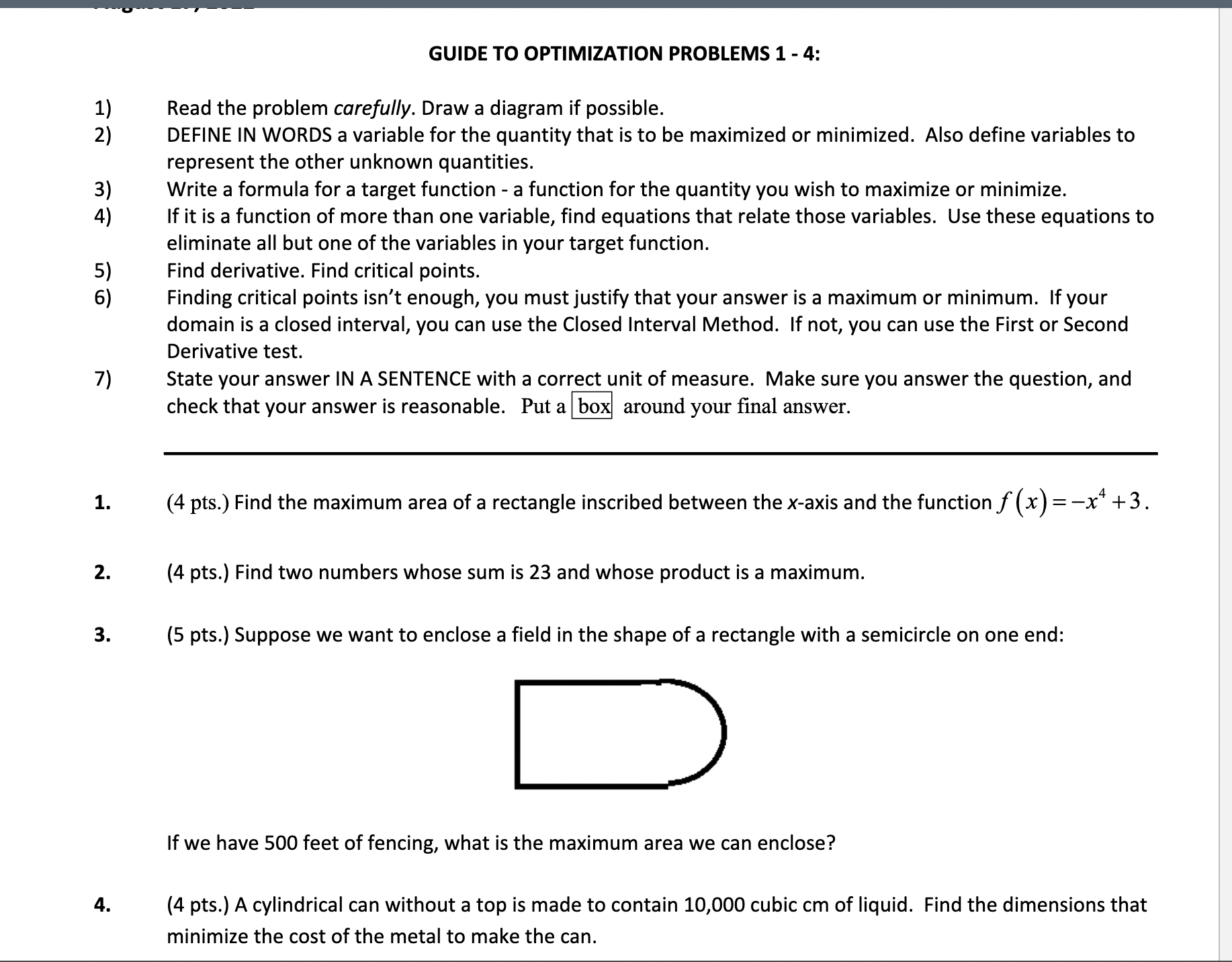
1) 2) 3) 4) 5) GUIDE TO OPTIMIZATION PROBLEMS 1 - 4: Read the problem carefully. Draw a diagram if possible. DEFINE IN WORDS a variable for the quantity that is to be maximized or minimized. Also define variables to represent the other unknown quantities. Write a formula for a target function - a function for the quantity you wish to maximize or minimize. If it is a function of more than one variable, find equations that relate those variables. Use these equations to eliminate all but one of the variables in your target function. Find derivative. Find critical points. Finding critical points isn't enough, you must justify that your answer is a maximum or minimum. If your domain is a closed interval, you can use the Closed Interval Method. If not, you can use the First or Second Derivative test. State your answer IN A SENTENCE with a correct unit of measure. Make sure you answer the question, and check that your answer is reasonable. Put a around your nal answer. (4 pts.) Find the maximum area of a rectangle inscribed between the x-axis and the function f(x) = x4 + 3. (4 pts.) Find two numbers whose sum is 23 and whose product is a maximum. (5 pts.) Suppose we want to enclose a field in the shape of a rectangle with a semicircle on one end: If we have 500 feet of fencing, what is the maximum area we can enclose? (4 pts.) A cylindrical can without a top is made to contain 10,000 cubic cm of liquid. Find the dimensions that minimize the cost of the metal to make the can
Step by Step Solution
There are 3 Steps involved in it

Get step-by-step solutions from verified subject matter experts
 Study Help