







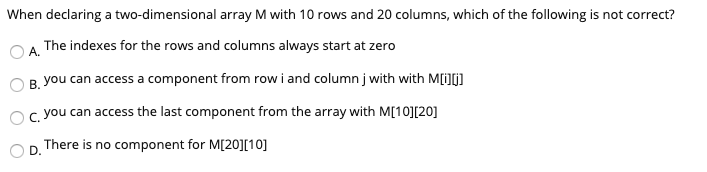
Question: 1 2 3 4 5 When declaring a two-dimensional array M with 10 rows and 20 columns, which of the following is not correct? The
1
2
3
4

5
![M[[j] c you can access the last component from the array with](https://dsd5zvtm8ll6.cloudfront.net/si.experts.images/questions/2024/09/66f086d456d76_18866f086d40363e.jpg)
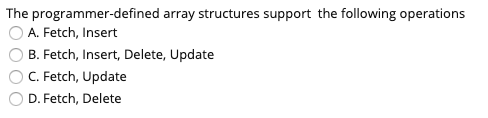
When declaring a two-dimensional array M with 10 rows and 20 columns, which of the following is not correct? The indexes for the rows and columns always start at zero OB. you can access a component from row i and column with with M[[j] c you can access the last component from the array with M[10][20] D. There is no component for M[20][10] The programmer-defined array structures support the following operations O A. Fetch, Insert O B. Fetch, Insert, Delete, Update OC. Fetch, Update OD. Fetch, Delete What is a Generic Data Structure? A data structure that can store any kind of node and can be used in an application A data structure that could not only be used to store the data for a telephone listing application but also an employee record application, a store inventory application or OB. any other type of data application without modifying its code OCA and B Od none of above Program spend a lot of the execution time searching through memory to locate the data they process. True False Logarithmic Speed Complexity is worse that Linear Speed Complexity True False
Step by Step Solution
There are 3 Steps involved in it

Get step-by-step solutions from verified subject matter experts
 Study Help