







Question: 1 2 3 Background This case involves a major electronics firm in India. It manufactures 3 basic product lines and has several thousand employees dispersed
1
2
3
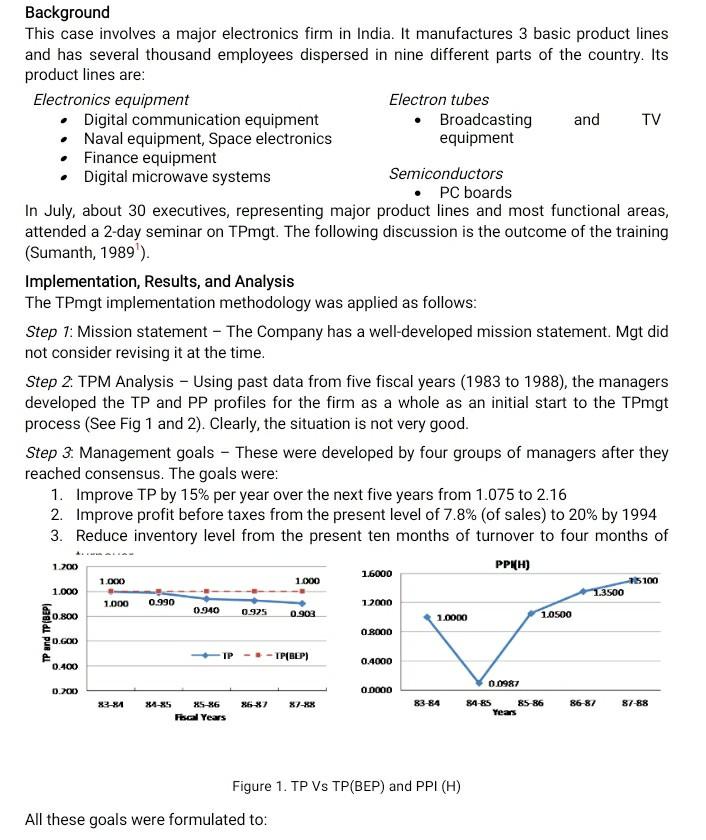
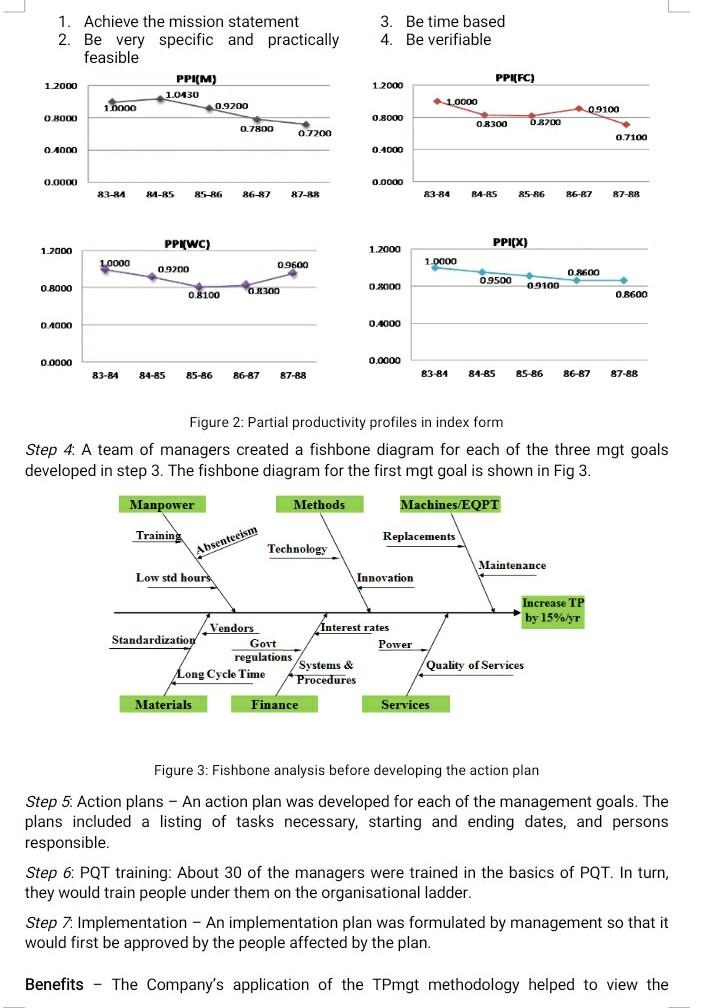
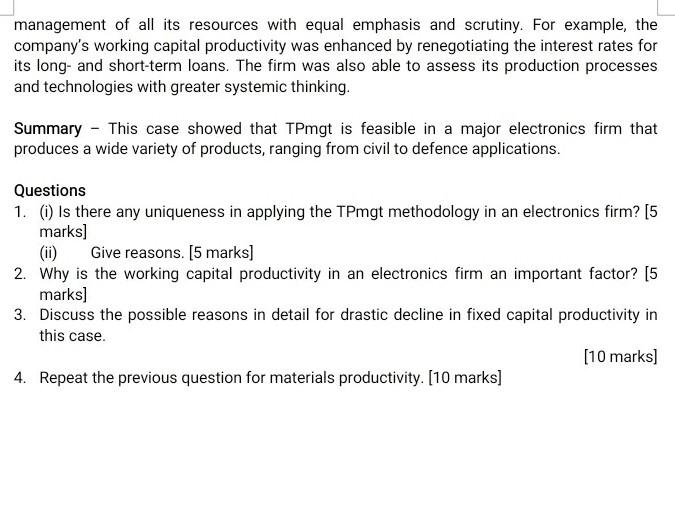
Background This case involves a major electronics firm in India. It manufactures 3 basic product lines and has several thousand employees dispersed in nine different parts of the country. Its product lines are: Electronics equipment Electron tubes Digital communication equipment Broadcasting and TV Naval equipment, Space electronics equipment Finance equipment Digital microwave systems Semiconductors PC boards In July, about 30 executives, representing major product lines and most functional areas, attended a 2-day seminar on TPmgt. The following discussion is the outcome of the training (Sumanth, 1989'). Implementation, Results, and Analysis The TPmgt implementation methodology was applied as follows: Step 1: Mission statement - The Company has a well-developed mission statement. Mgt did not consider revising it at the time. Step 2. TPM Analysis - Using past data from five fiscal years (1983 to 1988), the managers developed the TP and PP profiles for the firm as a whole as an initial start to the TPmgt process (See Fig 1 and 2). Clearly, the situation is not very good. Step 3. Management goals - These were developed by four groups of managers after they reached consensus. The goals were: 1. Improve TP by 15% per year over the next five years from 1.075 to 2.16 2. Improve profit before taxes from the present level of 7.8% (of sales) to 20% by 1994 3. Reduce inventory level from the present ten months of turnover to four months of PPH(H) 1.200) 1.6000 1.000 1.000 15100 1.3500 1.000 1.000 0.990 1.2000 0.940 0.800 0.925 0.903 1.0000 1.0500 0.8000 0.GOO IP - IPBP) 0.4000 0.400 0.0987 D.2x) 0.0000 83-84 6-7 87-XX 83-84 84-85 85-86 Years 86-87 84-85 85-86 Fbal Years 87-88 Figure 1. TP VS TP(BEP) and PPI (H) All these goals were formulated to: 3. Be time based 4. Be verifiable 1. Achieve the mission statement 2. Be very specific and practically feasible PPI(M) 1.0430 10000 PPI(FC) ( 1.2000 1.2000 0.9200 1.0000 09100 O ROCO 0.8000 0.7800 0.8300 0.8200 0.7200 0.7100 0.4000 0.4000 0.0000 0.0000 83-84 84-85 85-86 86-87 87-88 83-84 B4-RS 85-86 86-87 87-88 PPIWC) PPI(X) 1.2000 1.2000 1.0000 10000 0.9200 0.9600 0.8600 0.9500 0.8000 0.8000 09100 0.8100 0.8300 08600 0.4000 0.4000 0.0000 0.0000 83-84 84-85 85-86 86 87 87-88 83-84 84-85 85-86 86-87 87-88 Figure 2: Partial productivity profiles in index form Step 4: A team of managers created a fishbone diagram for each of the three mgt goals developed in step 3. The fishbone diagram for the first mgt goal is shown in Fig 3. Manpower Methods Machines/EQPT Training Replacements Absenteeism Technology Maintenance Low std hours Innovation Increase TP by 15%/yr Vendors Ainterest rates Standardization Govt Power regulations Systems & Quality of Services Long Cycle Time Procedures Materials Finance Services Figure 3: Fishbone analysis before developing the action plan Step 5. Action plans - An action plan was developed for each of the management goals. The plans included a listing of tasks necessary, starting and ending dates, and persons responsible. Step 6: PQT training: About 30 of the managers were trained in the basics of PQT. In turn, they would train people under them on the organisational ladder. Step 7. Implementation - An implementation plan was formulated by management so that it would first be approved by the people affected by the plan. Benefits - The Company's application of the TPmgt methodology helped to view the management of all its resources with equal emphasis and scrutiny. For example, the company's working capital productivity was enhanced by renegotiating the interest rates for its long and short-term loans. The firm was also able to assess its production processes and technologies with greater systemic thinking. Summary - This case showed that TPmgt is feasible in a major electronics firm that produces a wide variety of products, ranging from civil to defence applications. Questions 1. (1) Is there any uniqueness in applying the TPmgt methodology in an electronics firm? [5 marks] (ii) Give reasons. [5 marks] 2. Why is the working capital productivity in an electronics firm an important factor? [5 marks) 3. Discuss the possible reasons in detail for drastic decline in fixed capital productivity in this case. (10 marks) 4. Repeat the previous question for materials productivity. [10 marks]Step by Step Solution
There are 3 Steps involved in it
1 Expert Approved Answer
Step: 1 Unlock

Question Has Been Solved by an Expert!
Get step-by-step solutions from verified subject matter experts
Step: 2 Unlock
Step: 3 Unlock
 Study Help