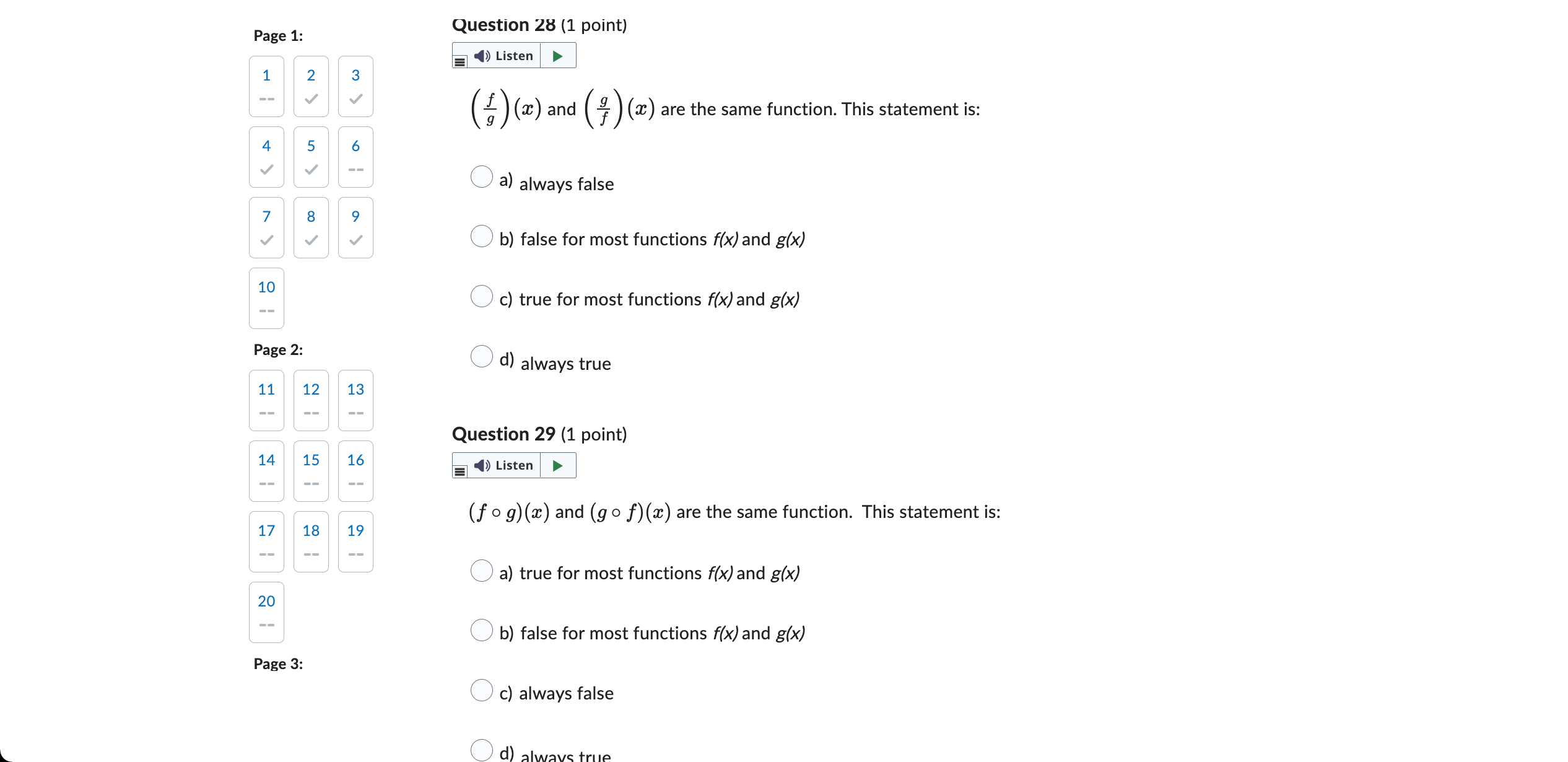
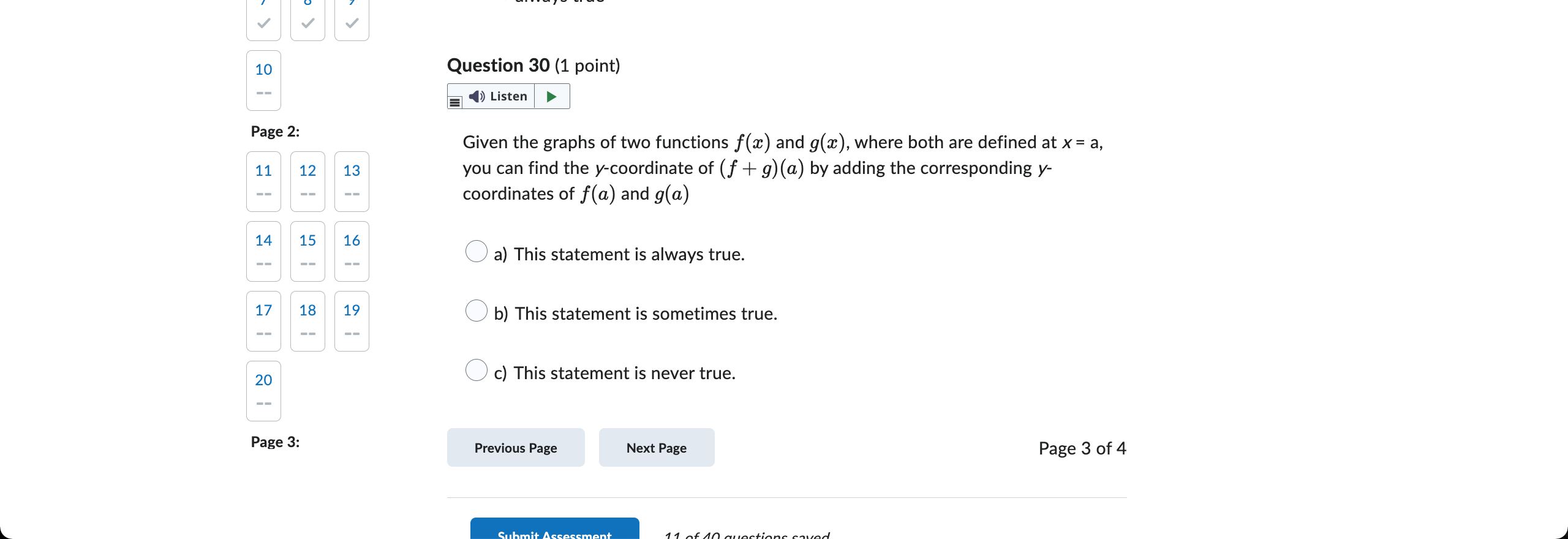
Question: ' 1 ' 2 ' ' 3 ' Question 24 (1 point) '/ '/ = (I) Listen V 4 5 6 For two functions,
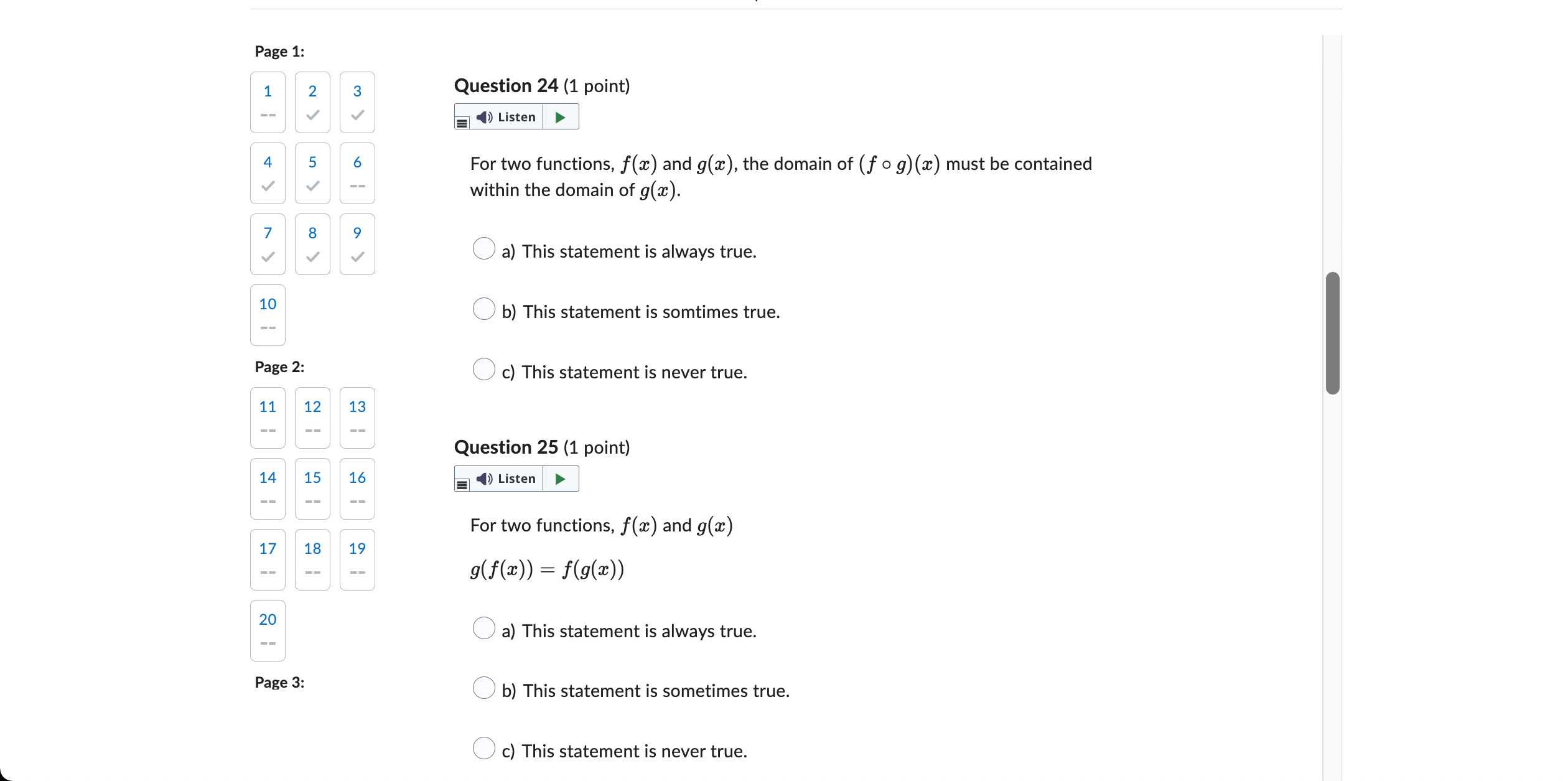
' 1 ' 2 ' ' 3 ' Question 24 (1' 1 ' 2 ' ' 3 ' Question 24 (1' 1 ' 2 ' ' 3 ' Question 24 (1' 1 ' 2 ' ' 3 ' Question 24 (1' 1 ' 2 ' ' 3 ' Question 24 (1
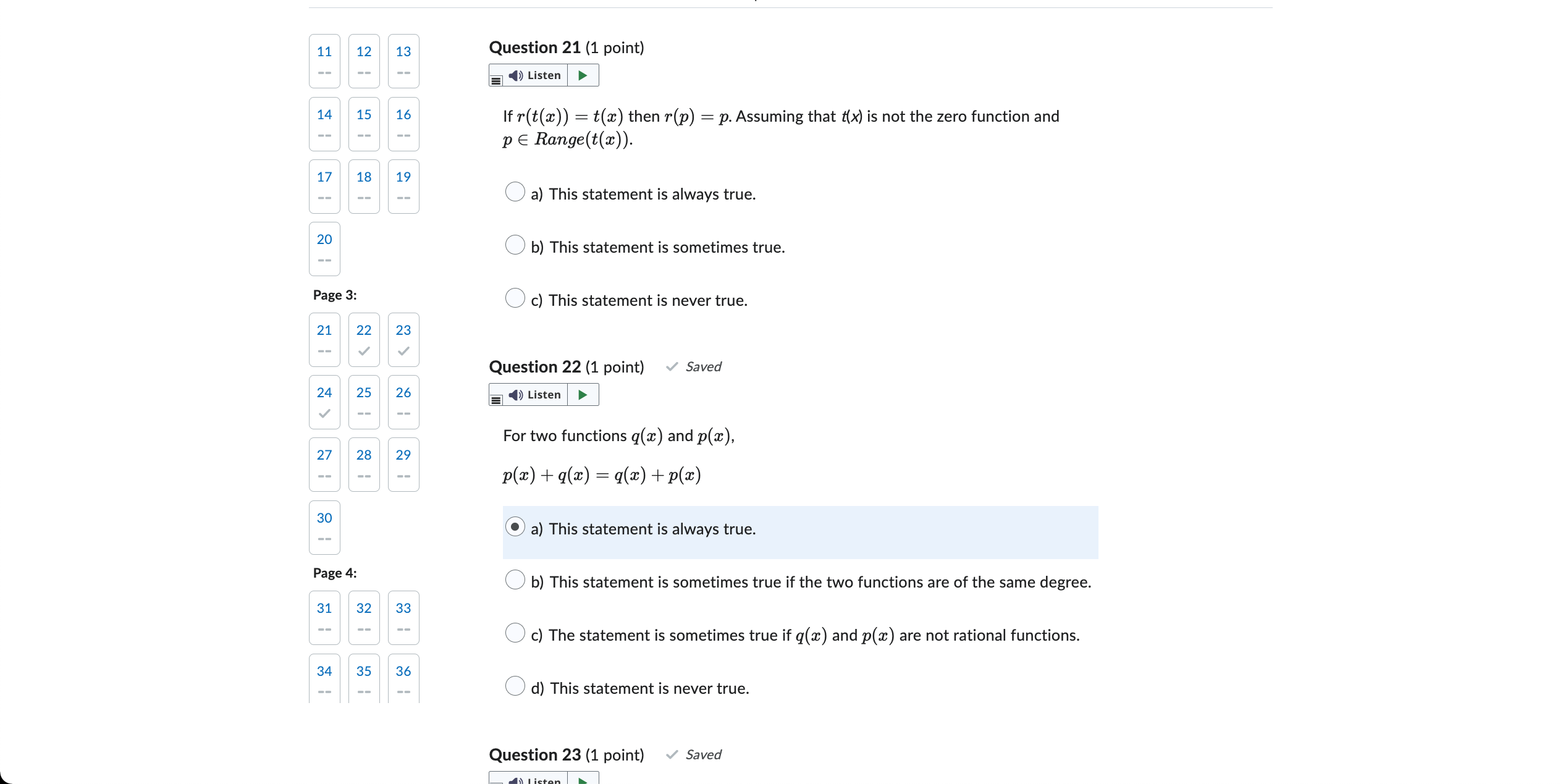
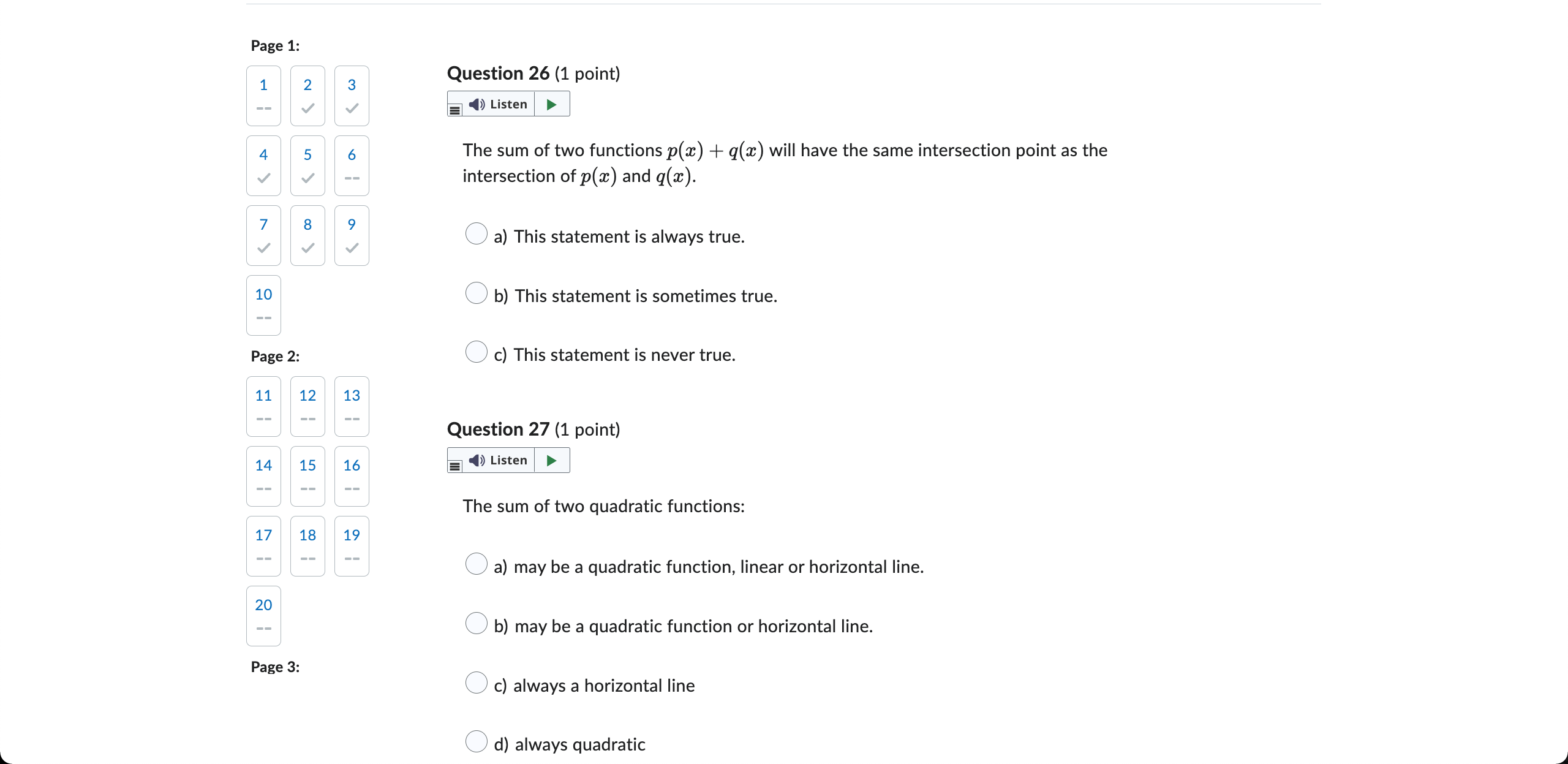
' 1 ' 2 ' ' 3 ' Question 24 (1 point) "" '/ '/ = (I) Listen V 4 5 6 For two functions, f(a:) and g(a:), the domain of (f o g)(m) must be contained :y \\L/ " within the domain of g(a:). 7 8 9 ', v O a) This statement is always true. 10 O b) This statement is somtimes true. Page 2' O c) This statement is never true. 11 12 13 ff: ff: ff: Question 25 (1 point) 14 15 16 i (D Listen b ;7' ;7: ii_ For two functions, f(:c) and g(w) 17 18 19 -- -- - 9(f($)) = f(9(x)) 20 . . __ O a) This statement IS always true. Page a: O b) This statement is sometimes true. 0 c) This statement is never true. Question 26 (1 point) __ '/ E (3) Listen l V I 4 L 5 I g, L The sum of two functions p(z) + q(a:) will have the same intersection point as the v v -- intersection of p(a:) and q(a:). 7 8 9 . . ~/ ~/ ~/ 0 a) ThIs statement IS always true. 10 O b) This statement is sometimes true. Page 2: O c) This statement is never true. 11 12 13 L/ x: :/ Question 27 (1 point) 14' ' 15 ' '16\\ i 1)) Listen P : j The sum of two quadratic functions: 0 a) may be a quadratic function, linear or horizontal line. 20 -- O b) may be a quadratic function or horizontal line. Page 3: O c) always a horizontal line 0 d) always quadratic Page 1: Question 28 (1 point) Listen 3 N (:) (2) and (# )(z) are the same function. This statement is: 4 U 6 O a) always false 8 9 V V V ( b) false for most functions f(x) and g(x) 10 O c) true for most functions f(x) and g(x) Page 2: O d) always true 1 12 13 Question 29 (1 point) 14 15 16 () Listen (f o g)(x) and (go f) (x) are the same function. This statement is: 17 8T 19 O a) true for most functions f(x) and g(x) 20 O b) false for most functions f(x) and g(x) Page 3: O c) always false O d)7 e.....,-...__ J \\l Question 30 (1 point) = {3 Listen } 7 ,7 Given the graphs of two functions f(a:) and {1(3), where both are defined at x = a, 12 13 you can find the y-coordinate of (f + g)(a) by adding the corresponding y- coordinates of u) and 9(a) O a) This statement is always true. O b) This statement is sometimes true. O c) This statement is never true. Page 3: Previous Page Next Page Page 3 of 4 W 1. ma -..'.....M. \"M 11 12 13 Question 21 (1 point) " " " IE 4)) Llsten b 14 15 16 If r(t(z)) = t(:c) then r(p) = 1). Assuming that 1(x) is not the zero function and " \" " p E Range(t(z)). 17 18 19 __ -. .- O a) This statement is always true. 20 O b) This statement is sometimes true. 0 c) This statement is never true. Question 22 (1 point) Saved 2 1 Listen y | 7/ ,7! \\i For two functions q(a:) and 11(2), 11(2) + 4(2) = 1(2) +p(w) 3) This statement is always true. 0 b) This statement is sometimes true if the two functions are of the same degree. 0 c) The statement is sometimes true if q(a:) and 12(2) are not rational functions. Q d) This statement is never true. Question 23 (1 point) Saved
Step by Step Solution

There are 3 Steps involved in it

1 Expert Approved Answer
Step: 1 Unlock blur-text-image

Question Has Been Solved by an Expert!

Get step-by-step solutions from verified subject matter experts

Step: 2 Unlock
Step: 3 Unlock

Students Have Also Explored These Related Mathematics Questions!