







Question: 1. 2. 90H??? n Ask one question about something at home, at work, or in your surroundings. Science involves asking questions. Formulate a hypothesis for
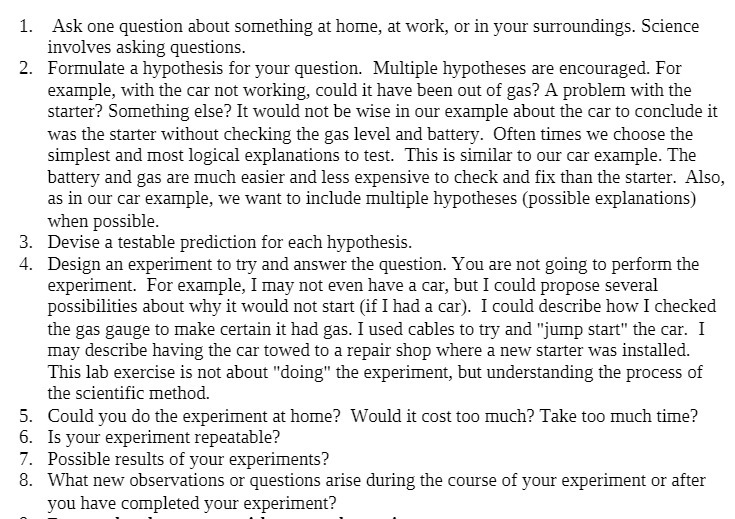
1. 2. 90H???\" n Ask one question about something at home, at work, or in your surroundings. Science involves asking questions. Formulate a hypothesis for your question. Multiple hypotheses are encouraged. For example, with the car not working, could it have been out of gas? A problem with the starter? Something else? It would not be wise in our example about the car to conclude it was the starter without checking the gas level and battery. Often times we choose the simplest and most logical explanations to test. This is similar to our car example. The battery and gas are much easier and less expensive to check and fix than the starter. Also, as in our car example, we want to include multiple hypotheses (possible explanations} when possible. 3. Devise a testable prediction for each hypothesis. 4. Design an experiment to try and answer the question. You are not going to perform the experiment. For example, I may not even have a car, but I could propose several possibilities about why it would not start (if I had a car). I could describe how I checked the gas gauge to make certain it had gas. I used cables to by and "jump start\" the car. I may describe having the car towed to a repair shop where a new starter was installed. This lab exercise is not about "doing" the experiment, but understanding the process of the scientific method. lCould you do the experiment at home? Would it cost too much? Take too much time? Is your experiment repeatable? Possible results of your experiments? What new observations or questions arise during the course of your experiment or after you have completed your experiment
Step by Step Solution
There are 3 Steps involved in it

Get step-by-step solutions from verified subject matter experts
 Study Help