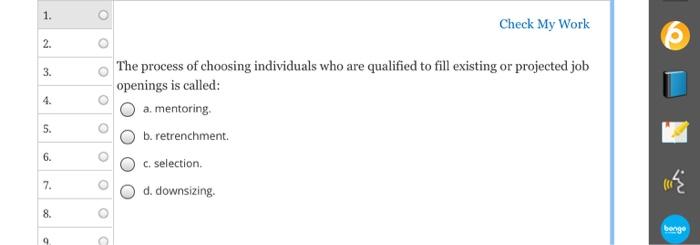
Question: 1. 2 Check My Work o 3. 4. 5. The process of choosing individuals who are qualified to fill existing or projected job openings is
1. 2 Check My Work o 3. 4. 5. The process of
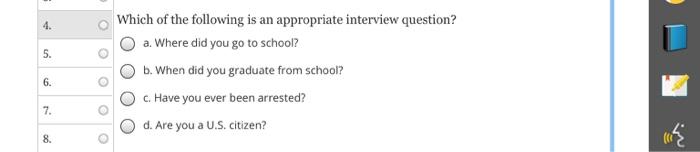
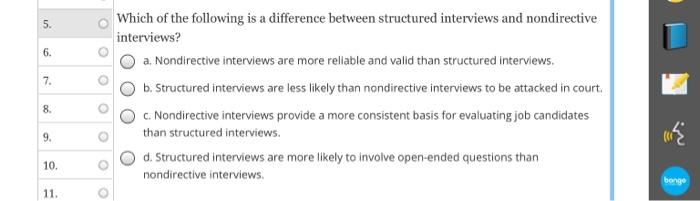
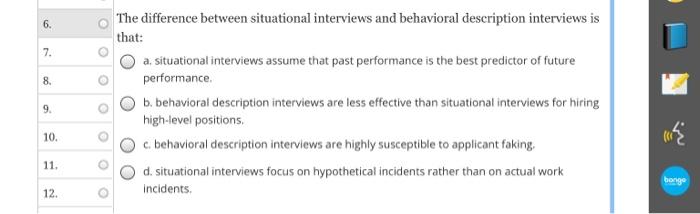
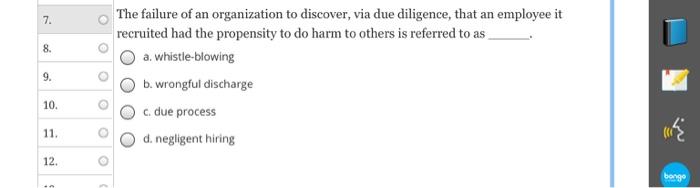
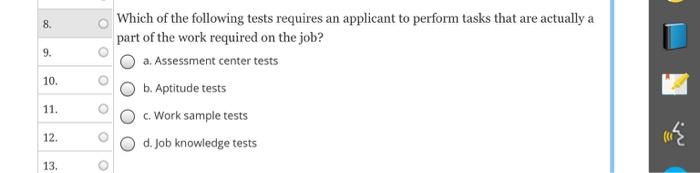
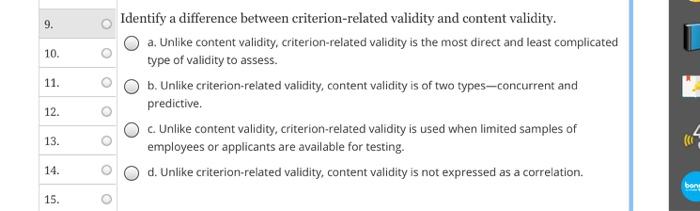
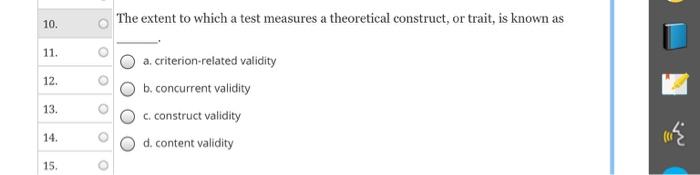
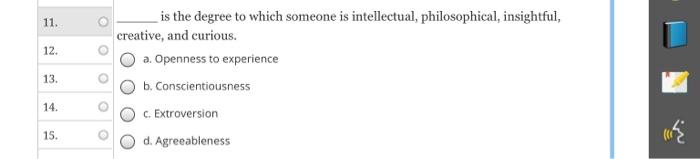
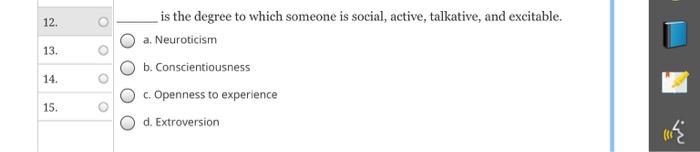
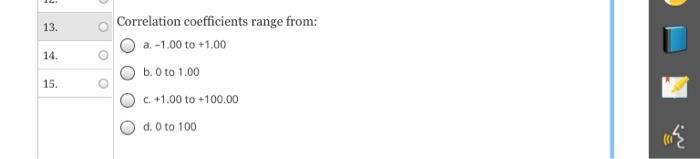
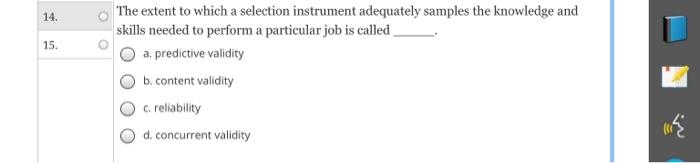
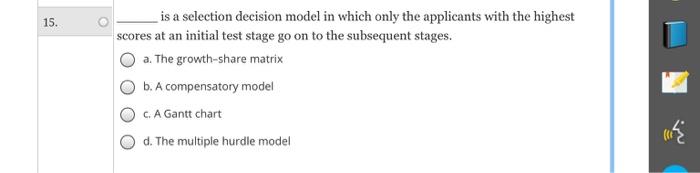
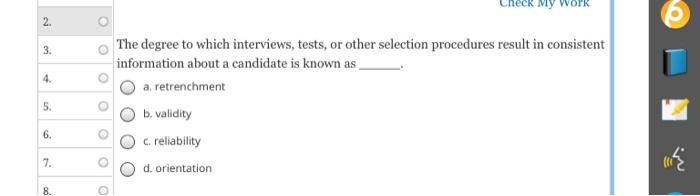
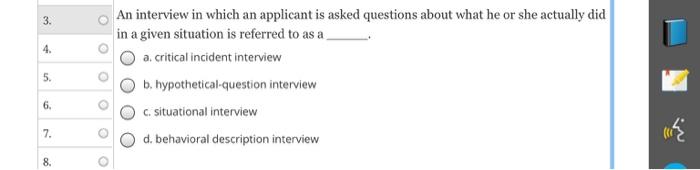
1. 2 Check My Work o 3. 4. 5. The process of choosing individuals who are qualified to fill existing or projected job openings is called: a mentoring b. retrenchment. C. selection d. downsizing 6. 7. 8. 0 2. 3. 4. 5. The degree to which interviews, tests, or other selection procedures result in consistent information about a candidate is known as a, retrenchment b. validity C. reliability d. orientation 6. 7. 8. 3. 5. An interview in which an applicant is asked questions about what he or she actually did in a given situation is referred to as a a critical incident interview b. hypothetical-question interview c. situational interview d. behavioral description interview 6. 7. ni 8. 5. Which of the following is an appropriate interview question? a. Where did you go to school? b. When did you graduate from school? c. Have you ever been arrested? d. Are you a U.S. citizen? 6. 7. 8. 5. 6. 7. Which of the following is a difference between structured interviews and nondirective interviews a. Nondirective interviews are more reliable and valid than structured interviews. b. Structured interviews are less likely than nondirective interviews to be attacked in court c.Nondirective interviews provide a more consistent basis for evaluating job candidates than structured interviews d. Structured interviews are more likely to involve open-ended questions than nondirective interviews 8. 9. 10. bonge 11. 6. 7. 8. 9. The difference between situational interviews and behavioral description interviews is that: a situational interviews assume that past performance is the best predictor of future performance. b. behavioral description interviews are less effective than situational interviews for hiring high-level positions c behavioral description interviews are highly susceptible to applicant faking, d. situational interviews focus on hypothetical incidents rather than on actual work incidents, 10. con 11. bonge 12. 7. 8. 9. The failure of an organization to discover, via due diligence, that an employee it recruited had the propensity to do harm to others is referred to as a. whistle-blowing b. wrongful discharge c. due process d. negligent hiring 10. 11. 12. bongo - 8. 9. 10. Which of the following tests requires an applicant to perform tasks that are actually a part of the work required on the job? a. Assessment center tests b. Aptitude tests c. Work sample tests d. Job knowledge tests 11. 12. 13. o 9. 10. 11. Identify a difference between criterion-related validity and content validity. a. Unlike content validity, criterion-related validity is the most direct and least complicated type of validity to assess b. Unlike criterion-related validity, content validity is of two types-concurrent and predictive. c. Unlike content validity, criterion-related validity is used when limited samples of employees or applicants are available for testing. d. Unlike criterion-related validity, content validity is not expressed as a correlation. 12. 13. 14. bons 15. 10. The extent to which a test measures a theoretical construct, or trait, is known as 11. 12. 13. a criterion-related validity b. concurrent validity C. construct validity d. content validity 14. 15. o 11. 12. 13. is the degree to which someone is intellectual, philosophical, insightful, creative, and curious. a. Openness to experience b. Conscientiousness c. Extroversion d. Agreeableness 14. 15. 12. 13. is the degree to which someone is social, active, talkative, and excitable. a. Neuroticism b. Conscientiousness c. Openness to experience d. Extroversion 14. 15. 13. Correlation coefficients range from: a. -1.00 to +1.00 b. 0 to 1.00 C. +1.00 to +100.00 15. d. 0 to 100 14. 15. The extent to which a selection instrument adequately samples the knowledge and skills needed to perform a particular job is called a predictive validity b. content validity c. reliability d. concurrent validity 15. is a selection decision model in which only the applicants with the highest scores at an initial test stage go on to the subsequent stages. a. The growth-share matrix b. A compensatory model C. A Gantt chart d. The multiple hurdle model
Step by Step Solution

There are 3 Steps involved in it

1 Expert Approved Answer
Step: 1 Unlock blur-text-image

Question Has Been Solved by an Expert!

Get step-by-step solutions from verified subject matter experts

Step: 2 Unlock
Step: 3 Unlock

Students Have Also Explored These Related General Management Questions!