







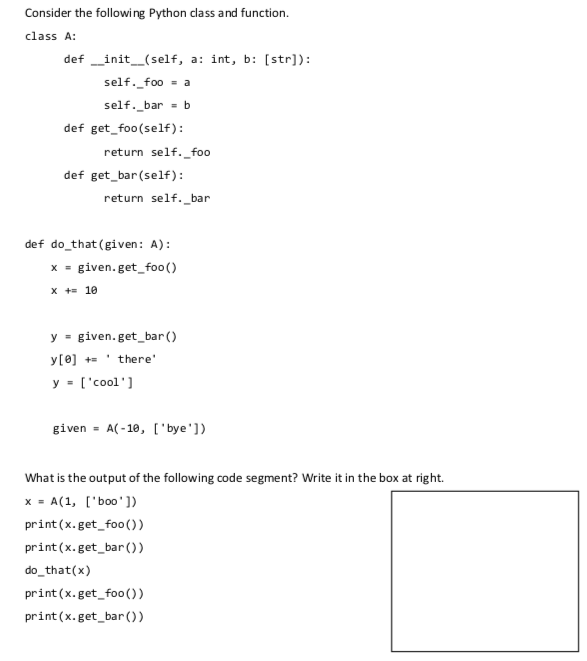
Question: 1. 2. Consider the following Python class and function. class A: def -init--(self, a: int, b: [str]): selffoo -a - def get_foo(self): return self._foo def
1.
2.
![-init--(self, a: int, b: [str]): selffoo -a - def get_foo(self): return self._foo](https://dsd5zvtm8ll6.cloudfront.net/si.experts.images/questions/2024/09/66f39e1a82122_75466f39e1a266df.jpg)
Consider the following Python class and function. class A: def -init--(self, a: int, b: [str]): selffoo -a - def get_foo(self): return self._foo def get_bar(self): return self._bar def do that (given: A): x - given.get_foo() y given. get-bar() y[e]there y ['cool given A(-10, ['bye']) What is the output of the following code segment? Write it in the box at right. print (x.get_foo()) print(x.get_bar)) do_that(x) print (x.get_foo)) print (x.get_bar))
Step by Step Solution
There are 3 Steps involved in it
1 Expert Approved Answer
Step: 1 Unlock

Question Has Been Solved by an Expert!
Get step-by-step solutions from verified subject matter experts
Step: 2 Unlock
Step: 3 Unlock
 Study Help