







Question: 1. 2. Let f(x) = e'f(t) dt +e* be a differentiable function for all x R. Then f(x) equals: (a) 2e (e-1) -1 (b)
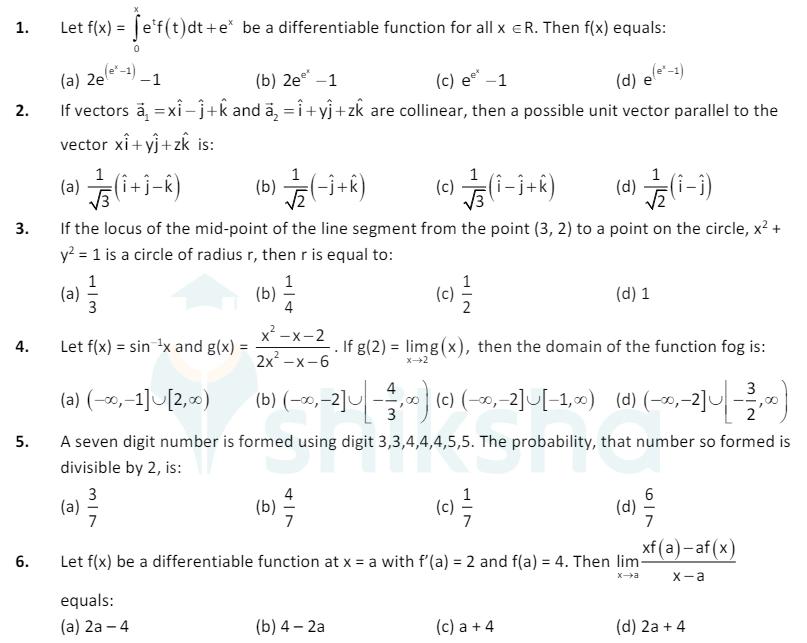
1. 2. Let f(x) = e'f(t) dt +e* be a differentiable function for all x R. Then f(x) equals: (a) 2e (e-1) -1 (b) 2e-1 (c) e-1 (d) e(-1) If vectors a =xi-j+k and a =1+yj+zk are collinear, then a possible unit vector parallel to the vector xi+yj+zk is: (a) (i+1-k) (b) (-i+k) (c)(i-j+k) (d) (ii) 3. If the locus of the mid-point of the line segment from the point (3, 2) to a point on the circle, x + y = 1 is a circle of radius r, then r is equal to: (a) 1/3 (b) 1/4 x-x-2 4. = Let f(x) sin x and g(x): = (a) (-0,-1][2,00) (b) (-0,- 5. 6. (c) (d) 1 2x-x-6 If g(2) limg(x), then the domain of the function fog is: = x-2 (c) (-,-2][-1,) (d) (-,- 3 t 3,3,4,4,4,5,5. A seven digit number is formed using digit 3,3,4,4,4,5,5. The probability, that number so formed is divisible by 2, is: 3 (a) 97 (b) 47 (c) Let f(x) be a differentiable function at x = a with f'(a) = 2 and f(a) = 4. Then lim- 6 (d) xf (a)-af(x) Ex x-a equals: (a) 2a-4 (b) 4-2a (c) a +4 (d) 2a +4
Step by Step Solution
There are 3 Steps involved in it

Get step-by-step solutions from verified subject matter experts
 Study Help