







Question: 1. (2 marks) Consider f(;r.,y, 3,1?) = (11,11) where u = 322 + 4:1:28t * y2 U = 2$y2352 +yt4 (a) Using Implicit Function Theorem,
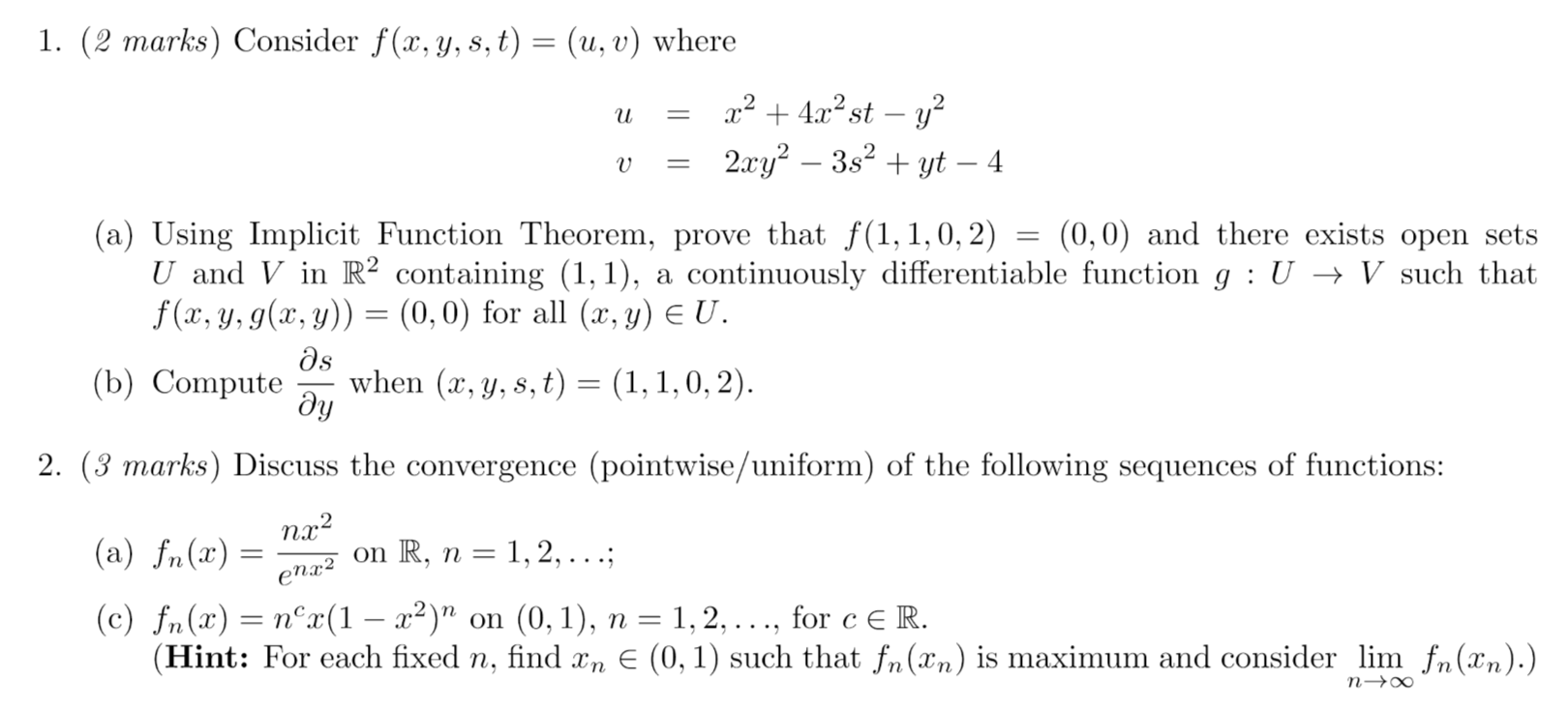
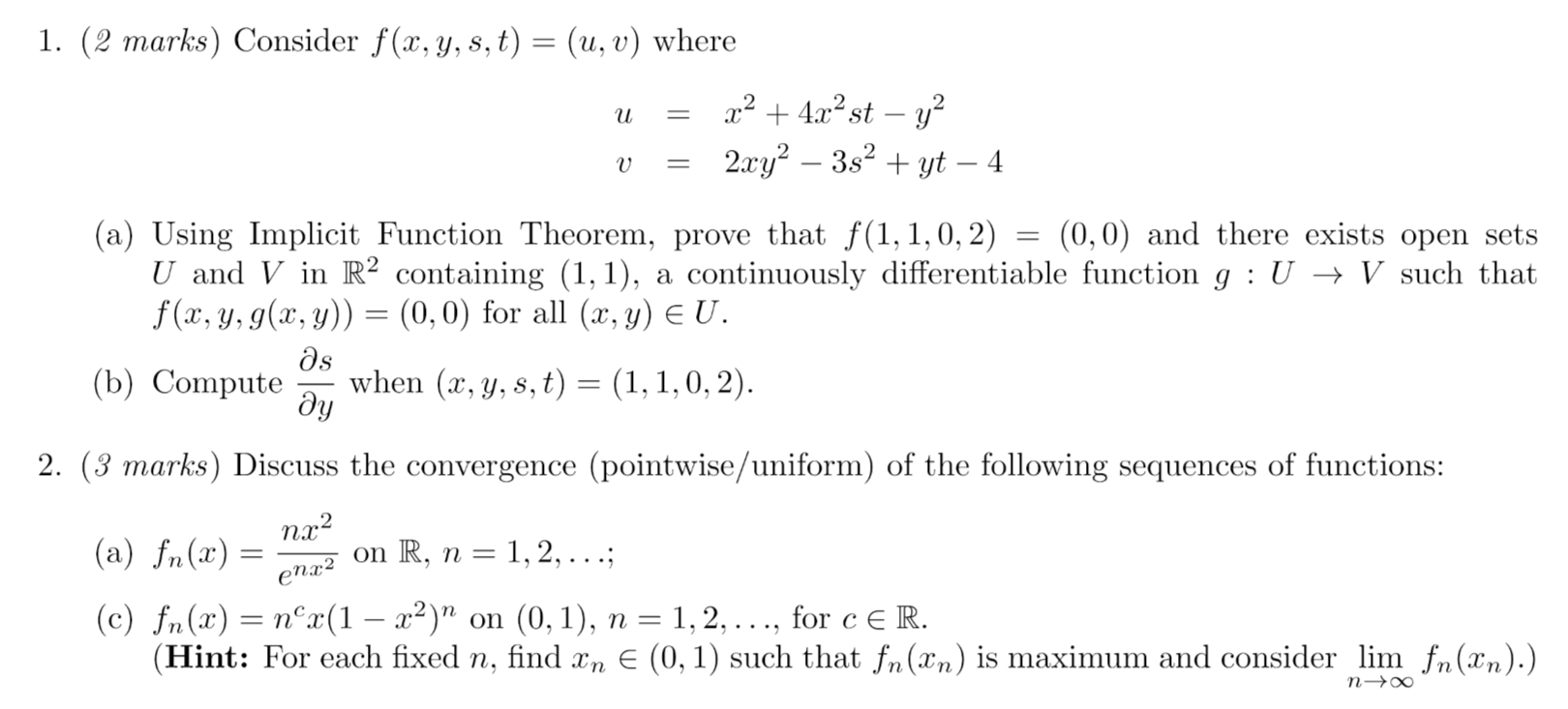
1. (2 marks) Consider f(;r.,y, 3,1?) = (11,11) where u = 322 + 4:1:28t * y2 "U = 2$y2352 +yt4 (a) Using Implicit Function Theorem, prove that f(1, 1,0,2) = (0,0) and there exists open sets U and V in R2 containing (1,1), a continuously differentiable function g 2 U > V such that mgm = (0,0) for all (any) 6 U. a. (1)) Compute 85 when (say, 3,15) = (1, 1,0, 2). CU 2. (3 marks) Discuss the convergence (pointwise/ uniform) of the following sequences of functions: T1372 (21) f,,(3:) 2 (mm, on R, n = 1,2, . , .; (c) f,,(m) = 'n.'m(1 mg)" on (0,1), n = 1,2, . . ., for (3 E R. (Hint: For each xed n, nd at", E (0, 1) such that f" (30") is maximum and consider lim f." (3:,,,).) "41'130
Step by Step Solution
There are 3 Steps involved in it

Get step-by-step solutions from verified subject matter experts
 Study Help