







Question: 1. (20 pts) For each statement determine whether it is true or false. If true, provide a proof (it is OK if this is somewhat
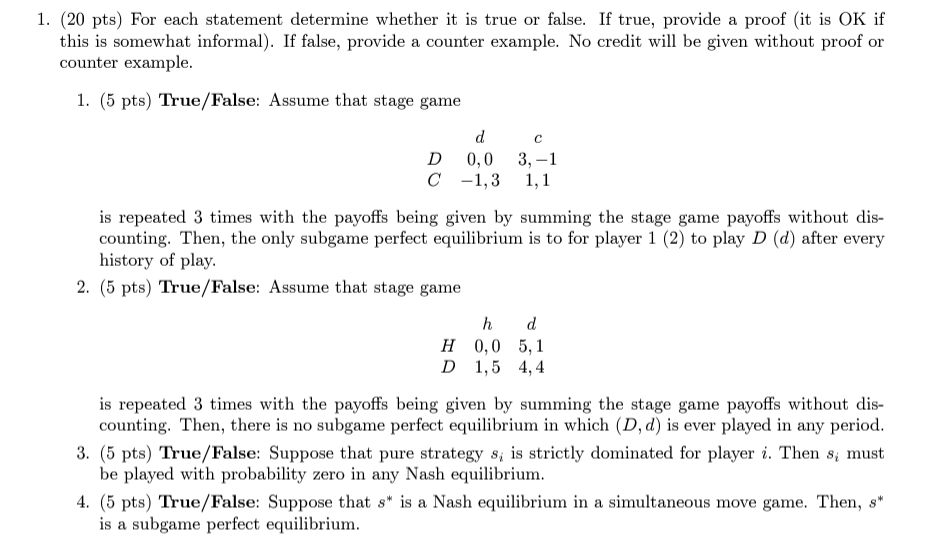
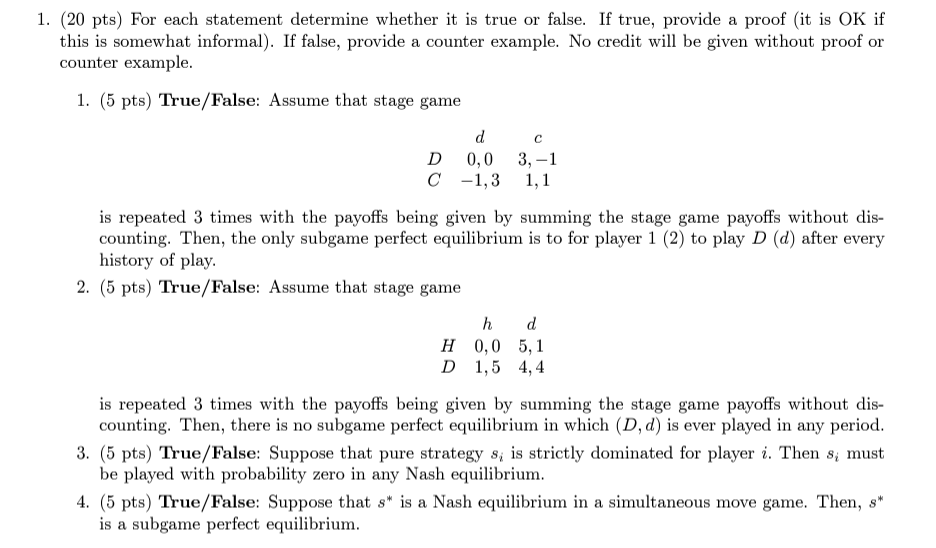
1. (20 pts) For each statement determine whether it is true or false. If true, provide a proof (it is OK if this is somewhat informal). If false, provide a counter example. No credit will be given without proof or counter example. 1. (5 pts) True/False: Assume that stage game d c D 0,0 3,-1 -1,3 1,1 is repeated 3 times with the payoffs being given by summing the stage game payoffs without dis- counting. Then, the only subgame perfect equilibrium is to for player 1 (2) to play D (d) after every history of play. 2. (5 pts) True/False: Assume that stage game h d H 0,0 5,1 D 1,5 4,4 is repeated 3 times with the payvoffs being given by summing the stage game payoffs without dis- counting. Then, there is no subgame perfect equilibrium in which (D, d) is ever played in any period. 3. (5 pts) True/False: Suppose that pure strategy s, is strictly dominated for player , Then s; must be played with probability zero in any Nash equilibrium. 4. (5 pts) True/False: Suppose that s* is a Nash equilibrium in a simultaneous move game. Then, s* is a subgame perfect equilibrium
Step by Step Solution
There are 3 Steps involved in it

Get step-by-step solutions from verified subject matter experts
 Study Help