







Question: 1. (23 points) Consider a two-period mining problem. Suppose the inverse demand for a mineral is given by p= 1100 - 10q, where p is
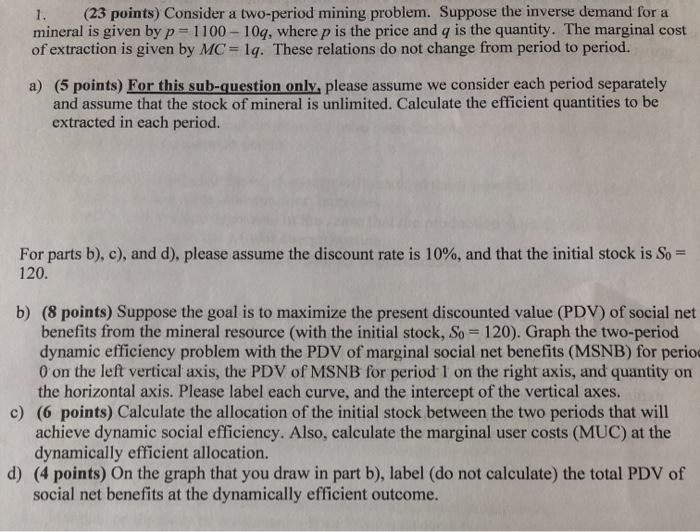
1. (23 points) Consider a two-period mining problem. Suppose the inverse demand for a mineral is given by p= 1100 - 10q, where p is the price and q is the quantity. The marginal cost of extraction is given by MC = lg. These relations do not change from period to period. a) (5 points) For this sub-question only, please assume we consider each period separately and assume that the stock of mineral is unlimited. Calculate the efficient quantities to be extracted in each period. For parts b), c), and d), please assume the discount rate is 10%, and that the initial stock is so = 120. b) (8 points) Suppose the goal is to maximize the present discounted value (PDV) of social net benefits from the mineral resource (with the initial stock, So = 120). Graph the two-period dynamic efficiency problem with the PDV of marginal social net benefits (MSNB) for perio O on the left vertical axis, the PDV of MSNB for period 1 on the right axis, and quantity on the horizontal axis. Please label each curve, and the intercept of the vertical axes. c) (6 points) Calculate the allocation of the initial stock between the two periods that will achieve dynamic social efficiency. Also, calculate the marginal user costs (MUC) at the dynamically efficient allocation. d) (4 points) On the graph that you draw in part b), label (do not calculate) the total PDV of social net benefits at the dynamically efficient outcome. 1. (23 points) Consider a two-period mining problem. Suppose the inverse demand for a mineral is given by p= 1100 - 10q, where p is the price and q is the quantity. The marginal cost of extraction is given by MC = lg. These relations do not change from period to period. a) (5 points) For this sub-question only, please assume we consider each period separately and assume that the stock of mineral is unlimited. Calculate the efficient quantities to be extracted in each period. For parts b), c), and d), please assume the discount rate is 10%, and that the initial stock is so = 120. b) (8 points) Suppose the goal is to maximize the present discounted value (PDV) of social net benefits from the mineral resource (with the initial stock, So = 120). Graph the two-period dynamic efficiency problem with the PDV of marginal social net benefits (MSNB) for perio O on the left vertical axis, the PDV of MSNB for period 1 on the right axis, and quantity on the horizontal axis. Please label each curve, and the intercept of the vertical axes. c) (6 points) Calculate the allocation of the initial stock between the two periods that will achieve dynamic social efficiency. Also, calculate the marginal user costs (MUC) at the dynamically efficient allocation. d) (4 points) On the graph that you draw in part b), label (do not calculate) the total PDV of social net benefits at the dynamically efficient outcome
Step by Step Solution
There are 3 Steps involved in it

Get step-by-step solutions from verified subject matter experts
 Study Help