



Question: 1. [25 marks] A social network is a social structure made up of a set of users and a set of social ties such as
![1. [25 marks] A social network is a social structure made](https://dsd5zvtm8ll6.cloudfront.net/si.experts.images/questions/2024/09/66ef516a14b8e_97766ef51698b2d0.jpg)
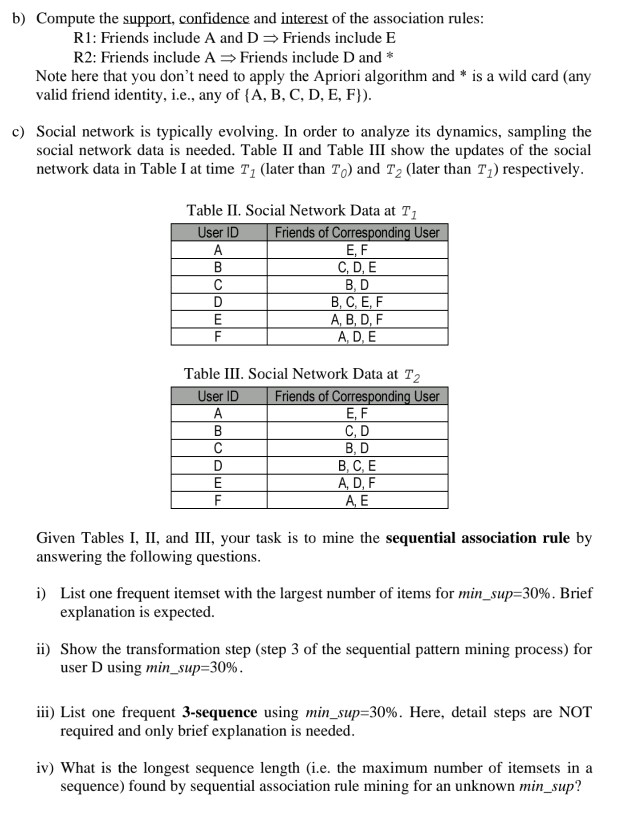
1. [25 marks] A social network is a social structure made up of a set of users and a set of social ties such as friendship between them. In the past decade, we have witnessed the rapid growth of social network services, like Facebook, Twitter and Weibo, which generate huge amount of data for various mining efforts. In view of the continuously evolving social network data, you are asked to carry out the following mining task. In Table I, you are given the social network data collected from an extremely small network at time To for association rule mining. For example, the friends of A are B, E, and F but B, E, and F are not necessarily mutual friends (cf. B's friend list does not include F). | Table I. Social Network Data at time to User ID Friends of Corresponding User B, E, F A, C, E | BD C, E, F A, B, D, F A, D, E a) Based on Table I, what is the largest itemset size (i.e. the maximum number of items in an itemset) found by the frequent itemset phase of an association rule mining algorithm? b) Compute the support, confidence and interest of the association rules: R1: Friends include A and D Friends include E R2: Friends include A Friends include D and * Note here that you don't need to apply the Apriori algorithm and * is a wild card (any valid friend identity, i.e., any of {A, B, C, D, E, F). c) Social network is typically evolving. In order to analyze its dynamics, sampling the social network data is needed. Table II and Table III show the updates of the social network data in Table I at time Tz (later than To) and T2 (later than T1) respectively. Table II. Social Network Data at Tz User ID Friends of Corresponding User E, F C, D, E CBD B, C, E, F A, B, D, F A,D,E Table III. Social Network Data at T2 User ID Friends of Corresponding User ALE, F C D BD B, C, E wu A, DF , Given Tables I, II, and III, your task is to mine the sequential association rule by answering the following questions. i) List one frequent itemset with the largest number of items for min_sup=30%. Brief explanation is expected. ii) Show the transformation step (step 3 of the sequential pattern mining process) for user D using min_sup=30%. iii) List one frequent 3-sequence using min_sup=30%. Here, detail steps are NOT required and only brief explanation is needed. iv) What is the longest sequence length (i.e. the maximum number of itemsets in a sequence) found by sequential association rule mining for an unknown min_sup? 1. [25 marks] A social network is a social structure made up of a set of users and a set of social ties such as friendship between them. In the past decade, we have witnessed the rapid growth of social network services, like Facebook, Twitter and Weibo, which generate huge amount of data for various mining efforts. In view of the continuously evolving social network data, you are asked to carry out the following mining task. In Table I, you are given the social network data collected from an extremely small network at time To for association rule mining. For example, the friends of A are B, E, and F but B, E, and F are not necessarily mutual friends (cf. B's friend list does not include F). | Table I. Social Network Data at time to User ID Friends of Corresponding User B, E, F A, C, E | BD C, E, F A, B, D, F A, D, E a) Based on Table I, what is the largest itemset size (i.e. the maximum number of items in an itemset) found by the frequent itemset phase of an association rule mining algorithm? b) Compute the support, confidence and interest of the association rules: R1: Friends include A and D Friends include E R2: Friends include A Friends include D and * Note here that you don't need to apply the Apriori algorithm and * is a wild card (any valid friend identity, i.e., any of {A, B, C, D, E, F). c) Social network is typically evolving. In order to analyze its dynamics, sampling the social network data is needed. Table II and Table III show the updates of the social network data in Table I at time Tz (later than To) and T2 (later than T1) respectively. Table II. Social Network Data at Tz User ID Friends of Corresponding User E, F C, D, E CBD B, C, E, F A, B, D, F A,D,E Table III. Social Network Data at T2 User ID Friends of Corresponding User ALE, F C D BD B, C, E wu A, DF , Given Tables I, II, and III, your task is to mine the sequential association rule by answering the following questions. i) List one frequent itemset with the largest number of items for min_sup=30%. Brief explanation is expected. ii) Show the transformation step (step 3 of the sequential pattern mining process) for user D using min_sup=30%. iii) List one frequent 3-sequence using min_sup=30%. Here, detail steps are NOT required and only brief explanation is needed. iv) What is the longest sequence length (i.e. the maximum number of itemsets in a sequence) found by sequential association rule mining for an unknown min_sup
Step by Step Solution
There are 3 Steps involved in it

Get step-by-step solutions from verified subject matter experts