







Question: 1. (25 points) In this problem, we show that optimal solutions are strongly structured by the form of the objective function, independent of the
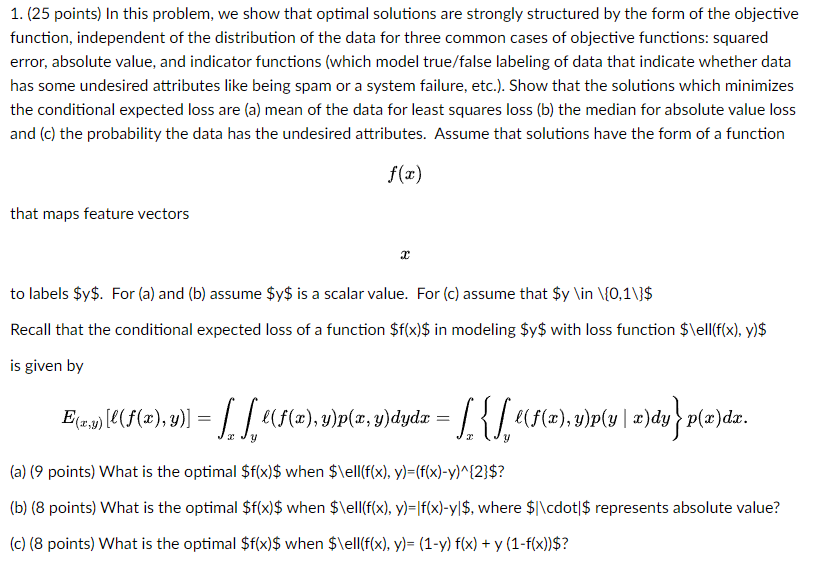
1. (25 points) In this problem, we show that optimal solutions are strongly structured by the form of the objective function, independent of the distribution of the data for three common cases of objective functions: squared error, absolute value, and indicator functions (which model true/false labeling of data that indicate whether data has some undesired attributes like being spam or a system failure, etc.). Show that the solutions which minimizes the conditional expected loss are (a) mean of the data for least squares loss (b) the median for absolute value loss and (c) the probability the data has the undesired attributes. Assume that solutions have the form of a function f(x) that maps feature vectors x to labels $y$. For (a) and (b) assume $y$ is a scalar value. For (c) assume that $y \in \{0,1\}$ Recall that the conditional expected loss of a function $f(x)$ in modeling $y$ with loss function $\ell(f(x), y)$ is given by = E{(x,y) [l(f(x), y)] = [ [ l(f(x), y)p(x, y)dydz : = [ { [_l(f(x), y)p(y | x)dy} p(x)dx. (a) (9 points) What is the optimal $f(x)$ when $\ell(f(x), y)=(f(x)-y)^{2}$? (b) (8 points) What is the optimal $f(x)$ when $\ell(f(x), y)=f(x)-y|$, where $\cdot|$ represents absolute value? (c) (8 points) What is the optimal $f(x)$ when $\ell(f(x), y)= (1-y) f(x) + y (1-f(x))$?
Step by Step Solution
3.45 Rating (161 Votes )
There are 3 Steps involved in it
The question provided is related to finding the optimal solutions for different loss functions in a ... View full answer

Get step-by-step solutions from verified subject matter experts
 Study Help