







Question: 1 3 : 5 3 C Files 0 2 4 Initially at rest: d y d t ( x , 0 ) = 0 Use
: C
Files
Initially at rest:
Use the fourthorder RungeKutta RK method with time step column length and to solve for the lateral displacement at the free end of the column for to seconds. Show all your steps.
Note that the system can be converted to a system of firstorder ODEs. Write and solve this system of equations. Report the maximum displacement to four decimal places.
Write a code that can be used to solve Question this code should consider the conversion of the system to firstorder ODE. You do not need to print the results of the code, but it should be functional. Explain what each command seeks to achieve.
OR
Explain in full how you would solve this on Excel. Your explanations should be detailed and clear.
marks
Question
For this question, you can choose to solve everything manually by hand or a computer program, except for Question If you solve by codingExcel you are required to send your code as well for plagiarism checks, this includes the use of GPT tools. Submit your work on myExams and your code to
sibani@unisa.acza
Population trends across South Africa's metropolitan areas have become critical data points for the country's engineers and urban planners. Consider the contrasting dynamics between Johannesburg's CBD and the rapidly expanding Sandton district. While the traditional city centre has seen fluctuating residential numbers since the postapartheid era, the northern suburbs continue to experience remarkable growth. This poses a challenge for civil engineers as they must design infrastructure that balances population estimates with transport systems
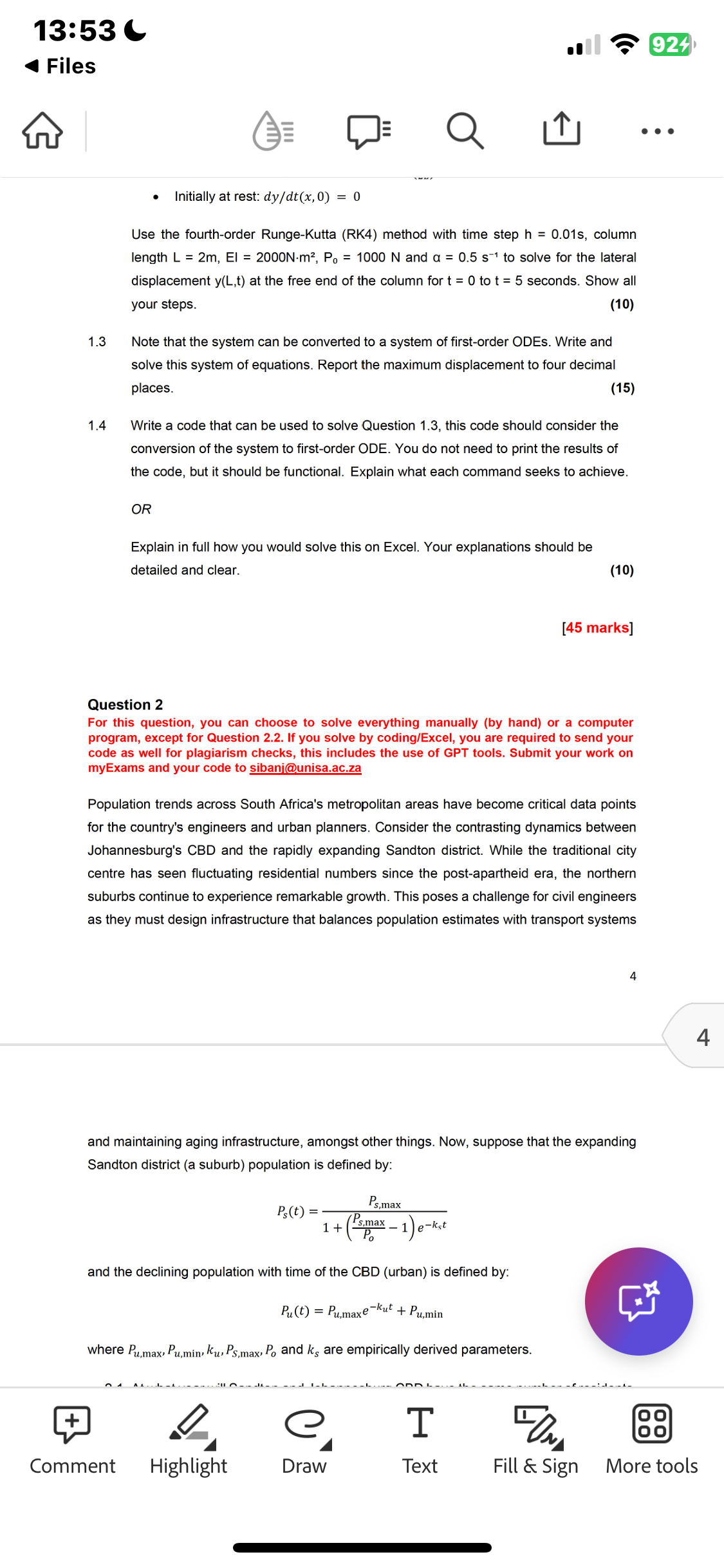
and maintaining aging infrastructure, amongst other things. Now, suppose that the expanding Sandton district a suburb population is defined by:
and the declining population with time of the CBD urban is defined by:
where and are empirically derived parameters.
Comment
Highlight
Draw
Text
Fill & Sign
More tools
Step by Step Solution
There are 3 Steps involved in it
1 Expert Approved Answer
Step: 1 Unlock

Question Has Been Solved by an Expert!
Get step-by-step solutions from verified subject matter experts
Step: 2 Unlock
Step: 3 Unlock
 Study Help