







Question: 1 3 . 7 - 5 . Reconsider the first quadratic programming variation of the Wyndor Glass Co . problem presented in Sec. 1 3
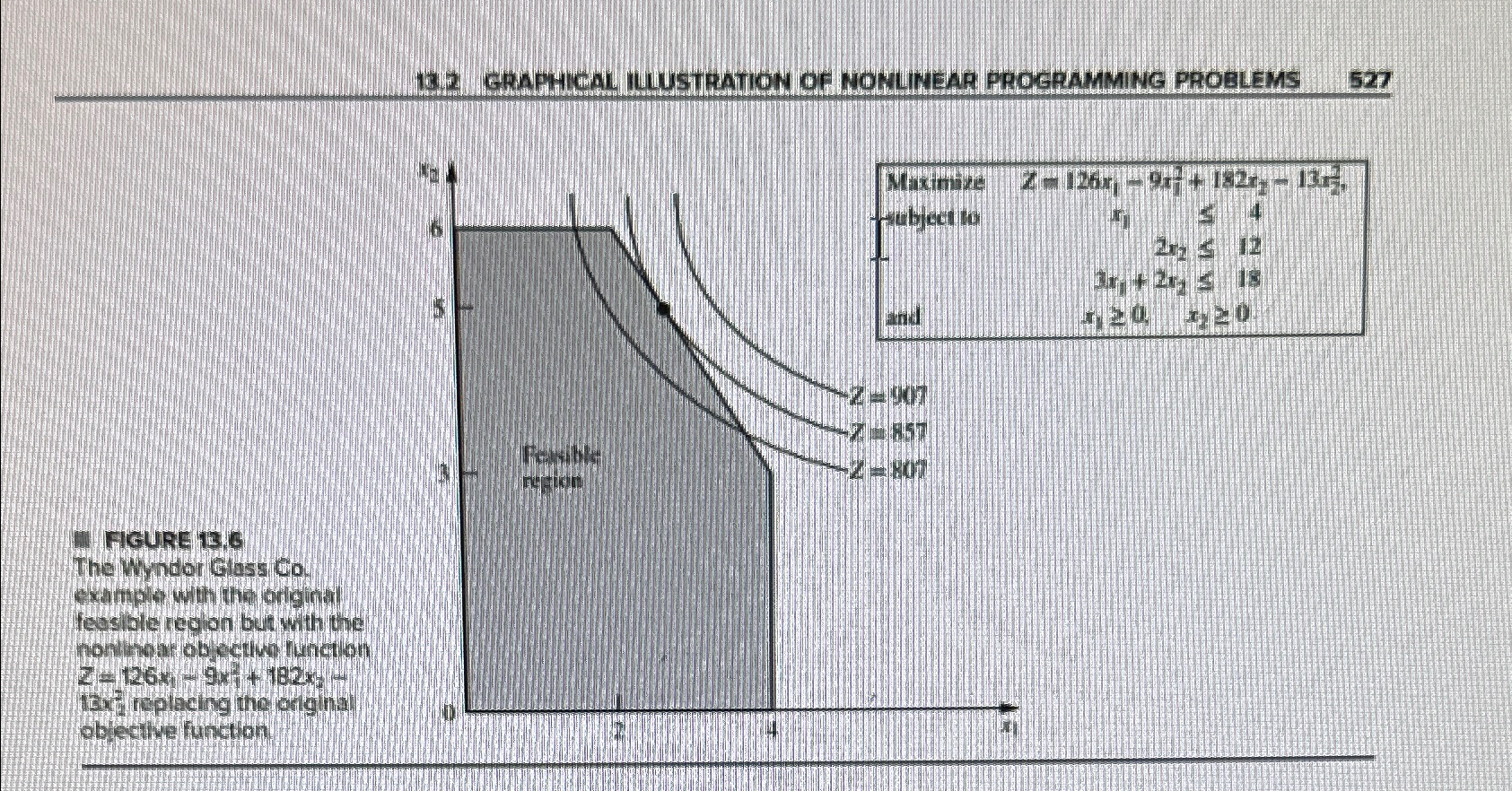
Reconsider the first quadratic programming variation of the Wyndor Glass Co problem presented in Sec. see Fig. Analyze this problem by following the instructions of parts and c of Prob.
Consider the following quadratic programming problem:
Maximize
subject to
and
a Use the KKT conditions to derive an optimal solution directly.
b Now suppose that this problem is to be solved by the modified simplex method. Formulate the linear programming problem that is to be addressed explicitly, and then identify the additional complementarity constraint that is enforced automatically by the algorithm.
c Without applying the modified simplex method, show that the solution derived in part is indeed optimal for the equivalent problem formulated in part b
I d Apply the modified simplex method to the problem as formulated in part b
C e Use the computer to solve the quadratic programming problem directly.
GRAPHICAL LUUSTRATION OF NONLINEAR PROGRAMMING PROBLEMS
FIGURE The Whder Glass exampls with the original feasible region but wh the nontwear ob ectue unction z replacing the origha oblective function
Step by Step Solution
There are 3 Steps involved in it
1 Expert Approved Answer
Step: 1 Unlock

Question Has Been Solved by an Expert!
Get step-by-step solutions from verified subject matter experts
Step: 2 Unlock
Step: 3 Unlock
 Study Help