







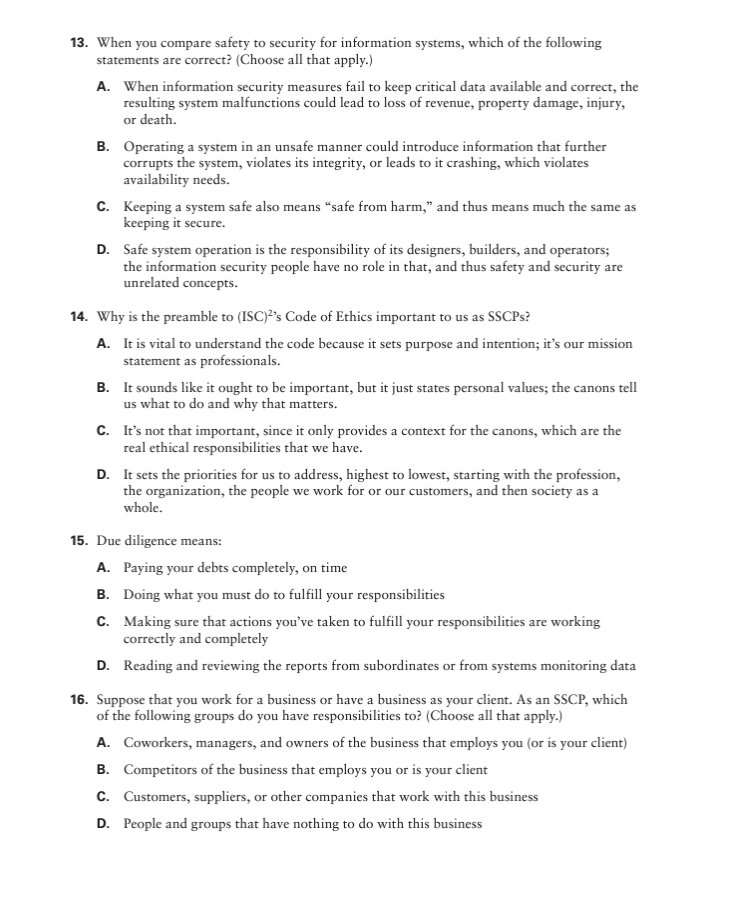
Question: 1 3 . When you compare safety to security for information systems, which of the following statements are correct? ( Choose all that apply. )
When you compare safety to security for information systems, which of the following statements are correct? Choose all that apply.
A When information security measures fail to keep critical data available and correct, the resulting system malfunctions could lead to loss of revenue, property damage, injury, or death.
B Operating a system in an unsafe manner could introduce information that further corrupts the system, violates its integrity, or leads to it crashing, which violates availability needs.
C Keeping a system safe also means "safe from harm," and thus means much the same as keeping it secure
D Safe system operation is the responsibility of its designers, builders, and operators; the information security people have no role in that, and thus safety and security are unrelated concepts.
Why is the preamble to ISCs Code of Ethics important to us as SSCPs
A It is vital to understand the code because it sets purpose and intention; it's our mission statement as professionals.
B It sounds like it ought to be important, but it just states personal values; the canons tell us what to do and why that matters.
C It's not that important, since it only provides a context for the canons, which are the real ethical responsibilities that we have.
D It sets the priorities for us to address, highest to lowest, starting with the profession, the organization, the people we work for or our customers, and then society as a whole.
Due diligence means:
A Paying your debts completely, on time
B Doing what you must do to fulfill your responsibilities
C Making sure that actions you've taken to fulfill your responsibilities are working correctly and completely
D Reading and reviewing the reports from subordinates or from systems monitoring data
Suppose that you work for a business or have a business as your client. As an SSCP which of the following groups do you have responsibilities toChoose all that apply.
A Coworkers, managers, and owners of the business that employs you or is your client
B Competitors of the business that employs you or is your client
C Customers, suppliers, or other companies that work with this business
D People and groups that have nothing to do with this business
Step by Step Solution
There are 3 Steps involved in it
1 Expert Approved Answer
Step: 1 Unlock

Question Has Been Solved by an Expert!
Get step-by-step solutions from verified subject matter experts
Step: 2 Unlock
Step: 3 Unlock
 Study Help