







Question: 1. [30 points total] The data in the two tables immediately below represent two different classifiers' predictions (given as probabilities) about the presence or absence
![1. [30 points total] The data in the two tables immediately](https://s3.amazonaws.com/si.experts.images/answers/2024/09/66daca3dbcec6_65366daca3d4b4fd.jpg)
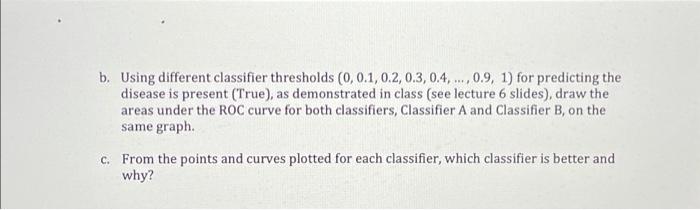
1. [30 points total] The data in the two tables immediately below represent two different classifiers' predictions (given as probabilities) about the presence or absence of a disease. a. First provide two tables: one that lists the sensitivity and specificity for classifier A at each threshold and one that lists the sensitivity and specificity of classifier B at each threshold (see example table below for a partial view of what that should look like). Classifier A prediction Classifier B prediction Actual disease outcome True Actual disease outcome True 0.9 0.7 0.8 True 0.6 True 0.2 False 0.4 False 0.6 True 0.4 True 0.7 True 0.5 True 0.1 False 0.1 False 0.3 False 0.3 False 0.8 True 0.6 True 0.9 True 0.3 True 0.4 False 0.1 False Specificity Example Table: Classifier X Sensitivity Threshold 0 1 0.1 1 0.2 0.9 0 0 0.1 0.9 1 0.1 0 1 1 b. Using different classifier thresholds (0,0.1,0.2, 0.3, 0.4,...,0.9, 1) for predicting the disease is present (True), as demonstrated in class (see lecture 6 slides)draw the areas under the ROC curve for both classifiers, Classifier A and Classifier B, on the same graph. c. From the points and curves plotted for each classifier, which classifier is better and why? 1. [30 points total] The data in the two tables immediately below represent two different classifiers' predictions (given as probabilities) about the presence or absence of a disease. a. First provide two tables: one that lists the sensitivity and specificity for classifier A at each threshold and one that lists the sensitivity and specificity of classifier B at each threshold (see example table below for a partial view of what that should look like). Classifier A prediction Classifier B prediction Actual disease outcome True Actual disease outcome True 0.9 0.7 0.8 True 0.6 True 0.2 False 0.4 False 0.6 True 0.4 True 0.7 True 0.5 True 0.1 False 0.1 False 0.3 False 0.3 False 0.8 True 0.6 True 0.9 True 0.3 True 0.4 False 0.1 False Specificity Example Table: Classifier X Sensitivity Threshold 0 1 0.1 1 0.2 0.9 0 0 0.1 0.9 1 0.1 0 1 1 b. Using different classifier thresholds (0,0.1,0.2, 0.3, 0.4,...,0.9, 1) for predicting the disease is present (True), as demonstrated in class (see lecture 6 slides)draw the areas under the ROC curve for both classifiers, Classifier A and Classifier B, on the same graph. c. From the points and curves plotted for each classifier, which classifier is better and why
Step by Step Solution
There are 3 Steps involved in it

Get step-by-step solutions from verified subject matter experts
 Study Help