







Question: 1. (31 points) Regarding classic ciphers: (a) (5 points) Show that the shift cipher is trvial to break using any of the three attacks: known-plaintext
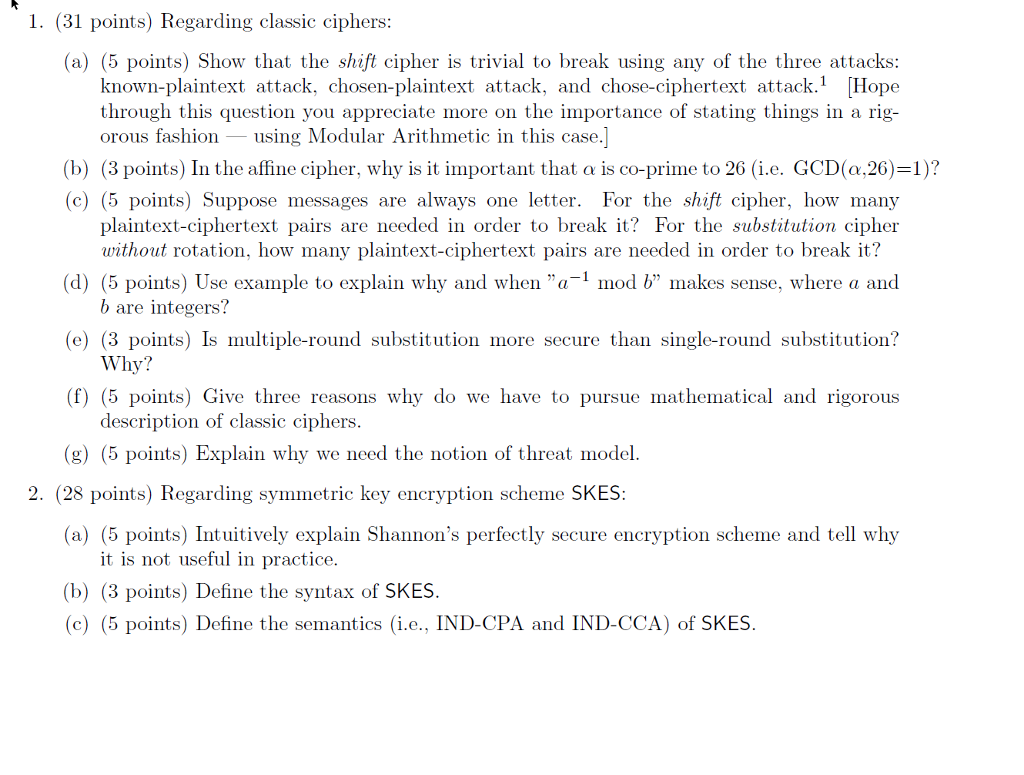
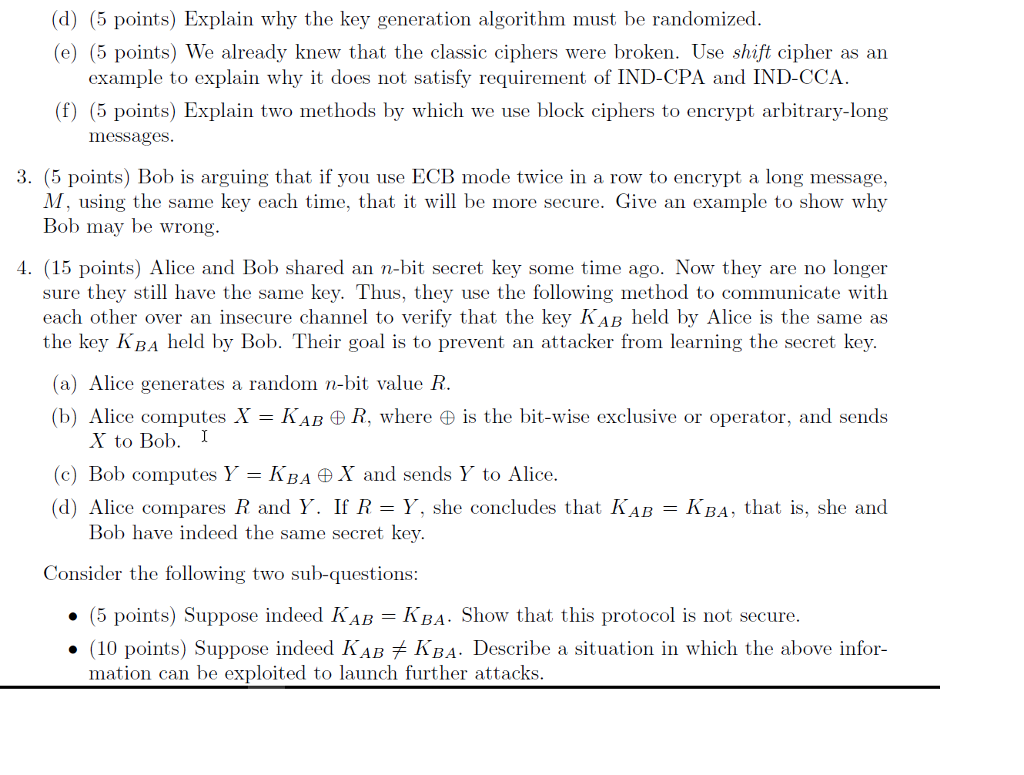
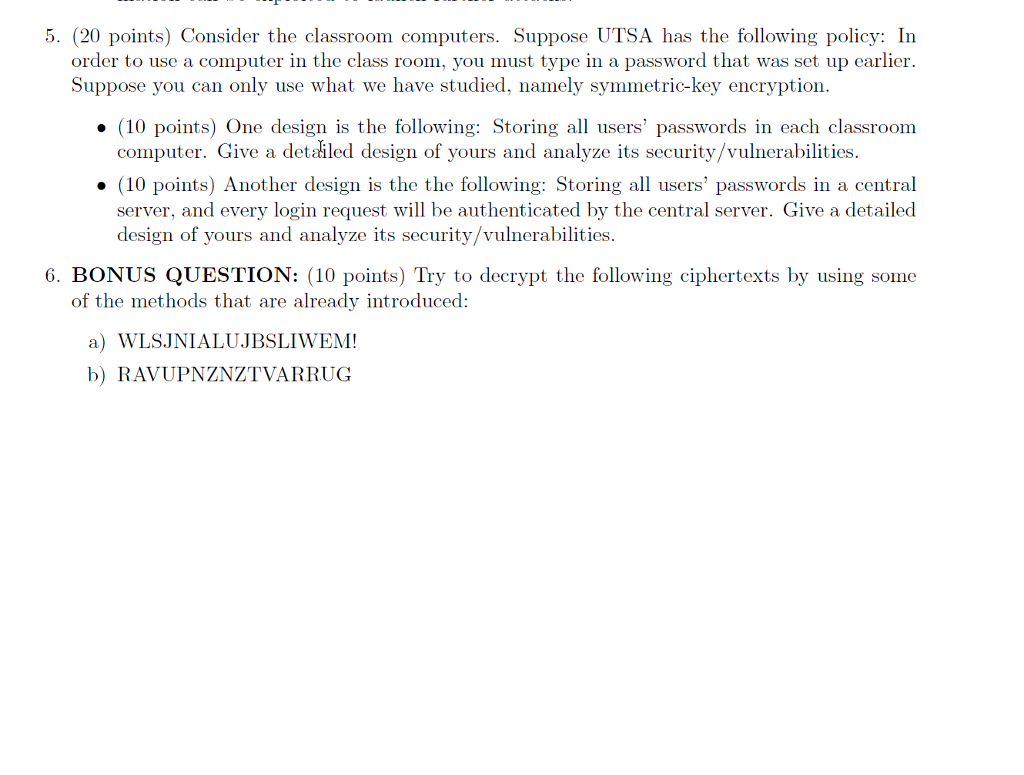
1. (31 points) Regarding classic ciphers: (a) (5 points) Show that the shift cipher is trvial to break using any of the three attacks: known-plaintext attack, chosen-plaintext attack, and chose-ciphertext attack.1 Hope through this question you appreciate more on the importance of stating things in a rig- orous fashion using Modular Arithmetic in this case.] (3 points) In the affine cipher. why is it important that a is co-prime to 26 (ie. GCD(a,26)=1)? (5 points) Suppose messages are always one letter. For the shift cipher, how many (b) (c) (d) (5 points) Use example to explain why and when "a-1 mod b" makes sense, where a and (e) (3 points)Is muliple-round substitution more secure than single-round substitution? (f) (5 points) Give three reasons why do we have to pursue mathematical and rigorous (g) (5 points) Explain why we need the notion of threat model. without rotation, how many plaintext-ciphertext pairs are needed in order to break it? b are integers? Why? description of classic ciphers. 2. (28 points) Regarding symmetric key encryption scheme SKES: (a) (5 points) Intuitively explain Shannon's perfectly secure encryption scheme and tell why it is not useful in practice. b) (3 points) Define the syntax of SKES. (e) (5 points) Define the semantics (i.e., IND-CPA and IND-CCA) of SKES
Step by Step Solution
There are 3 Steps involved in it

Get step-by-step solutions from verified subject matter experts
 Study Help