







Question: 1 . ( 4 marks ) Scientists are observing herds of squirbos as they move into new territory on the Nretsew island. Based on past
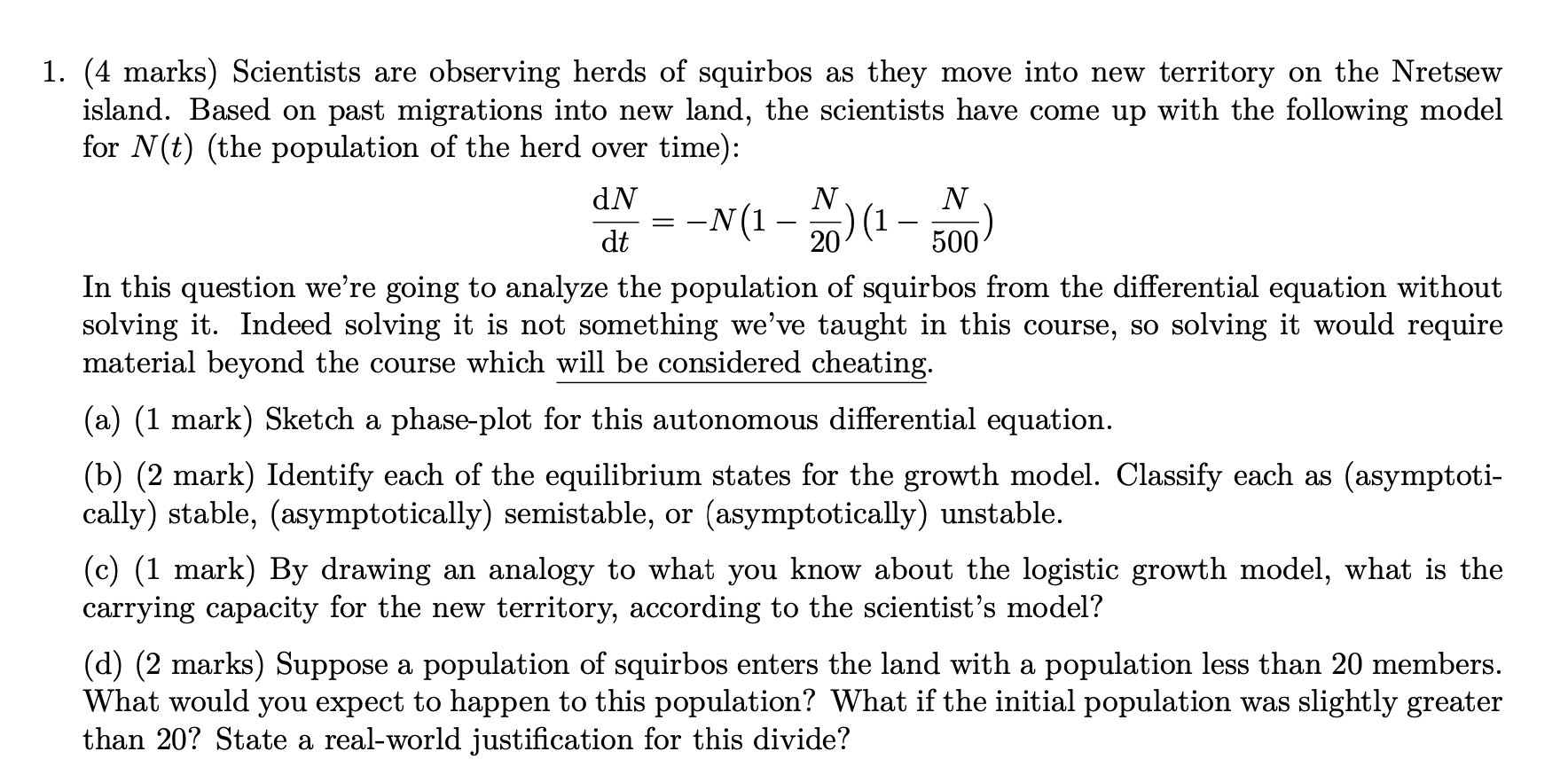
marks Scientists are observing herds of squirbos as they move into new territory on the Nretsew island. Based on past migrations into new land, the scientists have come up with the following model for Ntthe population of the herd over time: fracmathrmd Nmathrm~d tNleftfracNrightleftfracNright In this question we're going to analyze the population of squirbos from the differential equation without solving it Indeed solving it is not something we've taught in this course, so solving it would require material beyond the course which will be considered cheating. a mark Sketch a phaseplot for this autonomous differential equation. b mark Identify each of the equilibrium states for the growth model. Classify each as asymptotically stable, asymptotically semistable, or asymptotically unstable. c mark By drawing an analogy to what you know about the logistic growth model, what is the carrying capacity for the new territory, according to the scientist's model? d marks Suppose a population of squirbos enters the land with a population less than members. What would you expect to happen to this population? What if the initial population was slightly greater than State a realworld justification for this divide?
Step by Step Solution
There are 3 Steps involved in it
1 Expert Approved Answer
Step: 1 Unlock

Question Has Been Solved by an Expert!
Get step-by-step solutions from verified subject matter experts
Step: 2 Unlock
Step: 3 Unlock
 Study Help