







Question: 1. [-/4 Points] DETAILS MY NOTES ASK YOUR TEACHER PRACTICE ANOTHER An air-filled capacitor consists of two parallel plates, each with an area of
![1. [-/4 Points] DETAILS MY NOTES ASK YOUR TEACHER PRACTICE ANOTHER An](https://s3.amazonaws.com/si.experts.images/answers/2024/05/664388aba3146_931664388ab77db9.jpg)
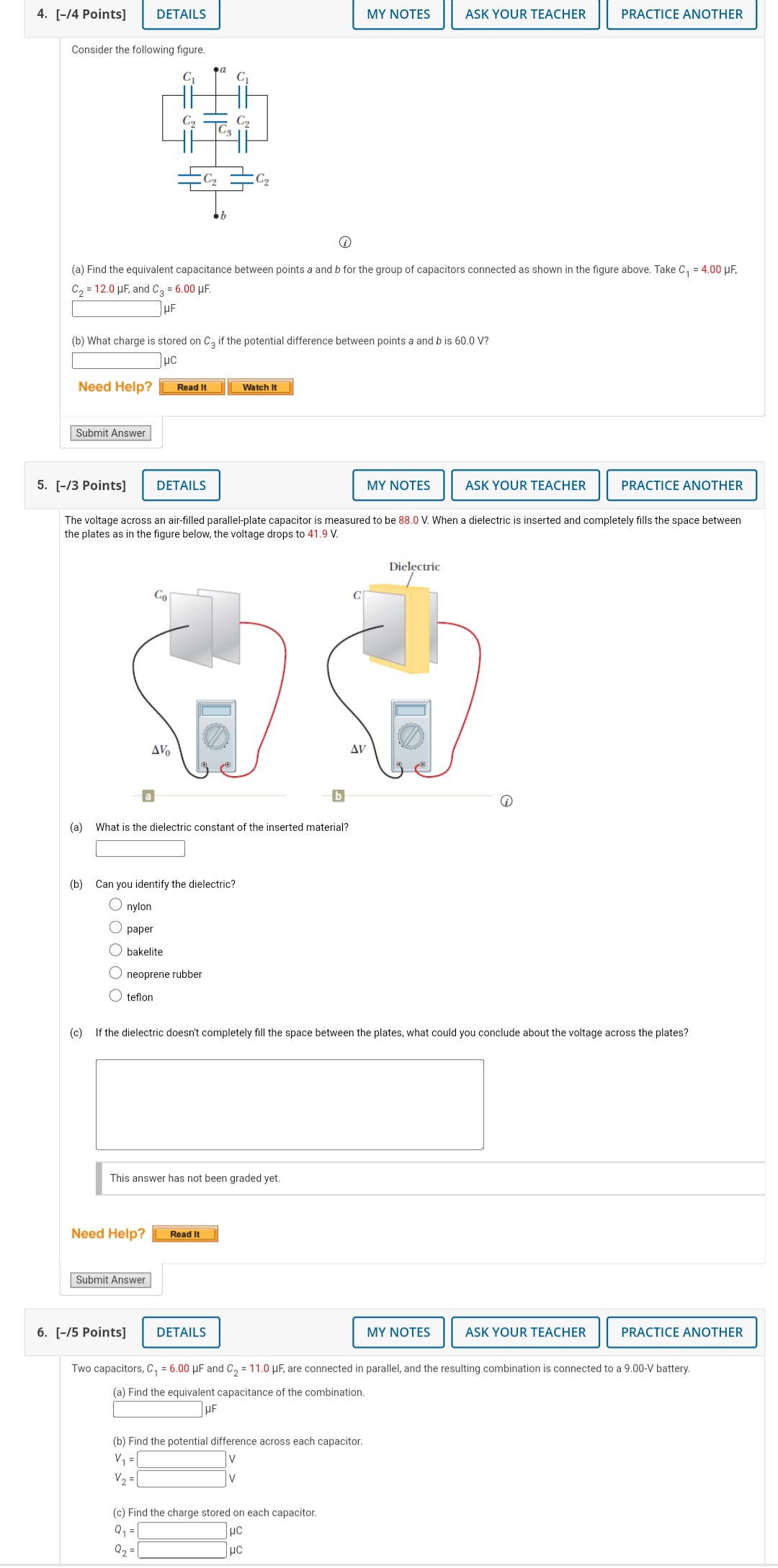
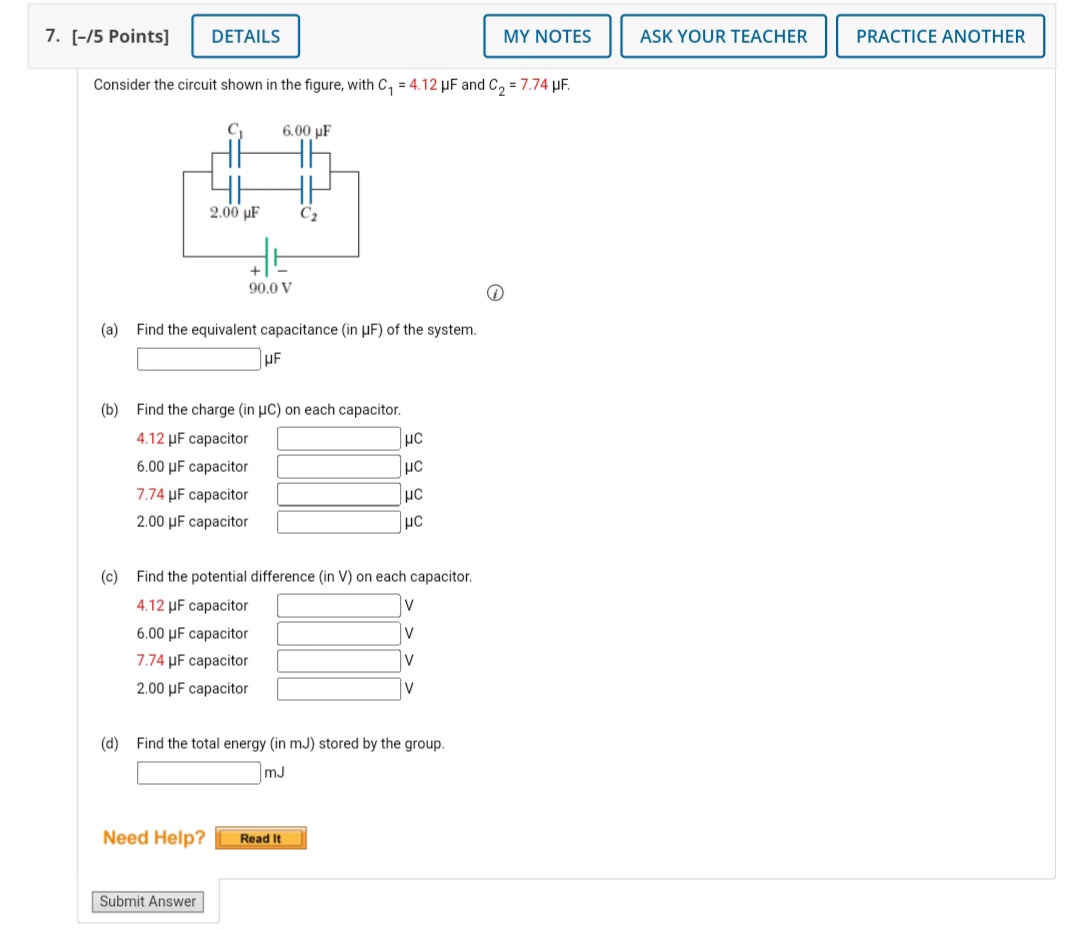
1. [-/4 Points] DETAILS MY NOTES ASK YOUR TEACHER PRACTICE ANOTHER An air-filled capacitor consists of two parallel plates, each with an area of 7.60 cm2, separated by a distance of 2.00 mm. A 17.0-V potential difference is applied to these plates. (a) Calculate the electric field between the plates. kV/m (b) Calculate the surface charge density. nC/m (c) Calculate the capacitance. pF (d) Calculate the charge on each plate. pC Need Help? Read It Master It Submit Answer 2. [-/4 Points] DETAILS MY NOTES ASK YOUR TEACHER PRACTICE ANOTHER Two capacitors (C = 8.00 F and C = 11.0 F) are now connected in series and to a 9.00-V battery. (a) Find the equivalent capacitance of the combination. F (b) Find the potential difference across each capacitor. V = V = V V (c) Find the charge on each capacitor. Q = Q2= Need Help? Read It Watch It Submit Answer 3. [-/5 Points] DETAILS MY NOTES ASK YOUR TEACHER PRACTICE ANOTHER Two capacitors, C = 16.0 F and C = 41.0 F, are connected in series, and a 24.0-V battery is connected across the two capacitors. (a) Find the equivalent capacitance. UF (b) Find the energy stored in this equivalent capacitance. (c) Find the energy stored in each individual capacitor. capacitor 1 capacitor 2 |J (d) Show that the sum of these two energies is the same as the energy found in part (b). This answer has not been graded yet. (e) Will this equality always be true, or does it depend on the number of capacitors and their capacitances? This equality will always be true. This equality depends on the number of capacitors. (f) If the same capacitors were connected in parallel, what potential difference would be required across them so that the combination stores the same energy as in part (a)? (g) Which capacitor stores more energy in this situation, C or C2? C The capacitors store the same amount of energy. Need Help? Read It Submit Answer ||| 4. [-/4 Points] DETAILS Consider the following figure. a C C C C b MY NOTES ASK YOUR TEACHER PRACTICE ANOTHER (a) Find the equivalent capacitance between points a and b for the group of capacitors connected as shown in the figure above. Take C = 4.00 F, C2 12.0 F, and C3 = 6.00 F. F (b) What charge is stored on C3 if the potential difference between points a and b is 60.0 V? Need Help? Read It Watch It Submit Answer 5. [-/3 Points] DETAILS MY NOTES ASK YOUR TEACHER PRACTICE ANOTHER The voltage across an air-filled parallel-plate capacitor is measured to be 88.0 V. When a dielectric is inserted and completely fills the space between the plates as in the figure below, the voltage drops to 41.9 V. Co AV (a) What is the dielectric constant of the inserted material? AV Dielectric (b) Can you identify the dielectric? nylon paper bakelite neoprene rubber Oteflon (c) If the dielectric doesn't completely fill the space between the plates, what could you conclude about the voltage across the plates? This answer has not been graded yet. Need Help? Read It Submit Answer 6. [-/5 Points] DETAILS MY NOTES ASK YOUR TEACHER PRACTICE ANOTHER Two capacitors, C = 6.00 F and C = 11.0 F, are connected in parallel, and the resulting combination is connected to a 9.00-V battery. (a) Find the equivalent capacitance of the combination. F (b) Find the potential difference across each capacitor. V2= V (c) Find the charge stored on each capacitor. Q = Q2 7. [-/5 Points] DETAILS MY NOTES ASK YOUR TEACHER PRACTICE ANOTHER Consider the circuit shown in the figure, with C = 4.12 F and C = 7.74 F. 6.00 F 2.00 F C 90.0 V (a) Find the equivalent capacitance (in F) of the system. HF (b) Find the charge (in C) on each capacitor. 4.12 uF capacitor 6.00 uF capacitor 7.74 uF capacitor 2.00 uF capacitor (c) Find the potential difference (in V) on each capacitor. 4.12 uF capacitor 6.00 uF capacitor 7.74 uF capacitor 2.00 uF capacitor V V (d) Find the total energy (in mJ) stored by the group. mJ Need Help? Read It Submit Answer
Step by Step Solution
There are 3 Steps involved in it

Get step-by-step solutions from verified subject matter experts
 Study Help