







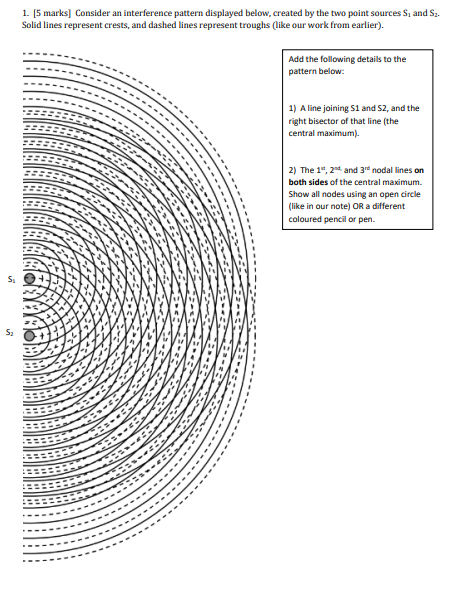
Question: 1. [5 marks] Consider an interference pattern displayed below, created by the two point sources S, and Sz. Solid lines represent crests, and dashed lines
![1. [5 marks] Consider an interference pattern displayed below, created by](https://s3.amazonaws.com/si.experts.images/answers/2024/06/6677a0c986d67_9776677a0c961851.jpg)
![OR a different coloured pencil or peri.2. [2 marks] Calculate the wavelength](https://s3.amazonaws.com/si.experts.images/answers/2024/06/6677a0cc0a7c4_9796677a0cbe9047.jpg)
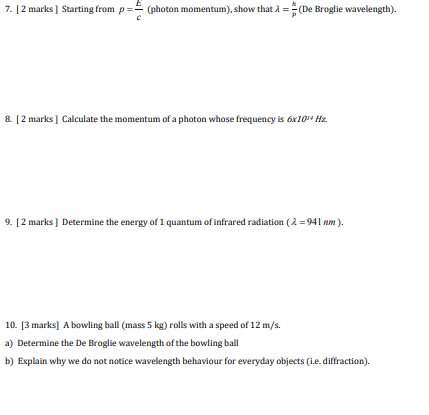
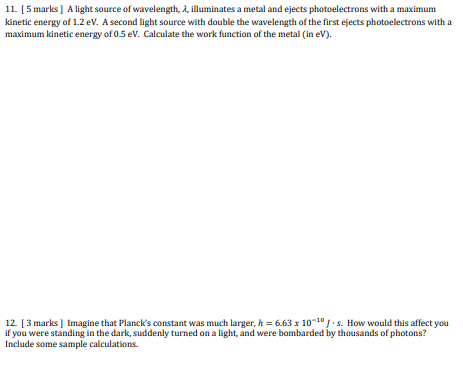
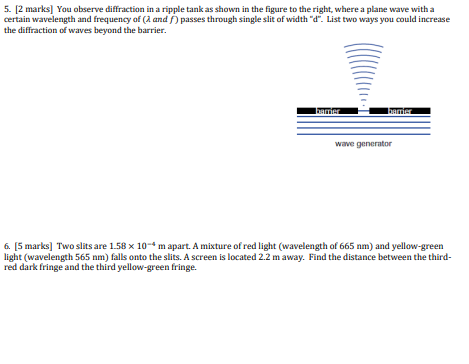
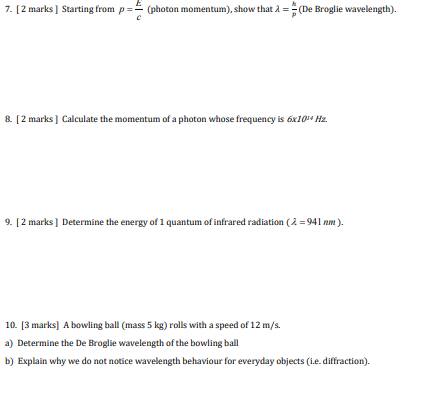
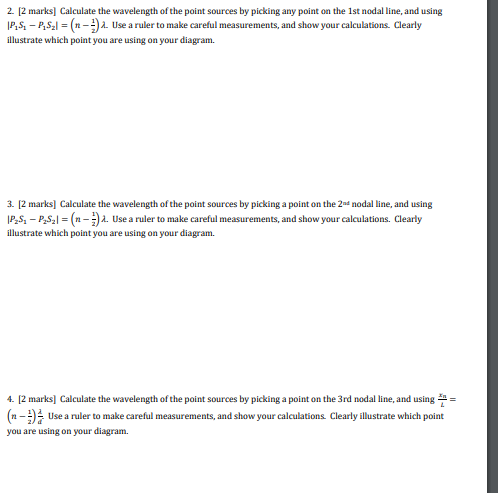
1. [5 marks] Consider an interference pattern displayed below, created by the two point sources S, and Sz. Solid lines represent crests, and dashed lines represent troughs (like our work from earlier). Add the following details to the pattern below: 1) A line joining 51 and 52, and the right bisector of that line (the central maximum). 2) The 1", 2" and 3" nodal lines on both sides of the central maximum. Show all nodes using an open circle (like in our note) OR a different coloured pencil or peri.2. [2 marks] Calculate the wavelength of the point sources by picking any point on the Ist nodal line, and using IP,$1 - P,521 = (nt -:) A. Use a ruler to make careful measurements, and show your calculations. Clearly illustrate which point you are using on your diagram. 3. [2 marks] Calculate the wavelength of the point sources by picking a point on the 2nd nodal line, and using [P251 - P.521 = (m -7) 2. Use a ruler to make careful measurements, and show your calculations. Clearly illustrate which point you are using on your diagram. 4. [2 marks] Calculate the wavelength of the point sources by picking a point on the 3rd nodal line, and using = = (m -) = Use a ruler to make careful measurements, and show your calculations. Clearly illustrate which point you are using on your diagram.5. [2 marks] You observe diffraction in a ripple tank as shown in the figure to the right, where a plane wave with a certain wavelength and frequency of (1 and /) passes through single slit of width "d". List two ways you could increase the diffraction of waves beyond the barrier. we generator 6. [5 marks] Two slits are 1.58 x 10 * m apart. A mixture of red light (wavelength of 665 mm) and yellow-green light (wavelength 565 mm) falls onto the slits. A screen is located 2.2 m away. Find the distance between the third- red dark fringe and the third yellow-green fringe.7. [2 marks ] Starting from p= - (photon momentum), show that 1 = = (De Broglie wavelength). B. [2 marks ] Calculate the momentum of a photon whose frequency is atION Ha. 9. [2 marks ] Determine the energy of 1 quantum of infrared radiation (1 = 941 am ). 10. [3 marks] A bowling ball (mass 5 kg) rolls with a speed of 12 m/s. a) Determine the De Broglie wavelength of the bowling ball b) Explain why we do not notice wavelength behaviour for everyday objects (i.e. diffraction).11. [5 marks ] A light source of wavelength, 1, illuminates a metal and ejects photoelectrons with a maximum kinetic energy of 1.2 ev. A second light source with double the wavelength of the first ejects photoelectrons with a maximum kinetic energy of 05 ev. Calculate the work function of the metal (in ev). 12. [3 marks ] Imagine that Planck's constant was much larger, h = 6.63 x 10⁻¹⁰ / . s. How would this affect you if you were standing in the dark, suddenly turned on a light, and were bombarded by thousands of photons? Include some sample calculations
Step by Step Solution
There are 3 Steps involved in it

Get step-by-step solutions from verified subject matter experts
 Study Help