







Question: ( 1 5 marks ) Now, let's consider a model where the possibility that the country will default is priced into the value of its
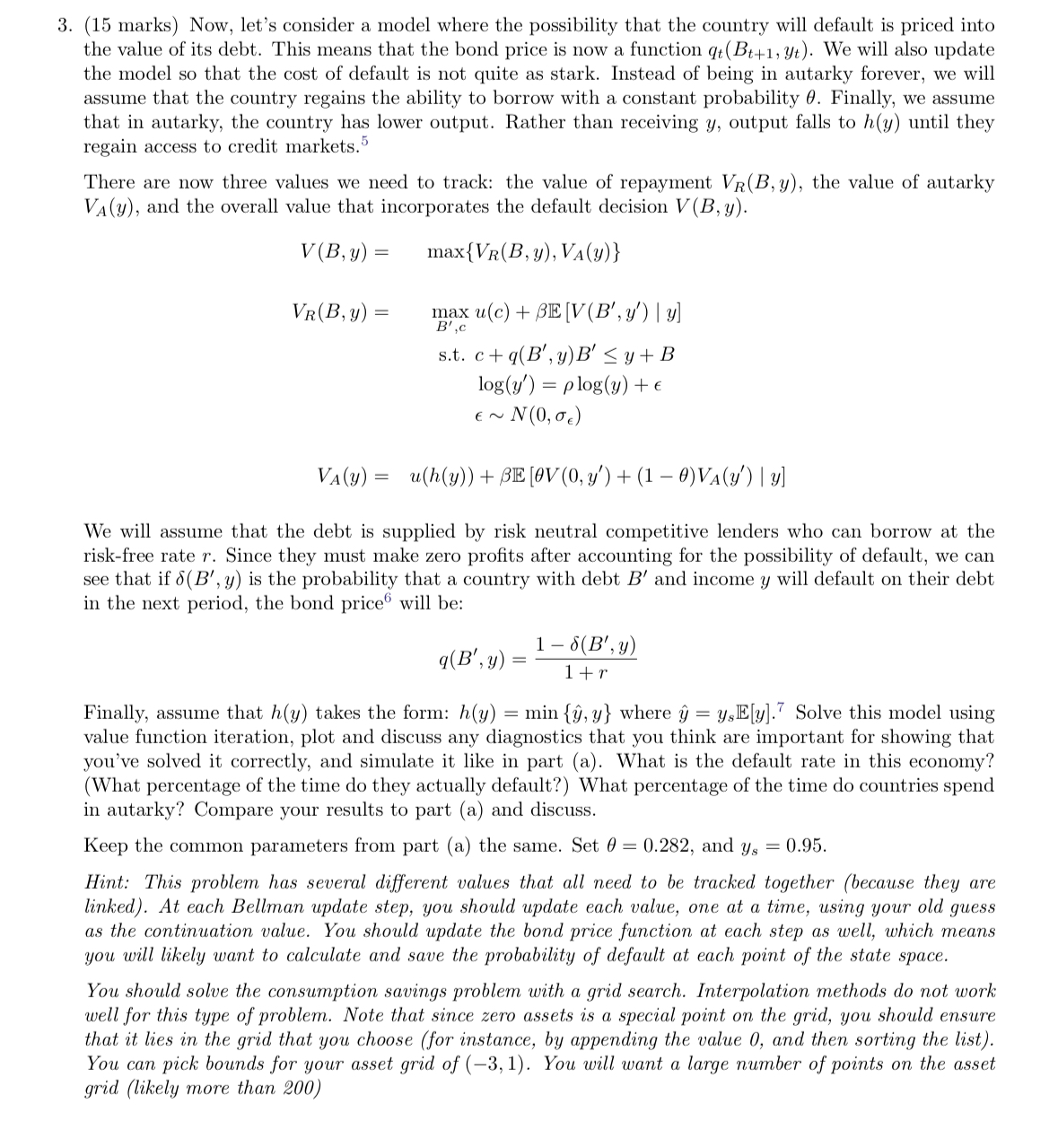
marks Now, let's consider a model where the possibility that the country will default is priced into the value of its debt. This means that the bond price is now a function We will also update the model so that the cost of default is not quite as stark. Instead of being in autarky forever, we will assume that the country regains the ability to borrow with a constant probability Finally, we assume that in autarky, the country has lower output. Rather than receiving output falls to until they regain access to credit markets.
There are now three values we need to track: the value of repayment the value of autarky and the overall value that incorporates the default decision
We will assume that the debt is supplied by risk neutral competitive lenders who can borrow at the riskfree rate Since they must make zero profits after accounting for the possibility of default, we can see that if is the probability that a country with debt and income will default on their debt in the next period, the bond price will be:
Finally, assume that takes the form: min where hat Solve this model using value function iteration, plot and discuss any diagnostics that you think are important for showing that you've solved it correctly, and simulate it like in part a What is the default rate in this economy? What percentage of the time do they actually default? What percentage of the time do countries spend in autarky? Compare your results to part a and discuss.
Keep the common parameters from part a the same. Set and
Hint: This problem has several different values that all need to be tracked together because they are linked At each Bellman update step, you should update each value, one at a time, using your old guess as the continuation value. You should update the bond price function at each step as well, which means you will likely want to calculate and save the probability of default at each point of the state space.
You should solve the consumption savings problem with a grid search. Interpolation methods do not work well for this type of problem. Note that since zero assets is a special point on the grid, you should ensure that it lies in the grid that you choose for instance, by appending the value and then sorting the list You can pick bounds for your asset grid of You will want a large number of points on the asset grid likely more than
Step by Step Solution
There are 3 Steps involved in it
1 Expert Approved Answer
Step: 1 Unlock

Question Has Been Solved by an Expert!
Get step-by-step solutions from verified subject matter experts
Step: 2 Unlock
Step: 3 Unlock
 Study Help