







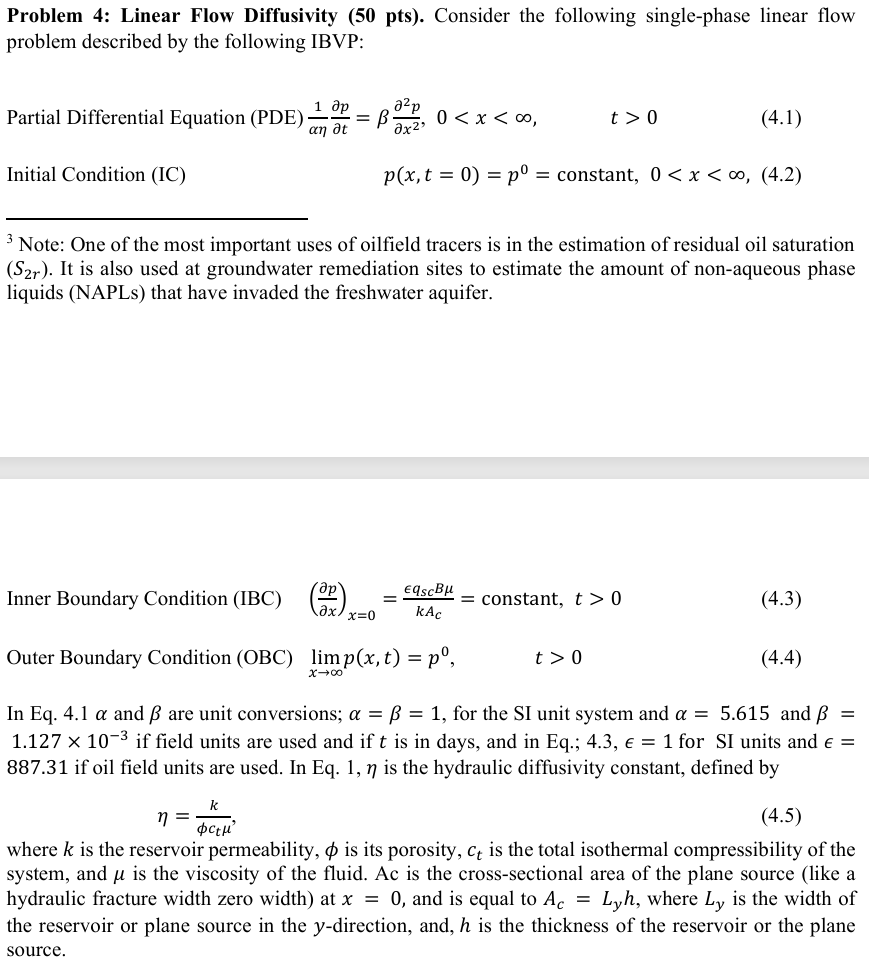
Question: 1 5 pts p ( x , t ) 5 pts q ( x , t ) ( volumetric rate ) solutions to predict the
pts pxtpts qxtvolumetric rate solutions to predict the volumetric flow rate inside the
system.
c pts You may consider time values at t hours. You
must use the Stehfest or GaverStehfest algorithm with the parameter Nstef to compute
your pxt and qxt as a function of x and tbarpxs
and barqxs where s is the Laplace variable with respect to time t and overbar represent Laplace
space solutionpxt and qxtpxtLbarpxs and qxtLbarqxs in the Laplace
space. Here, L represents the inverse Laplace operator, and would be Stehfest numerical
inversion algorithm in your case. You can use any method of coding that you are able to
generate your results from the Stehfest Numerical Inversion algorithm. Also, compare your
solutions with the solutions generated by using your realtime solutions of pxt and qxt to
see how accurately you can invert the Laplace space solutions with the numerical Laplace inverter.
Present a discussion of your results after you prepare loglog plots of Delta pppxt and
qxt versus x for a few time values or versus time for a few fixed values of x on the plot. You
can use the values given in Table
Table Input Data for Computing Solutions
Step by Step Solution
There are 3 Steps involved in it
1 Expert Approved Answer
Step: 1 Unlock

Question Has Been Solved by an Expert!
Get step-by-step solutions from verified subject matter experts
Step: 2 Unlock
Step: 3 Unlock
 Study Help