







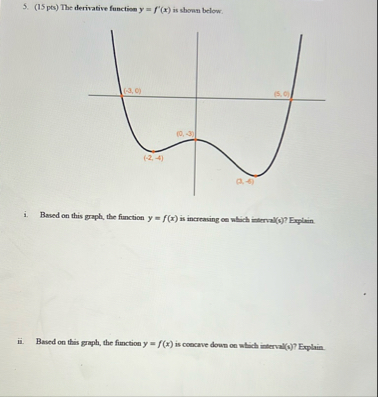
Question: ( 1 5 pts ) The derivative function y = f ' ( x ) is shown below. i . Based on this graph, the
pts The derivative function is shown below.
i Based on this graph, the function is increasing on which morvals Explain.
ii Based on this graph, the function is coscave down on which intervali Explain. pts Below is a graph of the function Assume that all points of discontinuity can be observed from the graph.
Estimate the value for the following nine expressions as accurately as possible based on the graph. Write "DNE" if the value does not exist and or as appropriate.
Finally, identify all the values in the interval such that is ceetimous but not differentiable.
a Using numerical and graphical techniques, we want to find Make sure the mode to your calculator is set to radians.
table nsuer
Therefore, by the table above and the graph of the function, the
b Using mumerical and graphical techniques, we want to find
table
Therefore, by the table above and the graph of the function, the
c Is the function differentiable at Why or why not?
Step by Step Solution
There are 3 Steps involved in it
1 Expert Approved Answer
Step: 1 Unlock

Question Has Been Solved by an Expert!
Get step-by-step solutions from verified subject matter experts
Step: 2 Unlock
Step: 3 Unlock
 Study Help