







Question: 1. (50%) Elements A and B form a liquid solution, which at 1000K, extend from pure A to pure B. This solution is known
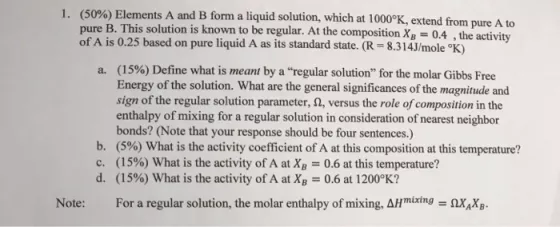
1. (50%) Elements A and B form a liquid solution, which at 1000K, extend from pure A to pure B. This solution is known to be regular. At the composition Xg = 0.4 , the activity of A is 0.25 based on pure liquid A as its standard state. (R = 8.314J/mole "K) a. (15%) Define what is meant by a regular solution" for the molar Gibbs Free Energy of the solution. What are the general significances of the magnitude and sign of the regular solution parameter, f, versus the role of composition in the enthalpy of mixing for a regular solution in consideration of nearest neighbor bonds? (Note that your response should be four sentences.) b. (5%) What is the activity coefficient of A at this composition at this temperature? c. (15%) What is the activity of A at X, = 0.6 at this temperature? d. (15%) What is the activity of A at Xg = 0.6 at 1200K? Note: For a regular solution, the molar enthalpy of mixing, AHmixing = Nx,Xg. %3D
Step by Step Solution
3.57 Rating (157 Votes )
There are 3 Steps involved in it
Here is the explained answer Step 1 a Regular solution definition In chemistry a regular solution is ... View full answer

Get step-by-step solutions from verified subject matter experts
 Study Help