







Question: 1. 50 points} Early computer systems allowed only one process to be executed at a time. In contrast, current computer systems allow multiple programs to
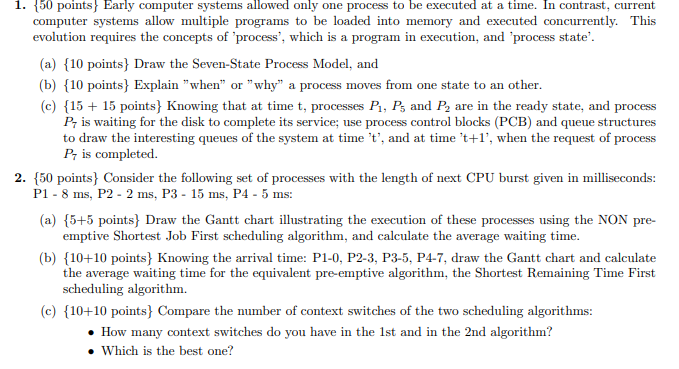
1. 50 points} Early computer systems allowed only one process to be executed at a time. In contrast, current computer systems allow multiple programs to be loaded into memory and executed concurrently. This evolution requires the concepts of process, which is a program in execution, and process state'. (a) {10 points} Draw the Seven-State Process Model, and (b) {10 points} Explain "when" or "why a process moves from one state to an other. (e) {15 + 15 points} Knowing that at time t, processes P1, Ps and P, are in the ready state, and process P, is waiting for the disk to complete its service; use process control blocks (PCB) and queue structures to draw the interesting queues of the system at time 't', and at time 't+1', when the request of process P, is completed. 2. {50 points} Consider the following set of processes with the length of next CPU burst given in milliseconds: P1 - 8 ms, P2 - 2 ms, P3 - 15 ms, P4 - 5 ms: (a) {5+5 points} Draw the Gantt chart illustrating the execution of these processes using the NON pre- emptive Shortest Job First scheduling algorithm, and calculate the average waiting time. (b) {10+10 points} Knowing the arrival time: P1-0, P2-3, P3-5, P4-7, draw the Gantt chart and calculate the average waiting time for the equivalent pre-emptive algorithm, the Shortest Remaining Time First scheduling algorithm. (e) {10+10 points} Compare the number of context switches of the two scheduling algorithms: How many context switches do you have in the 1st and in the 2nd algorithm? Which is the best one
Step by Step Solution
There are 3 Steps involved in it

Get step-by-step solutions from verified subject matter experts
 Study Help