







Question: 1. (50 pt., 10 pt. each) Prove each of the following statements using a direct proof, a proof by contrapositive, a proof by contradiction, or
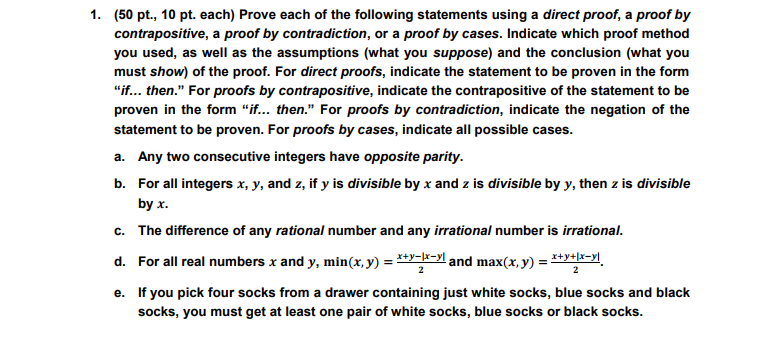
1. (50 pt., 10 pt. each) Prove each of the following statements using a direct proof, a proof by contrapositive, a proof by contradiction, or a proof by cases. Indicate which proof method you used, as well as the assumptions (what you suppose) and the conclusion (what you must show) of the proof. For direct proofs, indicate the statement to be proven in the form "if... then." For proofs by contrapositive, indicate the contrapositive of the statement to be proven in the form "if.. then." For proofs by contradiction, indicate the negation of the statement to be proven. For proofs by cases, indicate all possible cases. a. Any two consecutive integers have opposite parity. b. For all integers x, y, and z, if y is divisible by x and z is divisible by y, then z is divisible x. The difference of any rational number and any irrational number is irrational. For all real numbers x and y, min(x,y) = If you pick four socks from a drawer containing just white socks, blue socks and black c. d. xty-ryl and max(x, y) = x+y2 e. socks, you must get at least one pair of white socks, blue socks or black socks
Step by Step Solution
There are 3 Steps involved in it

Get step-by-step solutions from verified subject matter experts
 Study Help