







Question: 1 8 ( 1 0 % ) Determine whether the following statements are correct or not and justify your answers. ( 2 ) ( 2
Determine whether the following statements are correct or not and justify your answers.
Given a set of cities, the traveling salesperson problem is to find a shortest round Determine whether the following statements are correct or not and justify your answers.
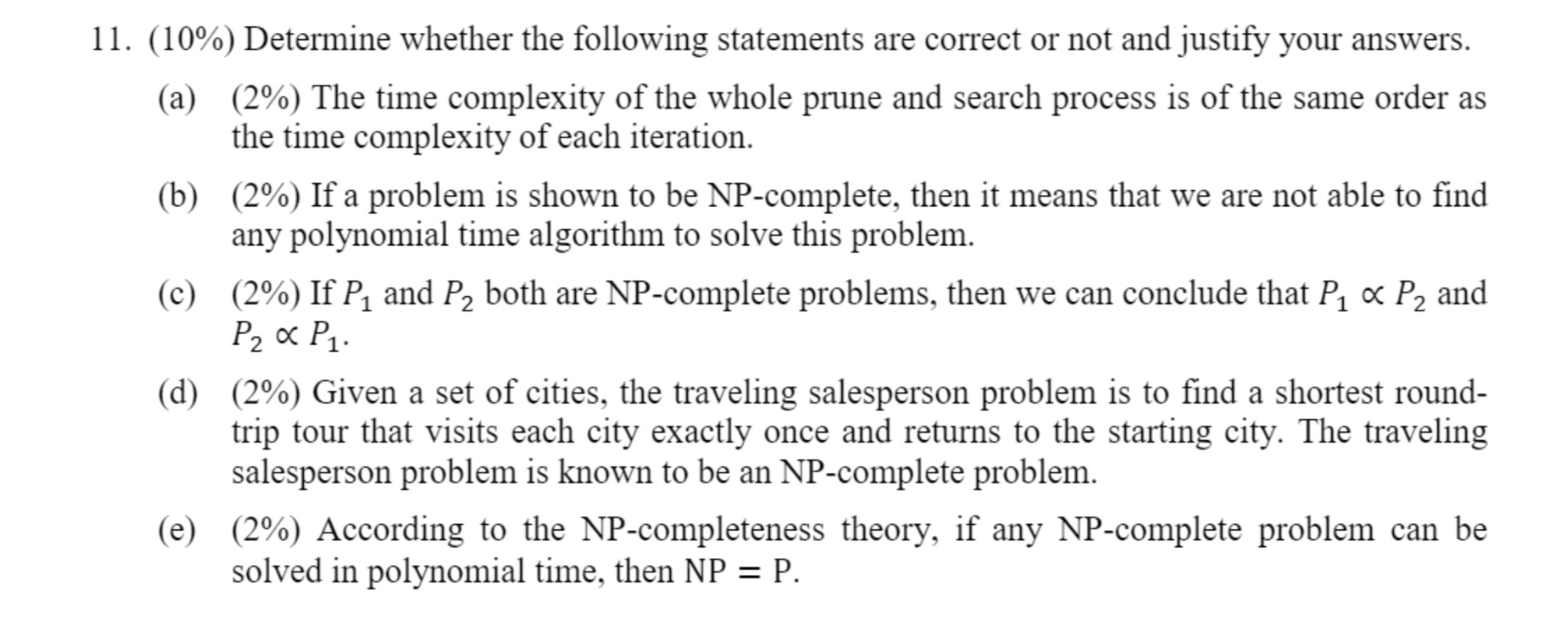
a The time complexity of the whole prune and search process is of the same order as
the time complexity of each iteration.
b If a problem is shown to be NPcomplete, then it means that we are not able to find
any polynomial time algorithm to solve this problem.
c If and both are NPcomplete problems, then we can conclude that and
d Given a set of cities, the traveling salesperson problem is to find a shortest round
trip tour that visits each city exactly once and returns to the starting city. The traveling
salesperson problem is known to be an NPcomplete problem.
e According to the NPcompleteness theory, if any NPcomplete problem can be
solved in polynomial time, then
trip tour that visits each city exactly once and returns to the starting city. The traveling
salesperson problem is known to be an NP problem.
b Not all NP problems can be reduced to the SAT problem.
c By the Cook's theorem, if the SAT problem is not a problem, then
d If a problem is shown to be NPcomplete, then it means that we are not able to find
any polynomial time algorithm to solve this problem.
e The difficulty degrees of any two NPhard problems are equivalent.
Step by Step Solution
There are 3 Steps involved in it
1 Expert Approved Answer
Step: 1 Unlock

Question Has Been Solved by an Expert!
Get step-by-step solutions from verified subject matter experts
Step: 2 Unlock
Step: 3 Unlock
 Study Help