







Question: 1 8 . 2 2 In the canning process, sealed cans of food are sterilized with pressurized steam in order to kill any microorganisms initially
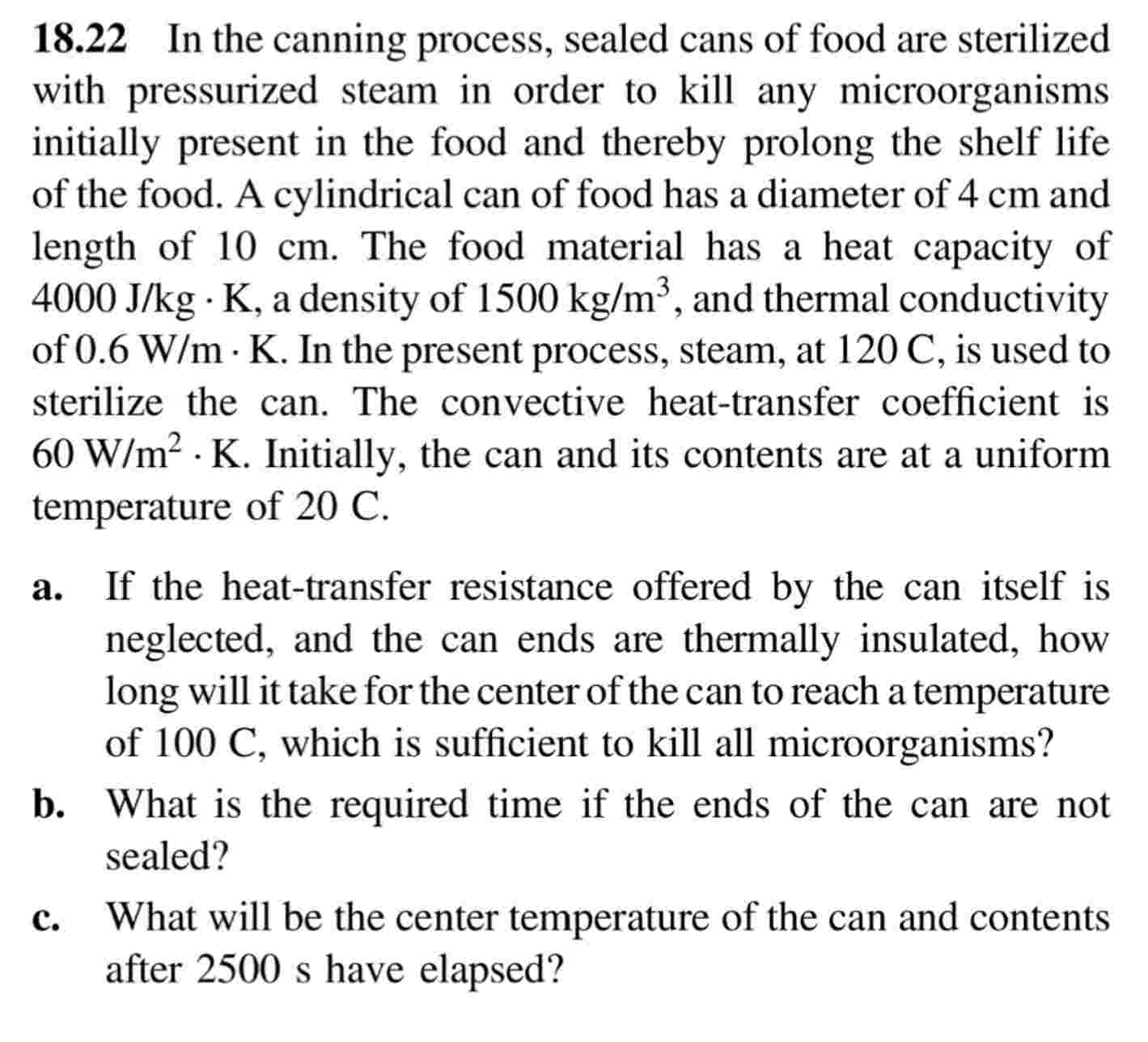
In the canning process, sealed cans of food are sterilized with pressurized steam in order to kill any microorganisms initially present in the food and thereby prolong the shelf life of the food. A cylindrical can of food has a diameter of cm and length of cm The food material has a heat capacity of mathrm~Jmathrmkgcdot mathrmK a density of mathrm~kgmathrmm and thermal conductivity of mathrm~Wmathrmmcdot mathrmK In the present process, steam, at C is used to sterilize the can. The convective heattransfer coefficient is mathrm~Wmathrmmcdot mathrm~K Initially, the can and its contents are at a uniform temperature of C
a If the heattransfer resistance offered by the can itself is neglected, and the can ends are thermally insulated, how long will it take for the center of the can to reach a temperature of C which is sufficient to kill all microorganisms?
b What is the required time if the ends of the can are not sealed?
c What will be the center temperature of the can and contents after s have elapsed?
Step by Step Solution
There are 3 Steps involved in it
1 Expert Approved Answer
Step: 1 Unlock

Question Has Been Solved by an Expert!
Get step-by-step solutions from verified subject matter experts
Step: 2 Unlock
Step: 3 Unlock
 Study Help