



Question: 1. $ 80.00 Alternative 2. 3. $ 80.00 $ 80.00 4. $ 80.00 h39 Stockout cost (given) Multiplied by the probability of running out of
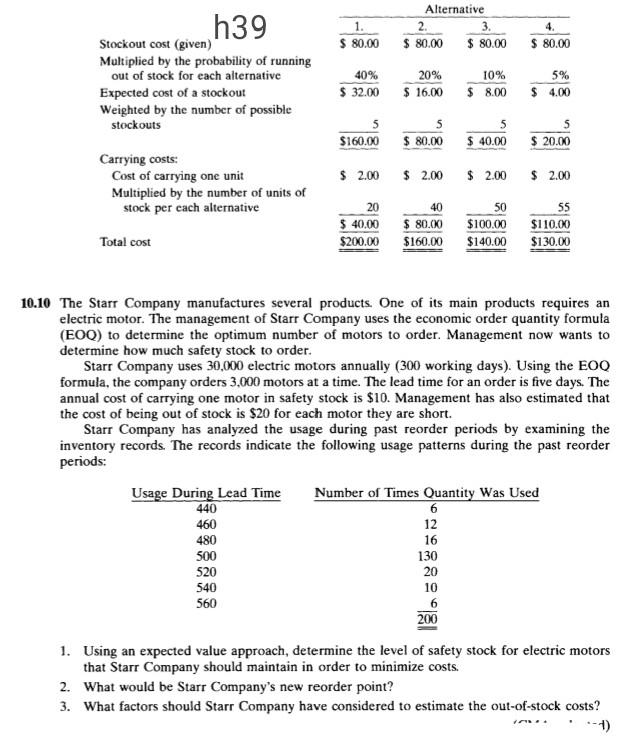
1. $ 80.00 Alternative 2. 3. $ 80.00 $ 80.00 4. $ 80.00 h39 Stockout cost (given) Multiplied by the probability of running out of stock for each alternative Expected cost of a stockout Weighted by the number of possible stockouts 40% $ 32.00 20% $ 16.00 10% $ 8.00 5% $ 4.00 $160.00 5 $ 80.00 5 $ 40.00 S $ 20.00 $ 2.00 $ 2.00 $ 2.00 $ 2.00 Carrying costs: Cost of carrying one unit Multiplied by the number of units of stock per each alternative 40 20 $ 40,00 $200.00 50 $100.00 $140.00 $ 80.00 $160.00 SS $110.00 $130.00 Total cost 10.10 The Start Company manufactures several products. One of its main products requires an electric motor. The management of Starr Company uses the economic order quantity formula (EOQ) to determine the optimum number of motors to order. Management now wants to determine how much safety stock to order. Starr Company uses 30,000 electric motors annually (300 working days). Using the EOQ formula, the company orders 3,000 motors at a time. The lead time for an order is five days. The annual cost of carrying one motor in safety stock is $10. Management has also estimated that the cost of being out of stock is $20 for each motor they are short. Starr Company has analyzed the usage during past reorder periods by examining the inventory records. The records indicate the following usage patterns during the past reorder periods: Usage During Lead Time Number of Times Quantity Was Used 6 460 12 480 16 130 520 20 10 560 200 440 500 540 1. Using an expected value approach, determine the level of safety stock for electric motors that Starr Company should maintain in order to minimize costs. 2. What would be Starr Company's new reorder point? 3. What factors should Starr Company have considered to estimate the out-of-stock costs? .-)
Step by Step Solution
There are 3 Steps involved in it

Get step-by-step solutions from verified subject matter experts