







Question: 1. (90 pts) Consider a double delta-function potential V(x) 2 oc [5(x + a) + 5(1: 0)] , where a and or are positive constants.
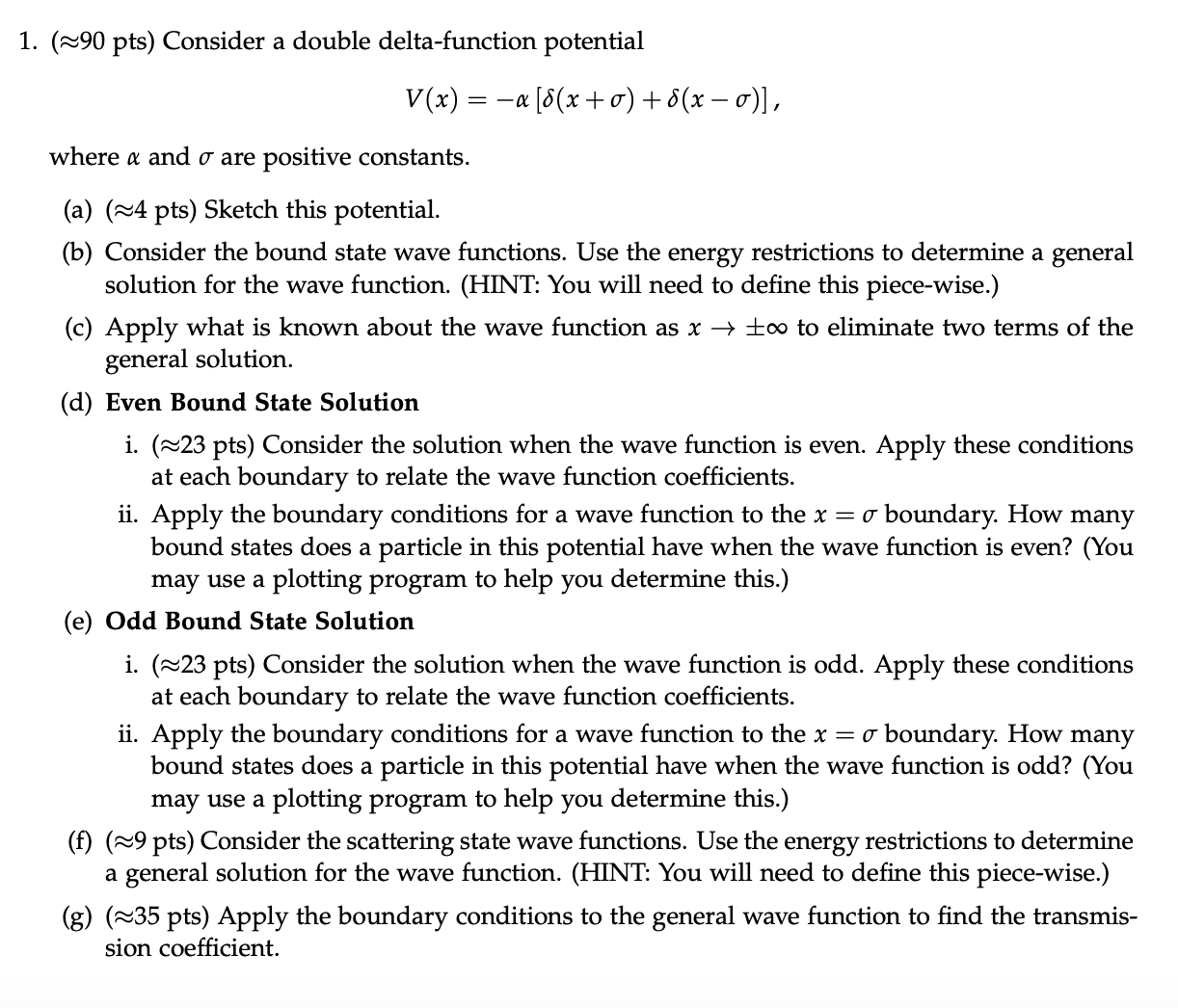
1. (90 pts) Consider a double delta-function potential V(x) 2 oc [5(x + a) + 5(1: 0)] , where a and or are positive constants. (a) ($4 pts) Sketch this potential. (b) Consider the bound state wave functions. Use the energy restrictions to determine a general solution for the wave function. (HINT: You will need to define this piece-wise.) (c) Apply what is known about the wave function as x > ice to eliminate two terms of the general solution. (d) Even Bound State Solution i. (23 pts) Consider the solution when the wave function is even. Apply these conditions at each boundary to relate the wave function coefficients. ii. Apply the boundary conditions for a wave function to the x = or boundary. How many bound states does a particle in this potential have when the wave function is even? (You may use a plotting program to help you determine this.) (e) Odd Bound State Solution i. (23 pts) Consider the solution when the wave function is odd. Apply these conditions at each boundary to relate the wave function coefficients. ii. Apply the boundary conditions for a wave function to the x : 0' boundary. How many bound states does a particle in this potential have when the wave function is odd? (You may use a plotting program to help you determine this.) (f) (:69 pts) Consider the scattering state wave functions. Use the energy restrictions to determine a general solution for the wave function. (HINT: You will need to define this piece-wise.) (g) (535 pts) Apply the boundary conditions to the general wave function to nd the transmis- sion coefficient
Step by Step Solution
There are 3 Steps involved in it

Get step-by-step solutions from verified subject matter experts
 Study Help