



Question: 1) A 1.56 m tall physicist is trying to shoot a basketball into a basketball hoop. Unfortunately, the player misses the hoop and hits the
1) A 1.56 m tall physicist is trying to shoot a basketball into a basketball hoop. Unfortunately, the player misses the hoop and hits the backboard, which is 7.43 m away from where the shot is taken. The ball is originally thrown from head height at an angle of 39? above the horizontal and hits the backboard t = 1.18 seconds after the shot is taken. a. Draw a diagram of this motion and label a coordinate system. b. What velocity (direction and magnitude) was the ball shot with? c. In order to calculate the maximum height, you have to make an assumption about some variable at that point. What is this assumption? Why is this variable allowed to be set to this value at the top of the trajectory? d. Find the maximum height the ball reaches. e. Calculate how many meters above the floor the ball hits the backboard? f. The same player must now take a shot while being guarded by an opponent. This means the player must shoot the ball at an increased angle from the horizontal. Will the shot take more or less time to reach the backboard than the original shot? Please explain.
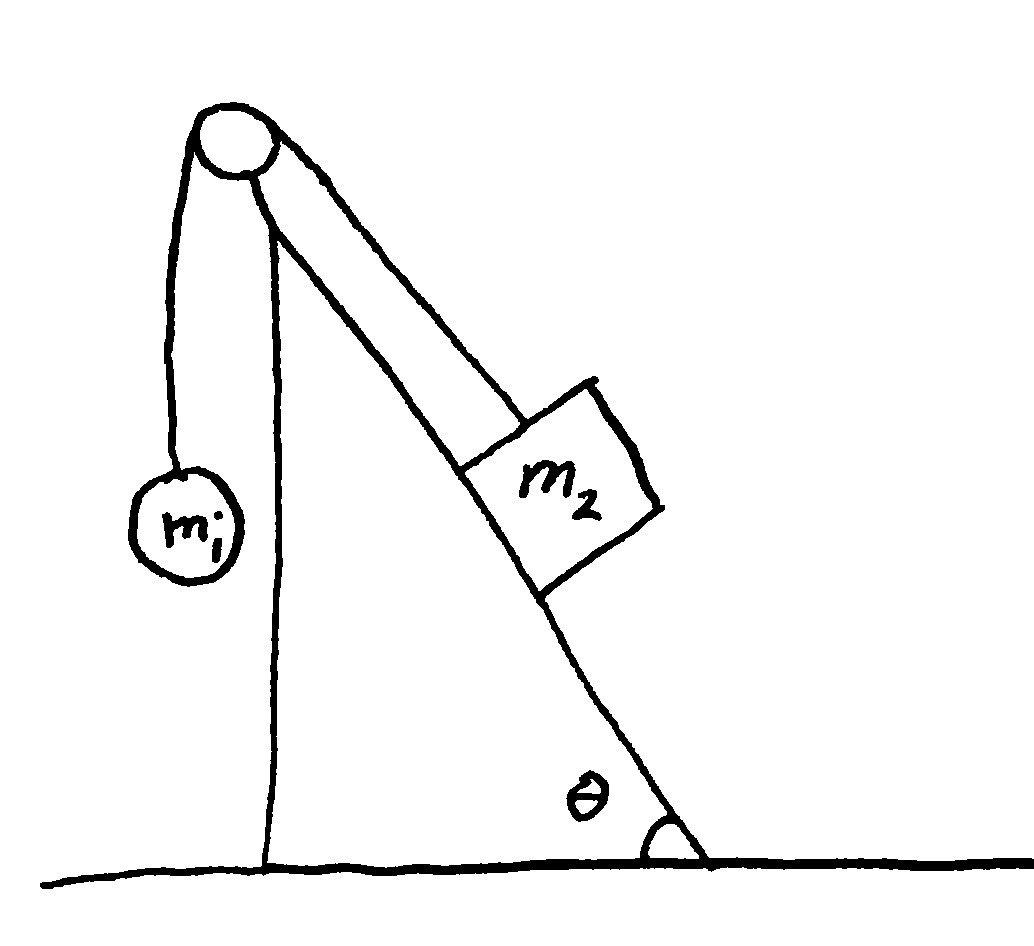
2) Two masses of mass m1 = 3.24kg and m2 = 8.71kg are connected by a light string which passes over a friction-less pulley as shown below. The mass m1 is initially held at rest on the floor and m2 rests on a rough inclined plane (include friction) elevated to an angle of ? = 67? degrees above the horizontal. After release, the mass m2 slides a distance of 1.32 meters down the incline in 3.94 seconds.
\f\f
Step by Step Solution
There are 3 Steps involved in it

Get step-by-step solutions from verified subject matter experts