







Question: 1. (a) (5 pts) True or false: ln((n!)2) = (n ln n)? Prove your answer. (b) (5 pts) Find f(n); g(n) > 0 such that
1. (a) (5 pts) True or false: ln((n!)2) = (n ln n)? Prove your answer. (b) (5 pts) Find f(n); g(n) > 0 such that f(n) = O(2g(n)) and f(n) 6= 2O(g(n)). Note: f(n) = 2O(g(n)) means that f(n) = 2h(n) and h(n) = O(g(n)). Prove that your answer is correct. (c) (5 pts) Find f(n); g(n) > 1 such that ln f(n) = o(ln g(n)) and f(n) 6= o(g(n)). Prove that your answer is correct. (d) (5 pts) Find f(n); g(n) 1 such that f(n) g(n) and f(n)n = o(g(n)n). Prove that your answer is correct. (e) (5 pts) Prove the following statement: If f(n) g(n) and h(n) k(n) and f(n)h(n) > 0 then f(n) + h(n) g(n) + k(n):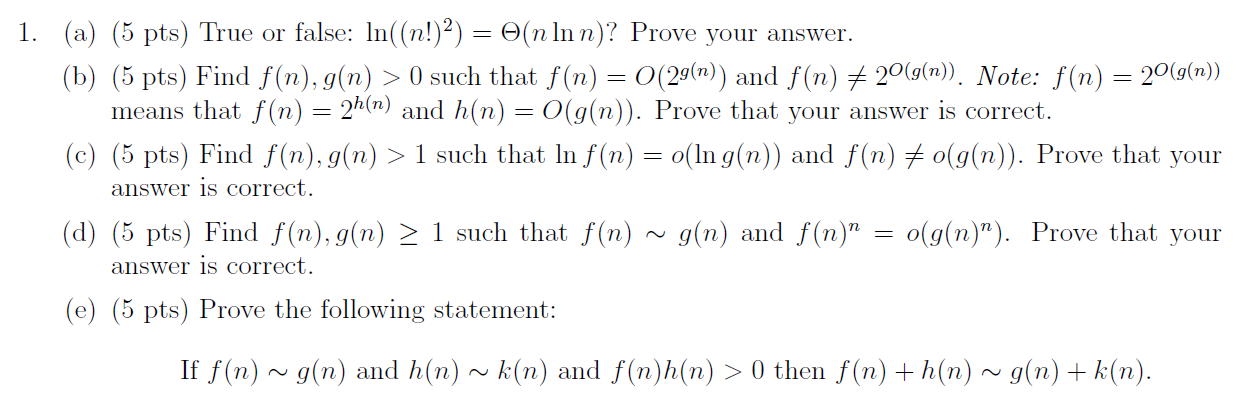
1. (a) (5 pts) True or false: ln((n!)2)=(nlnn) ? Prove your answer. (b) (5 pts) Find f(n),g(n)>0 such that f(n)=O(2g(n)) and f(n)=2O(g(n)). Note: f(n)=2O(g(n)) means that f(n)=2h(n) and h(n)=O(g(n)). Prove that your answer is correct. (c) (5 pts) Find f(n),g(n)>1 such that lnf(n)=o(lng(n)) and f(n)=o(g(n)). Prove that your answer is correct. (d) (5 pts) Find f(n),g(n)1 such that f(n)g(n) and f(n)n=o(g(n)n). Prove that your answer is correct. (e) (5 pts) Prove the following statement: If f(n)g(n) and h(n)k(n) and f(n)h(n)>0 then f(n)+h(n)g(n)+k(n)
Step by Step Solution
There are 3 Steps involved in it

Get step-by-step solutions from verified subject matter experts
 Study Help