







Question: 1. (a) A palindrome is a string that is the same backwards and forwards. (12 points) i. How many binary palindromes are there of length
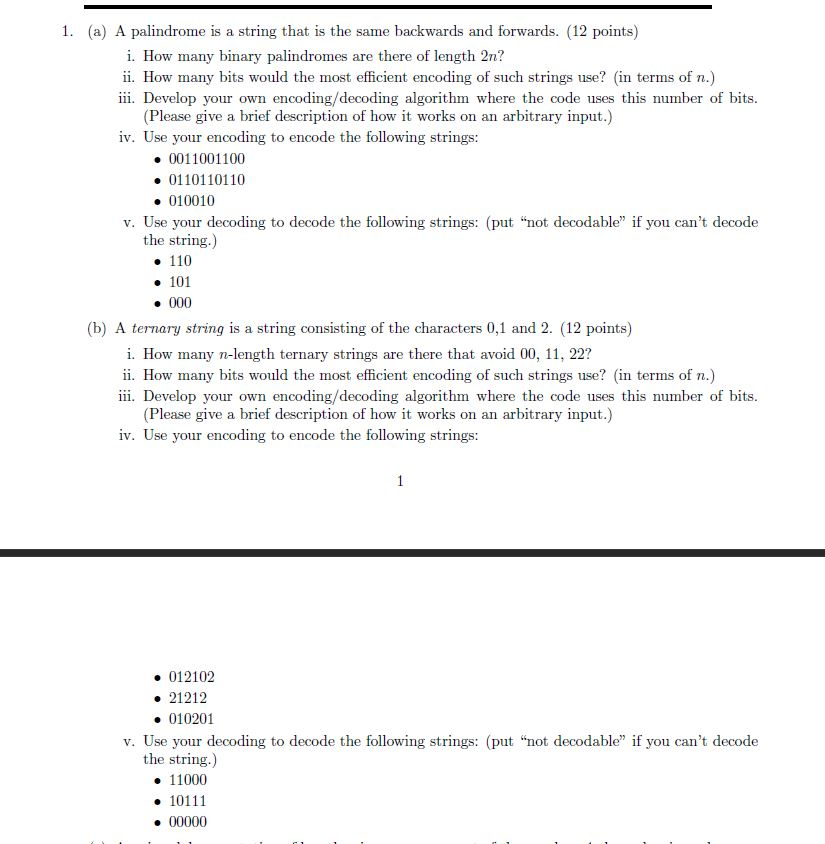
1. (a) A palindrome is a string that is the same backwards and forwards. (12 points) i. How many binary palindromes are there of length 2n? ii. How many bits would the most efficient encoding of such strings use? in terms of n.) iii. Develop your own encoding/decoding algorithm where the code uses this number of bits. (Please give a brief description of how it works on an arbitrary input.) iv. Use your encoding to encode the following strings: 0011001100 . 0110110110 . 010010 v. Use your decoding to decode the following strings: (put "not decodable" if you can't decode the string.) 110 . 101 .000 (b) A ternary string is a string consisting of the characters 0,1 and 2. (12 points) i. How many n-length ternary strings are there that avoid 00, 11, 22? ii. How many bits would the most efficient encoding of such strings use? (in terms of n.) iii. Develop your own encoding/decoding algorithm where the code uses this number of bits. (Please give a brief description of how it works on an arbitrary input.) iv. Use your encoding to encode the following strings: 012102 21212 . 010201 v. Use your decoding to decode the following strings: (put "not decodable" if you can't decode the string.) 11000 . 10111 . 00000 1. (a) A palindrome is a string that is the same backwards and forwards. (12 points) i. How many binary palindromes are there of length 2n? ii. How many bits would the most efficient encoding of such strings use? in terms of n.) iii. Develop your own encoding/decoding algorithm where the code uses this number of bits. (Please give a brief description of how it works on an arbitrary input.) iv. Use your encoding to encode the following strings: 0011001100 . 0110110110 . 010010 v. Use your decoding to decode the following strings: (put "not decodable" if you can't decode the string.) 110 . 101 .000 (b) A ternary string is a string consisting of the characters 0,1 and 2. (12 points) i. How many n-length ternary strings are there that avoid 00, 11, 22? ii. How many bits would the most efficient encoding of such strings use? (in terms of n.) iii. Develop your own encoding/decoding algorithm where the code uses this number of bits. (Please give a brief description of how it works on an arbitrary input.) iv. Use your encoding to encode the following strings: 012102 21212 . 010201 v. Use your decoding to decode the following strings: (put "not decodable" if you can't decode the string.) 11000 . 10111 . 00000
Step by Step Solution
There are 3 Steps involved in it

Get step-by-step solutions from verified subject matter experts
 Study Help