


Question: 1. A ball A is thrown vertically upwards at 25 ms from a point P. Three seconds later a second ball B is also thrown

1. A ball A is thrown vertically upwards at 251. A ball A is thrown vertically upwards at 251. A ball A is thrown vertically upwards at 25
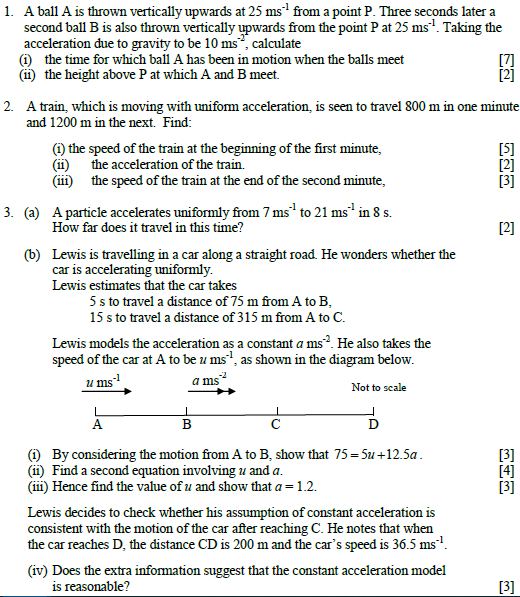
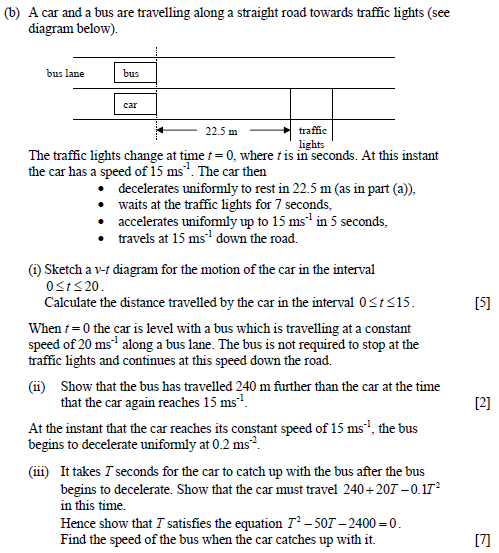
1. A ball A is thrown vertically upwards at 25 ms" from a point P. Three seconds later a second ball B is also thrown vertically upwards from the point P at 25 ms" . Taking the acceleration due to gravity to be 10 ms", calculate (i) the time for which ball A has been in motion when the balls meet [7] (ii) the height above P at which A and B meet. [2] 2. A train, which is moving with uniform acceleration, is seen to travel 800 m in one minute and 1200 m in the next. Find: (i) the speed of the train at the beginning of the first minute, the acceleration of the train. [2] (iii) the speed of the train at the end of the second minute, [3] 3. (a) A particle accelerates uniformly from 7 ms" to 21 ms in 8 s. How far does it travel in this time? [2] (b) Lewis is travelling in a car along a straight road. He wonders whether the car is accelerating uniformly. Lewis estimates that the car takes 5 s to travel a distance of 75 m from A to B, 15 s to travel a distance of 315 m from A to C. Lewis models the acceleration as a constant a ms". He also takes the speed of the car at A to be u ms", as shown in the diagram below. u ms" a ms Not to scale B (i) By considering the motion from A to B, show that 75 = 5u+12.5a. [3] (ii) Find a second equation involving u and a. [4] (iii) Hence find the value of u and show that a = 1.2. [3] Lewis decides to check whether his assumption of constant acceleration is consistent with the motion of the car after reaching C. He notes that when the car reaches D, the distance CD is 200 m and the car's speed is 36.5 ms" (iv) Does the extra information suggest that the constant acceleration model 15 reasonable? [3]4. (a) A particle travelling in a straight line at 15 ms" is brought to rest with constant deceleration in a distance of 22.5 m. Show that the deceleration takes 3 seconds. [2](b) A car and a bus are travelling along a straight road towards traffic lights (see diagram below). bus lane bus car 22.5 m traffic lights The traffic lights change at time f = 0, where f is in seconds. At this instant the car has a speed of 15 ms". The car then decelerates uniformly to rest in 22.5 m (as in part (a)), . waits at the traffic lights for 7 seconds, accelerates uniformly up to 15 ms in 5 seconds, . travels at 15 ms" down the road. (i) Sketch a v-t diagram for the motion of the car in the interval 0Ste 20 Calculate the distance travelled by the car in the interval 0 15. [5] When f =0 the car is level with a bus which is travelling at a constant speed of 20 ms" along a bus lane. The bus is not required to stop at the traffic lights and continues at this speed down the road. (1i) Show that the bus has travelled 240 m further than the car at the time that the car again reaches 15 ms". [2] At the instant that the car reaches its constant speed of 15 ms", the bus begins to decelerate uniformly at 0.2 ms"-. (iii) It takes 7 seconds for the car to catch up with the bus after the bus begins to decelerate. Show that the car must travel 240+207 -0.17' in this time. Hence show that / satisfies the equation 7' -507 -2400=0. Find the speed of the bus when the car catches up with it. [7]
Step by Step Solution

There are 3 Steps involved in it

1 Expert Approved Answer
Step: 1 Unlock blur-text-image
Question Has Been Solved by an Expert!

Get step-by-step solutions from verified subject matter experts

Step: 2 Unlock
Step: 3 Unlock

Students Have Also Explored These Related Mathematics Questions!