







Question: 1. a. Briefly outline the B/B1 case situation and primary points/issues presented in the case. b. List all the Becton-Dickinson Company strategic goals identified in
1. a. Briefly outline the B/B1 case situation and primary points/issues presented in the case.
b. List all the Becton-Dickinson Company strategic goals identified in the cases.
2. Compare BDs strategic organizational goals as presented in the case from the year the company started its global business (which have changed & why).
3. List BD's Strengths, Weaknesses, Opportunities, Threats (SWOT) based on response to 1b above.
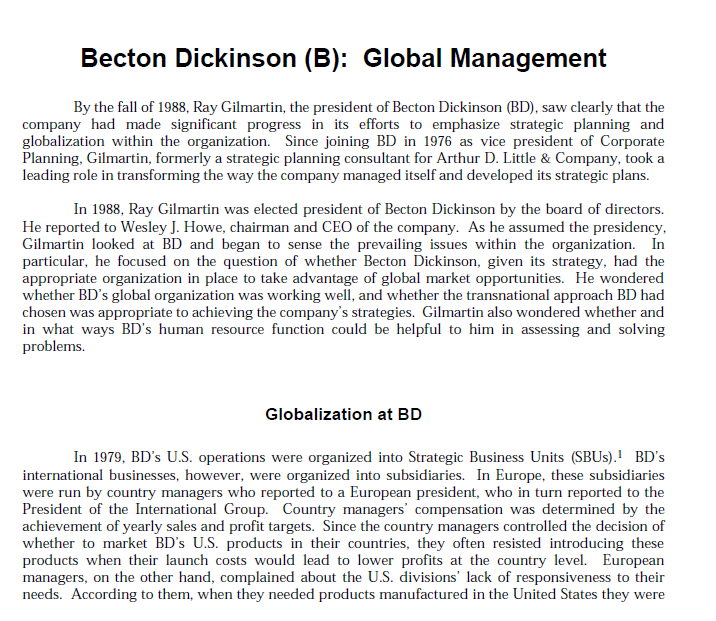
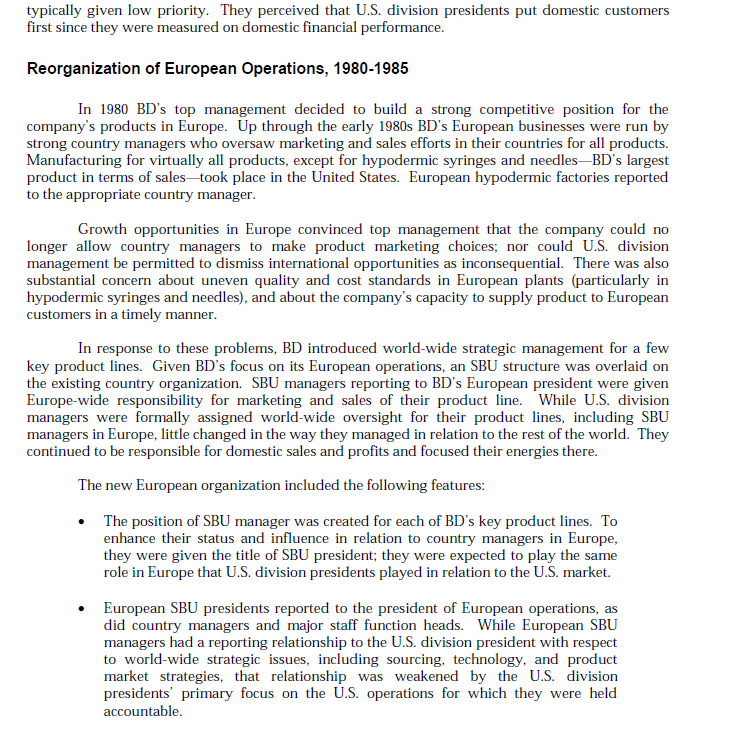
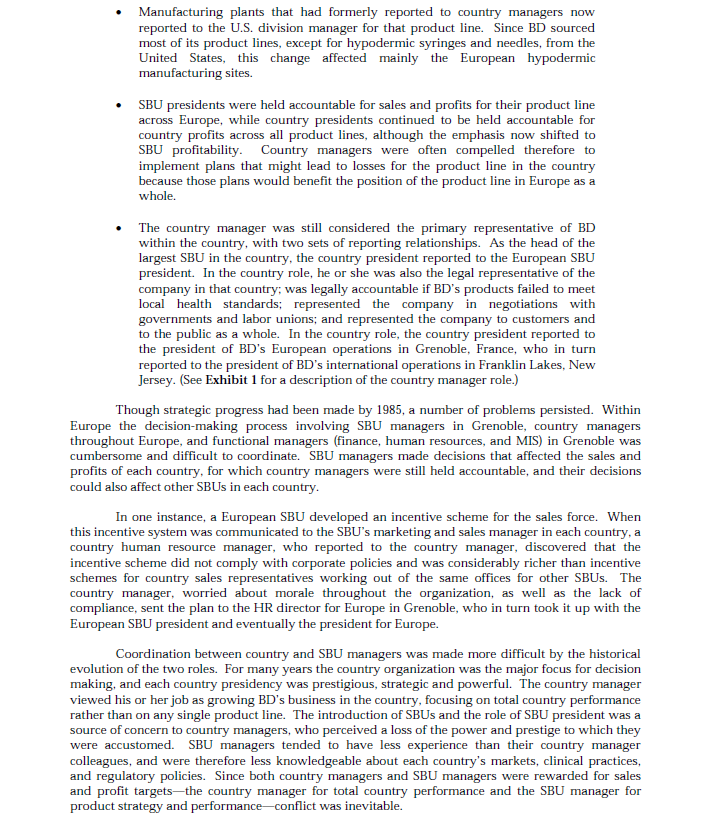
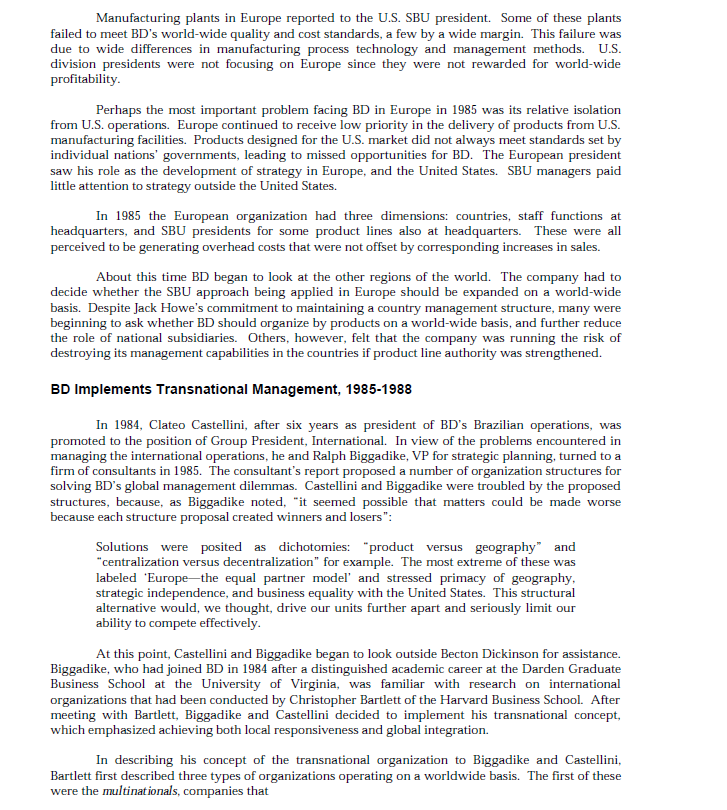
Becton Dickinson (B): Global Management By the fall of 1988, Ray Gilmartin, the president of Becton Dickinson (BD), saw clearly that the company had made significant progress in its efforts to emphasize strategic planning and globalization within the organization. Since joining BD in 1976 as vice president of Corporate Planning, Gilmartin, formerly a strategic planning consultant for Arthur D. Little & Company, took a leading role in transforming the way the company managed itself and developed its strategic plans. In 1988, Ray Gilmartin was elected president of Becton Dickinson by the board of directors. He reported to Wesley J. Howe, chairman and CEO of the company. As he assumed the presidency, Gilmartin looked at BD and began to sense the prevailing issues within the organization. In particular, he focused on the question of whether Becton Dickinson, given its strategy, had the appropriate organization in place to take advantage of global market opportunities. He wondered whether BD's global organization was working well, and whether the transnational approach BD had chosen was appropriate to achieving the company's strategies. Gilmartin also wondered whether and in what ways BD's human resource function could be helpful to him in assessing and solving problems. Globalization at BD In 1979, BD's U.S. operations were organized into Strategic Business Units (SBUS). BD's international businesses, however, were organized into subsidiaries. In Europe, these subsidiaries were run by country managers who reported to a European president, who in turn reported to the President of the International Group. Country managers' compensation was determined by the achievement of yearly sales and profit targets. Since the country managers controlled the decision of whether to market BD's U.S. products in their countries, they often resisted introducing these products when their launch costs would lead to lower profits at the country level. European managers, on the other hand, complained about the U.S. divisions' lack of responsiveness to their needs. According to them, when they needed products manufactured in the United States they were typically given low priority. They perceived that U.S. division presidents put domestic customers first since they were measured on domestic financial performance. Reorganization of European Operations, 1980-1985 In 1980 BD's top management decided to build a strong competitive position for the company's products in Europe. Up through the early 1980s BD's European businesses were run by strong country managers who oversaw marketing and sales efforts in their countries for all products. Manufacturing for virtually all products, except for hypodermic syringes and needles-BD's largest product in terms of sales-took place in the United States. European hypodermic factories reported to the appropriate country manager. Growth opportunities in Europe convinced top management that the company could no longer allow country managers to make product marketing choices; nor could U.S. division management be permitted to dismiss international opportunities as inconsequential. There was also substantial concern about uneven quality and cost standards in European plants (particularly in hypodermic syringes and needles), and about the company's capacity to supply product to European customers in a timely manner. In response to these problems, BD introduced world-wide strategic management for a few key product lines. Given BD's focus on its European operations, an SBU structure was overlaid on the existing country organization. SBU managers reporting to BD's European president were given Europe-wide responsibility for marketing and sales of their product line. While U.S. division managers were formally assigned world-wide oversight for their product lines, including SBU managers in Europe, little changed in the way they managed in relation to the rest of the world. They continued to be responsible for domestic sales and profits and focused their energies there. The new European organization included the following features: The position of SBU manager was created for each of BD's key product lines. To enhance their status and influence in relation to country managers in Europe, they were given the title of SBU president; they were expected to play the same role in Europe that U.S. division presidents played in relation to the U.S. market. European SBU presidents reported to the president of European operations, as did country managers and major staff function heads. While European SBU managers had a reporting relationship to the U.S. division president with respect to world-wide strategic issues, including sourcing, technology, and product market strategies, that relationship was weakened by the U.S. division presidents' primary focus on the U.S. operations for which they were held accountable. Manufacturing plants that had formerly reported to country managers now reported to the U.S. division manager for that product line. Since BD sourced most of its product lines, except for hypodermic syringes and needles, from the United States, this change affected mainly the European hypodermic manufacturing sites. SBU presidents were held accountable for sales and profits for their product line across Europe, while country presidents continued to be held accountable for country profits across all product lines, although the emphasis now shifted to SBU profitability. Country managers were often compelled therefore to implement plans that might lead to losses for the product line in the country because those plans would benefit the position of the product line in Europe as a whole. The country manager was still considered the primary representative of BD within the country, with two sets of reporting relationships. As the head of the largest SBU in the country, the country president reported to the European SBU president. In the country role, he or she was also the legal representative of the company in that country; was legally accountable if BD's products failed to meet local health standards; represented the company in negotiations with governments and labor unions; and represented the company to customers and to the public as a whole. In the country role, the country president reported to the president of BD's European operations in Grenoble, France, who in turn reported to the president of BD's international operations in Franklin Lakes, New Jersey. (See Exhibit 1 for a description of the country manager role.) Though strategic progress had been made by 1985, a number of problems persisted. Within Europe the decision-making process involving SBU managers in Grenoble, country managers throughout Europe, and functional managers (finance, human resources, and MIS) in Grenoble was cumbersome and difficult to coordinate. SBU managers made decisions that affected the sales and profits of each country, for which country managers were still held accountable, and their decisions could also affect other SBUs in each country. In one instance, a European SBU developed an incentive scheme for the sales force. When this incentive system was communicated to the SBU's marketing and sales manager in each country, a country human resource manager, who reported to the country manager, discovered that the incentive scheme did not comply with corporate policies and was considerably richer than incentive schemes for country sales representatives working out of the same offices for other SBUs. The country manager, worried about morale throughout the organization, as well as the lack of compliance, sent the plan to the HR director for Europe in Grenoble, who in turn took it up with the European SBU president and eventually the president for Europe. Coordination between country and SBU managers was made more difficult by the historical evolution of the two roles. For many years the country organization was the major focus for decision making, and each country presidency was prestigious, strategic and powerful. The country manager viewed his or her job as growing BD's business in the country, focusing on total country performance rather than on any single product line. The introduction of SBUs and the role of SBU president was a source of concern to country managers, who perceived a loss of the power and prestige to which they were accustomed. SBU managers tended to have less experience than their country manager colleagues, and were therefore less knowledgeable about each country's markets, clinical practices, and regulatory policies. Since both country managers and SBU managers were rewarded for sales and profit targets-the country manager for total country performance and the SBU manager for product strategy and performance-conflict was inevitable. Manufacturing plants in Europe reported to the U.S. SBU president. Some of these plants failed to meet BD's world-wide quality and cost standards, a few by a wide margin. This failure was due to wide differences in manufacturing process technology and management methods. U.S. division presidents were not focusing on Europe since they were not rewarded for world-wide profitability. Perhaps the most important problem facing BD in Europe in 1985 was its relative isolation from U.S. operations. Europe continued to receive low priority in the delivery of products from U.S. manufacturing facilities. Products designed for the U.S. market did not always meet standards set by individual nations' governments, leading to missed opportunities for BD. The European president saw his role as the development of strategy in Europe, and the United States. SBU managers paid little attention to strategy outside the United States. In 1985 the European organization had three dimensions: countries, staff functions at headquarters, and SBU presidents for some product lines also at headquarters. These were all perceived to be generating overhead costs that were not offset by corresponding increases in sales. About this time BD began to look at the other regions of the world. The company had to decide whether the SBU approach being applied in Europe should be expanded on a world-wide basis. Despite Jack Howe's commitment to maintaining a country management structure, many were beginning to ask whether BD should organize by products on a world-wide basis, and further reduce the role of national subsidiaries. Others, however, felt that the company was running the risk of destroying its management capabilities in the countries if product line authority was strengthened. BD Implements Transnational Management, 1985-1988 In 1984, Clateo Castellini, after six years as president of BD's Brazilian operations, was promoted to the position of Group President, International. In view of the problems encountered in managing the international operations, he and Ralph Biggadike, VP for strategic planning, turned to a firm of consultants in 1985. The consultant's report proposed a number of organization structures for solving BD's global management dilemmas. Castellini and Biggadike were troubled by the proposed structures, because, as Biggadike noted, "it seemed possible that matters could be made worse because each structure proposal created winners and losers": Solutions were posited as dichotomies: "product versus geography" and "centralization versus decentralization" for example. The most extreme of these was labeled 'Europethe equal partner model and stressed primacy of geography, strategic independence, and business equality with the United States. This structural alternative would, we thought, drive our units further apart and seriously limit our ability to compete effectively. At this point, Castellini and Biggadike began to look outside Becton Dickinson for assistance. Biggadike, who had joined BD in 1984 after a distinguished academic career at the Darden Graduate Business School at the University of Virginia, was familiar with research on international organizations that had been conducted by Christopher Bartlett of the Harvard Business School. After meeting with Bartlett, Biggadike and Castellini decided to implement his transnational concept, which emphasized achieving both local responsiveness and global integration. In describing his concept of the transnational organization to Biggadike and Castellini, Bartlett first described three types of organizations operating on a worldwide basis. The first of these were the multinationals, companies that have developed a strategic posture and organizational capability that allows them to be very sensitive and responsive to differences in national environments around the world. In effect these corporations manage a portfolio of multiple national entities. The second group of companies Bartlett described as global companies, which were much more driven by the need for global efficiency, and much more centralized in their strategic and operational decisions... To these companies the global operating environment and worldwide consumer demand are the dominant unit of analysis, not the nation-state or the local market. Products and strategies are developed to exploit an integrated unitary world market. Finally, Bartlett discussed the international organization, whose strategy is based primarily on transferring and adapting the parent company's knowledge or expertise to foreign markets. The parent retains considerable influence and control, but less than in a classic global company, national units can adapt products and ideas coming from the center, but have less independence and autonomy than multinational subsidiaries. Bartlett argued that focusing on only one of these models was an insufficient response to the increasing environmental pressures on companies operating worldwide. The transnational organization he proposed would develop global competitiveness, multinational flexibility, and worldwide learning capability simultaneously. He was careful, however, to differentiate that model from the more traditional matrix form: Rather than assign joint responsibility for everything, as the classic matrix structure suggests, top management in the transnational retains the clarity of line authority, but pays a great deal of attention to the allocation of responsibilities. In such organizations, it is important that country subsidiary managers, product division managers, and corporate staff managers all have the legitimacy, influence, and resource access to represent their viewpoints; at the same time the company must guard against extensive overlap in responsibilities, which might leave managers bogged down in internal negotiations and conflict resolution. Finally, he illustrated the flexibility of the transnational form by explaining how decisions would be made in that organization: Some decisions will tend to be made on a global basis, often at the corporate center (most often research priorities and financing decisions, for example); others will be the appropriate responsibility of local management (typically sales and service tasks and labor relations, for instance). But for some issues, multiple perspectives are important and shared responsibility is necessary. Product policy decisions, for example, often involve negotiation between global product divison managers pushing for greater standardization to achieve scale economies, and local subsidiary managers advocating modifications to fit the product to their local product needs. Transnational management was introduced to BD's executives in 1986 and 1987 at five education conferences lasting three days each. The first of these meetings was held in London, England to signal BD's commitment to the new international thrust. In attendance were Jack Howe, Clateo Castellini, Ray Gilmartin (then president of the Diagnostic Sector), Mandel (president of the Medical Sector), top staff people and key geographic managers. Subsequent meetings were held in Franklin Lakes and Singapore. The conferences began with case discussions designed to introduce the concepts. The participants then broke up into groups to begin the process of applying the transnational concepts to their SBUS. Each group looked at its products, technologies, and customers to determine what aspects of their SBU would be dealt with at the worldwide level, and what should be dealt with locally. A particular group may have decided, for example, that within the marketing function, product decisions would be best handled globally, advertising plans locally. They began thinking about their businesses in order to understand the multiple forces in the environment and how they impacted BD's different businesses and markets in different ways. Understanding these differences was particularly important since BD, like most multinational corporations, had tended to cast all of its subsidiaries in the same mold without consideration for local differences. What set the implementation of transnational management apart from BD's earlier attempts to improve its global management was the emphasis on implementing a new process and way of thinking about global organization, rather than on creating an entirely new structure for the international businesses. Although BD was experiencing difficulties with its European businesses, the company was nonetheless performing well and was not facing a crisis. Consequently, there was no reason to disrupt the organization. In fact, one objective of this change process was to re-emphasize the importance of understanding the company's markets and competitors. Managers were told that their task was to keep abreast of developments in their various products and national markets, and to make structural decisions on that basis. BD's management created worldwide teams to facilitate integration and transnational management. A few such teams had been formed by Ray Gilmartin in the Diagnostic Group earlier. Now a team was formed for each of the company's major products. The worldwide teams consisted of the U.S. division president, the senior U.S. marketing person, the senior representative of U.S. R&D, key manufacturing executives, and their counterparts from the international regions. The teams were charged with formulating worldwide strategy and working on coordination issues; they were not, however, held accountable for operations. The chair of each team was to come from the lead market, which meant that almost all of the worldwide teams were led by Americans. BD had begun to transfer European managers to the United States to lead domestic divisions-Castellini was one of the most successful examples of this policy-but the flow had been, for the most part, in the other direction. Although standardized, the product lines remained wide enough to permit local market flexibility. For example, regional management could choose needles to fit local medical practices. In the case of diagnostic equipment, the hardware was standardized worldwide, but the tests incorporated into that equipment were selected with attention to the diseases prevalent in a particular region. Local responsiveness was assured through the deployment of regionally based marketing and distribution networks. Keeping marketing local, said Gilmartin gives us an advantage over any purely global product-line competitor, because of the knowledge our people have of local medical practices and the infrastructure and how health care supplies are bought in those markets. Gilmartin also noted that, in applying the transnational philosophy, we are able to gain scale economies in R&D and manufacturing and to achieve the economic leverage that derives from the fact that medical practices are similar throughout the world. Thus, the function and the application of the product are the same worldwide. Yet we are also able to market the product differently and recognize that markets are at different stages of development in terms of product acceptance. Before the transnational concept was implemented, it was not unusual for the marketing staff in BD's non-European regions-Africa, South America, Asia/Pacificto claim that no demand existed in their regions for, as an example, blood collection products. Applying the assumptions underlying transnational management, these people began to recognize that the lack of demand stemmed from a fundamental lack of knowledge within their region's medical establishment of the existence and usefulness of these products. The marketing task was therefore reconceptualized to identify and capture such opportunities. As a member of the corporate planning staff explained it: The impetus behind the transnational concept is to capitalize on the growth potential for medical devices and diagnostic products abroad that might be in a more advanced stage of industrial maturity here in the United States. The hemoguard closure exemplified the successful application of the transnational concept at BD. The device, a new cap system for blood collection devices, arose as a response to concerns raised in West Germany about the safety of laboratory technicians and the risk of being splashed by blood. The idea came from the blood collection worldwide team, and soon was being rolled out by the billions on a worldwide basis. Because the idea had not originated in the United States, without the worldwide team structure in place, the idea may have gone nowhere. Although the West Germans had not anticipated the AIDS and hepatitis outbreaks and the fears that would accompany them, BD, because of the worldwide team structure, was able to offer a globally unified response to an emerging problem. Response to Transnational Management International sales took on increasing importance for BD during this period. In 1987, for example, BD's U.S. sales grew 12.9% while international sales, which accounted for 33.5% of BD's total revenues, increased 43.1%. It was anticipated that, by 1995, BD's international business would draw even with and then overtake the domestic business. Although Europe was BD's largest international market, the company was also placing considerable emphasis on its Asia/Pacific region. Much of the company's capital spending in 1987 and 1988 went to this region, including a diagnostic equipment facility in Fukushima, Japan, a syringe and needle plant in Singapore, and funds to enlarge BD's sales and distribution networks throughout the region. Initially, managers resisted the transnational concept; having attended the educational conferences, they were skeptical of the assertion that BD was attempting to implement a process and not a particular management structure. Given the company's history with, for example, the implementation of the European SBUs, many were suspicious and thought that the educational conferences were merely a precursor to a major structural change which top management had already figured out. "5 Castellini reported that, initially, "transnational was not well understood. People do not find it easy to work with ambiguities, and we have to continue to reinforce the elements of the transnational concept." The implementation of the worldwide teams, although welcomed by many in the international division who were frustrated by the former organization of BD's international businesses, was not without its problems. One of the biggest problems was identifying who was truly in charge of the product teams. Although the worldwide product teams had been charged with the responsibility of setting worldwide product strategy, they had no direct authority over budgets in the country organizations; nor did U.S. division presidents, who typically chaired these groups, have any formal authority over their team members. Some division managers raised questions about compensation and its role in the successful implementation of transnational management at BD. The dilemma arose because transnational management was, essentially, a combination of global planning and local implementation. While the worldwide groups met quarterly to plot a worldwide strategy, implementation continued to depend upon divisions whose managers were disciplined by budgets and compensation plans that were regionally oriented. For example, it was possible for strategy to call for sales growth in Europe while the European SBU manager, under budget and profit pressure from the international sector, made cuts in the advertising budget and sales force. At that time, such conflicts could only be resolved by Ray Gilmartin. Many members of the worldwide teams began to debate how incentives could be structured. For example, the Japanese country manager could be compensated for activities that contributed to the achievement of worldwide product goals, in addition to contributions to the achievement of strategy and objectives in Japan. The worldwide teams operated in different ways. Some teams functioned simply as a forum for the worldwide exchange of product information. Others took a more proactive approach, and were becoming very involved with worldwide sourcing, manufacturing, and product decisions. The agendas of worldwide team meetings varied, but could include data gathering, strategic profiling, product design, and budget decisions. BD's top management had not yet resolved whether there needed to be consistency in the way worldwide teams were run, and the extent to which they should be allowed to pursue their own paths. Moreover, it was not yet clear what action should be taken if a worldwide team was not functioning effectively-or by what criteria effectiveness should be measured. The implementation of transnational management necessitated changes in the strategic planning process at BD. Initially, according to a member of the corporate planning staff: Worldwide team leaders (U.S. division presidents) had cobbled together a worldwide plan that was not the product of the team; it was really an independent exercise done on the basis of some of the regional plans. Outside the United States there was a particularly acute shortage of managers schooled in strategic planning who were also experienced in BD's businesses. The individuals who fit this description were rare and as a consequence found themselves sitting on several worldwide teams. There was widespread concern about the amount of time required to effectively participate in the activities of a worldwide team. Of particular concern was the extent to which division presidents spent time on worldwide team activities, given their responsibilities to run their domestic divisions profitably. As one division manager reported: I seem to spend 75% of my time in meetings. Transnational management, while a terrific approach, has been a big problem because of its time requirement. All this time in meetings creates inefficiency. I just don't think we're being decisive enough. In addition to the quarterly worldwide meetings, BD was also considering another level at which the profiling process should take place. Using the hypodermic business as an example of the extremes to which this proposal might be taken, a member of the corporate planning staff explained that regional profiles would be made of Mexico, Brazil, Japan, Asia/Pacific and Europe-meetings that would be attended by the core group of U.S. managers described above. If the head of BD's U.S. hypodermic business were to participate in all these meetings, he would have to spend nearly a third of his time travelling Becton Dickinson (B): Global Management By the fall of 1988, Ray Gilmartin, the president of Becton Dickinson (BD), saw clearly that the company had made significant progress in its efforts to emphasize strategic planning and globalization within the organization. Since joining BD in 1976 as vice president of Corporate Planning, Gilmartin, formerly a strategic planning consultant for Arthur D. Little & Company, took a leading role in transforming the way the company managed itself and developed its strategic plans. In 1988, Ray Gilmartin was elected president of Becton Dickinson by the board of directors. He reported to Wesley J. Howe, chairman and CEO of the company. As he assumed the presidency, Gilmartin looked at BD and began to sense the prevailing issues within the organization. In particular, he focused on the question of whether Becton Dickinson, given its strategy, had the appropriate organization in place to take advantage of global market opportunities. He wondered whether BD's global organization was working well, and whether the transnational approach BD had chosen was appropriate to achieving the company's strategies. Gilmartin also wondered whether and in what ways BD's human resource function could be helpful to him in assessing and solving problems. Globalization at BD In 1979, BD's U.S. operations were organized into Strategic Business Units (SBUS). BD's international businesses, however, were organized into subsidiaries. In Europe, these subsidiaries were run by country managers who reported to a European president, who in turn reported to the President of the International Group. Country managers' compensation was determined by the achievement of yearly sales and profit targets. Since the country managers controlled the decision of whether to market BD's U.S. products in their countries, they often resisted introducing these products when their launch costs would lead to lower profits at the country level. European managers, on the other hand, complained about the U.S. divisions' lack of responsiveness to their needs. According to them, when they needed products manufactured in the United States they were typically given low priority. They perceived that U.S. division presidents put domestic customers first since they were measured on domestic financial performance. Reorganization of European Operations, 1980-1985 In 1980 BD's top management decided to build a strong competitive position for the company's products in Europe. Up through the early 1980s BD's European businesses were run by strong country managers who oversaw marketing and sales efforts in their countries for all products. Manufacturing for virtually all products, except for hypodermic syringes and needles-BD's largest product in terms of sales-took place in the United States. European hypodermic factories reported to the appropriate country manager. Growth opportunities in Europe convinced top management that the company could no longer allow country managers to make product marketing choices; nor could U.S. division management be permitted to dismiss international opportunities as inconsequential. There was also substantial concern about uneven quality and cost standards in European plants (particularly in hypodermic syringes and needles), and about the company's capacity to supply product to European customers in a timely manner. In response to these problems, BD introduced world-wide strategic management for a few key product lines. Given BD's focus on its European operations, an SBU structure was overlaid on the existing country organization. SBU managers reporting to BD's European president were given Europe-wide responsibility for marketing and sales of their product line. While U.S. division managers were formally assigned world-wide oversight for their product lines, including SBU managers in Europe, little changed in the way they managed in relation to the rest of the world. They continued to be responsible for domestic sales and profits and focused their energies there. The new European organization included the following features: The position of SBU manager was created for each of BD's key product lines. To enhance their status and influence in relation to country managers in Europe, they were given the title of SBU president; they were expected to play the same role in Europe that U.S. division presidents played in relation to the U.S. market. European SBU presidents reported to the president of European operations, as did country managers and major staff function heads. While European SBU managers had a reporting relationship to the U.S. division president with respect to world-wide strategic issues, including sourcing, technology, and product market strategies, that relationship was weakened by the U.S. division presidents' primary focus on the U.S. operations for which they were held accountable. Manufacturing plants that had formerly reported to country managers now reported to the U.S. division manager for that product line. Since BD sourced most of its product lines, except for hypodermic syringes and needles, from the United States, this change affected mainly the European hypodermic manufacturing sites. SBU presidents were held accountable for sales and profits for their product line across Europe, while country presidents continued to be held accountable for country profits across all product lines, although the emphasis now shifted to SBU profitability. Country managers were often compelled therefore to implement plans that might lead to losses for the product line in the country because those plans would benefit the position of the product line in Europe as a whole. The country manager was still considered the primary representative of BD within the country, with two sets of reporting relationships. As the head of the largest SBU in the country, the country president reported to the European SBU president. In the country role, he or she was also the legal representative of the company in that country; was legally accountable if BD's products failed to meet local health standards; represented the company in negotiations with governments and labor unions; and represented the company to customers and to the public as a whole. In the country role, the country president reported to the president of BD's European operations in Grenoble, France, who in turn reported to the president of BD's international operations in Franklin Lakes, New Jersey. (See Exhibit 1 for a description of the country manager role.) Though strategic progress had been made by 1985, a number of problems persisted. Within Europe the decision-making process involving SBU managers in Grenoble, country managers throughout Europe, and functional managers (finance, human resources, and MIS) in Grenoble was cumbersome and difficult to coordinate. SBU managers made decisions that affected the sales and profits of each country, for which country managers were still held accountable, and their decisions could also affect other SBUs in each country. In one instance, a European SBU developed an incentive scheme for the sales force. When this incentive system was communicated to the SBU's marketing and sales manager in each country, a country human resource manager, who reported to the country manager, discovered that the incentive scheme did not comply with corporate policies and was considerably richer than incentive schemes for country sales representatives working out of the same offices for other SBUs. The country manager, worried about morale throughout the organization, as well as the lack of compliance, sent the plan to the HR director for Europe in Grenoble, who in turn took it up with the European SBU president and eventually the president for Europe. Coordination between country and SBU managers was made more difficult by the historical evolution of the two roles. For many years the country organization was the major focus for decision making, and each country presidency was prestigious, strategic and powerful. The country manager viewed his or her job as growing BD's business in the country, focusing on total country performance rather than on any single product line. The introduction of SBUs and the role of SBU president was a source of concern to country managers, who perceived a loss of the power and prestige to which they were accustomed. SBU managers tended to have less experience than their country manager colleagues, and were therefore less knowledgeable about each country's markets, clinical practices, and regulatory policies. Since both country managers and SBU managers were rewarded for sales and profit targets-the country manager for total country performance and the SBU manager for product strategy and performance-conflict was inevitable. Manufacturing plants in Europe reported to the U.S. SBU president. Some of these plants failed to meet BD's world-wide quality and cost standards, a few by a wide margin. This failure was due to wide differences in manufacturing process technology and management methods. U.S. division presidents were not focusing on Europe since they were not rewarded for world-wide profitability. Perhaps the most important problem facing BD in Europe in 1985 was its relative isolation from U.S. operations. Europe continued to receive low priority in the delivery of products from U.S. manufacturing facilities. Products designed for the U.S. market did not always meet standards set by individual nations' governments, leading to missed opportunities for BD. The European president saw his role as the development of strategy in Europe, and the United States. SBU managers paid little attention to strategy outside the United States. In 1985 the European organization had three dimensions: countries, staff functions at headquarters, and SBU presidents for some product lines also at headquarters. These were all perceived to be generating overhead costs that were not offset by corresponding increases in sales. About this time BD began to look at the other regions of the world. The company had to decide whether the SBU approach being applied in Europe should be expanded on a world-wide basis. Despite Jack Howe's commitment to maintaining a country management structure, many were beginning to ask whether BD should organize by products on a world-wide basis, and further reduce the role of national subsidiaries. Others, however, felt that the company was running the risk of destroying its management capabilities in the countries if product line authority was strengthened. BD Implements Transnational Management, 1985-1988 In 1984, Clateo Castellini, after six years as president of BD's Brazilian operations, was promoted to the position of Group President, International. In view of the problems encountered in managing the international operations, he and Ralph Biggadike, VP for strategic planning, turned to a firm of consultants in 1985. The consultant's report proposed a number of organization structures for solving BD's global management dilemmas. Castellini and Biggadike were troubled by the proposed structures, because, as Biggadike noted, "it seemed possible that matters could be made worse because each structure proposal created winners and losers": Solutions were posited as dichotomies: "product versus geography" and "centralization versus decentralization" for example. The most extreme of these was labeled 'Europethe equal partner model and stressed primacy of geography, strategic independence, and business equality with the United States. This structural alternative would, we thought, drive our units further apart and seriously limit our ability to compete effectively. At this point, Castellini and Biggadike began to look outside Becton Dickinson for assistance. Biggadike, who had joined BD in 1984 after a distinguished academic career at the Darden Graduate Business School at the University of Virginia, was familiar with research on international organizations that had been conducted by Christopher Bartlett of the Harvard Business School. After meeting with Bartlett, Biggadike and Castellini decided to implement his transnational concept, which emphasized achieving both local responsiveness and global integration. In describing his concept of the transnational organization to Biggadike and Castellini, Bartlett first described three types of organizations operating on a worldwide basis. The first of these were the multinationals, companies that have developed a strategic posture and organizational capability that allows them to be very sensitive and responsive to differences in national environments around the world. In effect these corporations manage a portfolio of multiple national entities. The second group of companies Bartlett described as global companies, which were much more driven by the need for global efficiency, and much more centralized in their strategic and operational decisions... To these companies the global operating environment and worldwide consumer demand are the dominant unit of analysis, not the nation-state or the local market. Products and strategies are developed to exploit an integrated unitary world market. Finally, Bartlett discussed the international organization, whose strategy is based primarily on transferring and adapting the parent company's knowledge or expertise to foreign markets. The parent retains considerable influence and control, but less than in a classic global company, national units can adapt products and ideas coming from the center, but have less independence and autonomy than multinational subsidiaries. Bartlett argued that focusing on only one of these models was an insufficient response to the increasing environmental pressures on companies operating worldwide. The transnational organization he proposed would develop global competitiveness, multinational flexibility, and worldwide learning capability simultaneously. He was careful, however, to differentiate that model from the more traditional matrix form: Rather than assign joint responsibility for everything, as the classic matrix structure suggests, top management in the transnational retains the clarity of line authority, but pays a great deal of attention to the allocation of responsibilities. In such organizations, it is important that country subsidiary managers, product division managers, and corporate staff managers all have the legitimacy, influence, and resource access to represent their viewpoints; at the same time the company must guard against extensive overlap in responsibilities, which might leave managers bogged down in internal negotiations and conflict resolution. Finally, he illustrated the flexibility of the transnational form by explaining how decisions would be made in that organization: Some decisions will tend to be made on a global basis, often at the corporate center (most often research priorities and financing decisions, for example); others will be the appropriate responsibility of local management (typically sales and service tasks and labor relations, for instance). But for some issues, multiple perspectives are important and shared responsibility is necessary. Product policy decisions, for example, often involve negotiation between global product divison managers pushing for greater standardization to achieve scale economies, and local subsidiary managers advocating modifications to fit the product to their local product needs. Transnational management was introduced to BD's executives in 1986 and 1987 at five education conferences lasting three days each. The first of these meetings was held in London, England to signal BD's commitment to the new international thrust. In attendance were Jack Howe, Clateo Castellini, Ray Gilmartin (then president of the Diagnostic Sector), Mandel (president of the Medical Sector), top staff people and key geographic managers. Subsequent meetings were held in Franklin Lakes and Singapore. The conferences began with case discussions designed to introduce the concepts. The participants then broke up into groups to begin the process of applying the transnational concepts to their SBUS. Each group looked at its products, technologies, and customers to determine what aspects of their SBU would be dealt with at the worldwide level, and what should be dealt with locally. A particular group may have decided, for example, that within the marketing function, product decisions would be best handled globally, advertising plans locally. They began thinking about their businesses in order to understand the multiple forces in the environment and how they impacted BD's different businesses and markets in different ways. Understanding these differences was particularly important since BD, like most multinational corporations, had tended to cast all of its subsidiaries in the same mold without consideration for local differences. What set the implementation of transnational management apart from BD's earlier attempts to improve its global management was the emphasis on implementing a new process and way of thinking about global organization, rather than on creating an entirely new structure for the international businesses. Although BD was experiencing difficulties with its European businesses, the company was nonetheless performing well and was not facing a crisis. Consequently, there was no reason to disrupt the organization. In fact, one objective of this change process was to re-emphasize the importance of understanding the company's markets and competitors. Managers were told that their task was to keep abreast of developments in their various products and national markets, and to make structural decisions on that basis. BD's management created worldwide teams to facilitate integration and transnational management. A few such teams had been formed by Ray Gilmartin in the Diagnostic Group earlier. Now a team was formed for each of the company's major products. The worldwide teams consisted of the U.S. division president, the senior U.S. marketing person, the senior representative of U.S. R&D, key manufacturing executives, and their counterparts from the international regions. The teams were charged with formulating worldwide strategy and working on coordination issues; they were not, however, held accountable for operations. The chair of each team was to come from the lead market, which meant that almost all of the worldwide teams were led by Americans. BD had begun to transfer European managers to the United States to lead domestic divisions-Castellini was one of the most successful examples of this policy-but the flow had been, for the most part, in the other direction. Although standardized, the product lines remained wide enough to permit local market flexibility. For example, regional management could choose needles to fit local medical practices. In the case of diagnostic equipment, the hardware was standardized worldwide, but the tests incorporated into that equipment were selected with attention to the diseases prevalent in a particular region. Local responsiveness was assured through the deployment of regionally based marketing and distribution networks. Keeping marketing local, said Gilmartin gives us an advantage over any purely global product-line competitor, because of the knowledge our people have of local medical practices and the infrastructure and how health care supplies are bought in those markets. Gilmartin also noted that, in applying the transnational philosophy, we are able to gain scale economies in R&D and manufacturing and to achieve the economic leverage that derives from the fact that medical practices are similar throughout the world. Thus, the function and the application of the product are the same worldwide. Yet we are also able to market the product differently and recognize that markets are at different stages of development in terms of product acceptance. Before the transnational concept was implemented, it was not unusual for the marketing staff in BD's non-European regions-Africa, South America, Asia/Pacificto claim that no demand existed in their regions for, as an example, blood collection products. Applying the assumptions underlying transnational management, these people began to recognize that the lack of demand stemmed from a fundamental lack of knowledge within their region's medical establishment of the existence and usefulness of these products. The marketing task was therefore reconceptualized to identify and capture such opportunities. As a member of the corporate planning staff explained it: The impetus behind the transnational concept is to capitalize on the growth potential for medical devices and diagnostic products abroad that might be in a more advanced stage of industrial maturity here in the United States. The hemoguard closure exemplified the successful application of the transnational concept at BD. The device, a new cap system for blood collection devices, arose as a response to concerns raised in West Germany about the safety of laboratory technicians and the risk of being splashed by blood. The idea came from the blood collection worldwide team, and soon was being rolled out by the billions on a worldwide basis. Because the idea had not originated in the United States, without the worldwide team structure in place, the idea may have gone nowhere. Although the West Germans had not anticipated the AIDS and hepatitis outbreaks and the fears that would accompany them, BD, because of the worldwide team structure, was able to offer a globally unified response to an emerging problem. Response to Transnational Management International sales took on increasing importance for BD during this period. In 1987, for example, BD's U.S. sales grew 12.9% while international sales, which accounted for 33.5% of BD's total revenues, increased 43.1%. It was anticipated that, by 1995, BD's international business would draw even with and then overtake the domestic business. Although Europe was BD's largest international market, the company was also placing considerable emphasis on its Asia/Pacific region. Much of the company's capital spending in 1987 and 1988 went to this region, including a diagnostic equipment facility in Fukushima, Japan, a syringe and needle plant in Singapore, and funds to enlarge BD's sales and distribution networks throughout the region. Initially, managers resisted the transnational concept; having attended the educational conferences, they were skeptical of the assertion that BD was attempting to implement a process and not a particular management structure. Given the company's history with, for example, the implementation of the European SBUs, many were suspicious and thought that the educational conferences were merely a precursor to a major structural change which top management had already figured out. "5 Castellini reported that, initially, "transnational was not well understood. People do not find it easy to work with ambiguities, and we have to continue to reinforce the elements of the transnational concept." The implementation of the worldwide teams, although welcomed by many in the international division who were frustrated by the former organization of BD's international businesses, was not without its problems. One of the biggest problems was identifying who was truly in charge of the product teams. Although the worldwide product teams had been charged with the responsibility of setting worldwide product strategy, they had no direct authority over budgets in the country organizations; nor did U.S. division presidents, who typically chaired these groups, have any formal authority over their team members. Some division managers raised questions about compensation and its role in the successful implementation of transnational management at BD. The dilemma arose because transnational management was, essentially, a combination of global planning and local implementation. While the worldwide groups met quarterly to plot a worldwide strategy, implementation continued to depend upon divisions whose managers were disciplined by budgets and compensation plans that were regionally oriented. For example, it was possible for strategy to call for sales growth in Europe while the European SBU manager, under budget and profit pressure from the international sector, made cuts in the advertising budget and sales force. At that time, such conflicts could only be resolved by Ray Gilmartin. Many members of the worldwide teams began to debate how incentives could be structured. For example, the Japanese country manager could be compensated for activities that contributed to the achievement of worldwide product goals, in addition to contributions to the achievement of strategy and objectives in Japan. The worldwide teams operated in different ways. Some teams functioned simply as a forum for the worldwide exchange of product information. Others took a more proactive approach, and were becoming very involved with worldwide sourcing, manufacturing, and product decisions. The agendas of worldwide team meetings varied, but could include data gathering, strategic profiling, product design, and budget decisions. BD's top management had not yet resolved whether there needed to be consistency in the way worldwide teams were run, and the extent to which they should be allowed to pursue their own paths. Moreover, it was not yet clear what action should be taken if a worldwide team was not functioning effectively-or by what criteria effectiveness should be measured. The implementation of transnational management necessitated changes in the strategic planning process at BD. Initially, according to a member of the corporate planning staff: Worldwide team leaders (U.S. division presidents) had cobbled together a worldwide plan that was not the product of the team; it was really an independent exercise done on the basis of some of the regional plans. Outside the United States there was a particularly acute shortage of managers schooled in strategic planning who were also experienced in BD's businesses. The individuals who fit this description were rare and as a consequence found themselves sitting on several worldwide teams. There was widespread concern about the amount of time required to effectively participate in the activities of a worldwide team. Of particular concern was the extent to which division presidents spent time on worldwide team activities, given their responsibilities to run their domestic divisions profitably. As one division manager reported: I seem to spend 75% of my time in meetings. Transnational management, while a terrific approach, has been a big problem because of its time requirement. All this time in meetings creates inefficiency. I just don't think we're being decisive enough. In addition to the quarterly worldwide meetings, BD was also considering another level at which the profiling process should take place. Using the hypodermic business as an example of the extremes to which this proposal might be taken, a member of the corporate planning staff explained that regional profiles would be made of Mexico, Brazil, Japan, Asia/Pacific and Europe-meetings that would be attended by the core group of U.S. managers described above. If the head of BD's U.S. hypodermic business were to participate in all these meetings, he would have to spend nearly a third of his time travellingStep by Step Solution
There are 3 Steps involved in it
1 Expert Approved Answer
Step: 1 Unlock

Question Has Been Solved by an Expert!
Get step-by-step solutions from verified subject matter experts
Step: 2 Unlock
Step: 3 Unlock
 Study Help