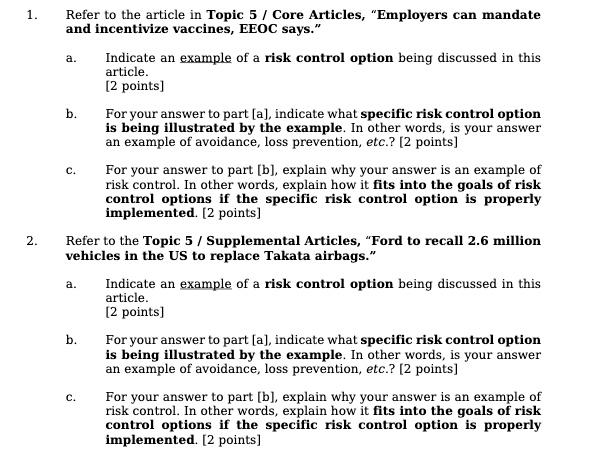
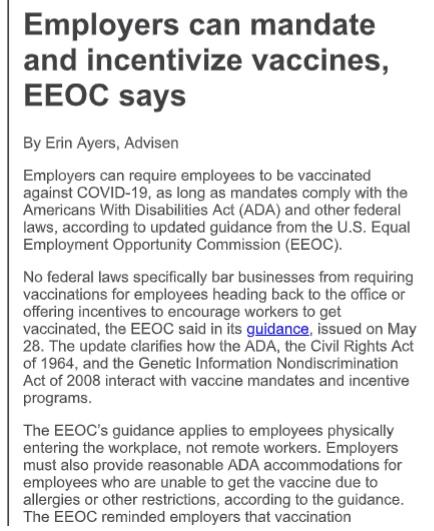
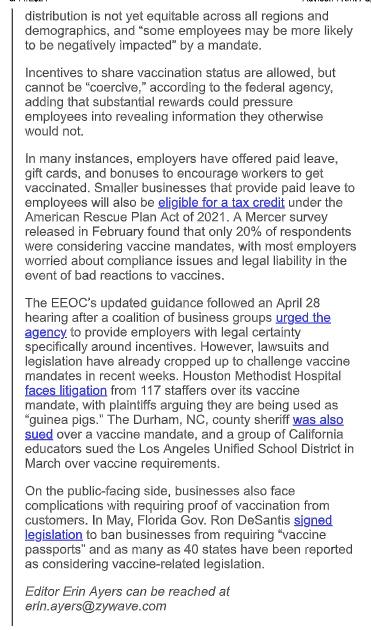
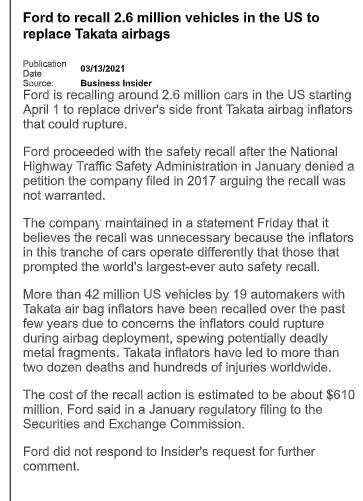
1. a. C. Refer to the article in Topic 5 / Core Articles, "Employers can mandate and incentivize vaccines, EEOC says." Indicate an example of a risk control option being discussed in this article. [2 points) b. For your answer to part [a], indicate what specific risk control option is being illustrated by the example. In other words, is your answer an example of avoidance, loss prevention, etc.? [2 points) For your answer to part [b], explain why your answer is an example of risk control. In other words, explain how it fits into the goals of risk control options if the specific risk control option is properly implemented. (2 points) Refer to the Topic 5 / Supplemental Articles, "Ford to recall 2.6 million vehicles in the US to replace Takata airbags." Indicate an example of a risk control option being discussed in this article. [2 points) For your answer to part [a], indicate what specific risk control option is being illustrated by the example. In other words, is your answer an example of avoidance, loss prevention, etc.? [2 points) For your answer to part [b], explain why your answer is an example of risk control. In other words, explain how it fits into the goals of risk control options if the specific risk control option is properly implemented. [2 points) 2. a. b. C. Employers can mandate and incentivize vaccines, EEOC says By Erin Ayers, Advisen Employers can require employees to be vaccinated against COVID-19, as long as mandates comply with the Americans With Disabilities Act (ADA) and other federal laws, according to updated guidance from the U.S. Equal Employment Opportunity Commission (EEOC). No federal laws specifically bar businesses from requiring vaccinations for employees heading back to the office or offering incentives to encourage workers to get vaccinated, the EEOC said in its guidance, issued on May 28. The update clarifies how the ADA, the Civil Rights Act of 1964, and the Genetic Information Nondiscrimination Act of 2008 interact with vaccine mandates and incentive programs. The EEOC's guidance applies to employees physically entering the workplace, not remote workers. Employers must also provide reasonable ADA accommodations for employees who are unable to get the vaccine due to allergies or other restrictions, according to the guidance. The EEOC reminded employers that vaccination distribution is not yet equitable across all regions and demographics, and some employees may be more likely to be negatively impacted" by a mandate. Incentives to share vaccination status are allowed, but cannot be "coercive," according to the federal agency. adding that substantial rewards could pressure employees into revealing information they otherwise would not In many instances, employers have offered paid leave, gift cards, and bonuses to encourage workers to get vaccinated. Smaller businesses that provide paid leave to employees will also be eligible for a tax credit under the American Rescue Plan Act of 2021. A Mercer survey released in February found that only 20% of respondents were considering vaccine mandates, with most employers worried about compliance issues and legal liability in the event of bad reactions to vaccines. The EEOC's updated guidance followed an April 28 hearing after a coalition of business groups urged the agency, to provide employers with legal certainty specifically around incentives. However, lawsuits and legislation have already cropped up to challenge vaccine mandates in recent weeks. Houston Methodist Hospital faces litigation from 117 staffers over its vaccine mandate, with plaintiffs arguing they are being used as "guinea pigs." The Durham, NC, county sheriff was also sued over a vaccine mandate, and a group of California educators sued the Los Angeles Unified School District in March over vaccine requirements. On the public-facing side, businesses also face complications with requiring proof of vaccination from customers. In May, Florida Gov. Ron De Santis signed legislation to ban businesses from requiring vaccine passports" and as many as 40 states have been reported as considering vaccine-related legislation. Editor Erin Ayers can be reached at erin.ayers@zywave.com Ford to recall 2.6 million vehicles in the US to replace Takata airbags Publication Date 03/13/2021 Source: Business Insider Ford is recalling around 2.6 million cars in the US starting April 1 to replace driver's side front Takata airbag inflators that could rupture. Ford proceeded with the safety recall after the National Highway Traffic Safety Administration in January denied a petition the company filed in 2017 arguing the recall was not warranted. The company maintained in a statement Friday that it believes the recall was unnecessary because the inflators in this tranche of cars operate differently that those that prompted the world's largest-ever auto safety recall. More than 42 million US vehicles by 19 automakers with Takata air bag inflators have been recalled over the past few years due to concerns the inflators could rupture during airbag deployment, spewing potentially deadly metal fragments. Takata inflators have led to more than two dozen deaths and hundreds of injuries worldwide. The cost of the recall action is estimated to be about $610 million, Ford said in a January regulatory filing to the Securities and Exchange Commission. Ford did not respond to Insider's request for further comment The company is also recalling 274,737 of the affected vehicles in Canada and 46,078 vehicles in Mexico, according to Ford's statement. Dealers are expected to replace the driver-side airbag inflator or airbag module. Car models include the Ford Fusion 2006-2012, Ford Edge 2007-2010, Ford Ranger 2007-2011. Mercury Milan 2006-2011, Lincoln Zephyr/MKZ 2006-2012, and Lincoln MKX 2007-2010. Separately, Ford is also recalling 15,769 vehicles in the US over faulty tires, 3,082 vehicles in Canada, and 138 in Mexico. A break may happen on the sidewall of the tire leading to sudden air loss or a belt edge separation which could cause partial or full belt loss and increasing the risk of a crash, Ford said citing a safety report by the Continental Tire of America. The company said that it is not aware of any accident or injury related to this issue. The recalled car models include Ford F-250 and F-350 select 2018-2020. F-150 select 2018, and Ford Escape select 2019. Owners will be notified during the week of March 29 about the fix in which dealers will inspect tires and replace those that match the suspect tire list provided by Continental Tire of America. Last month, Ford said that it is recalling around 90,000 of its F-Series pickups over faulty windshields. The company said that the windshields "are inadequately bonded to the vehicle body structure," and that the windshield may not stay in place if a crash occurs, increasing the risk of an injury




