







Question: 1. A case-control study with equal-sized groups (case-control ratio = 1:1) is planned to assess an association between exposure X and outcome Y. About 25%
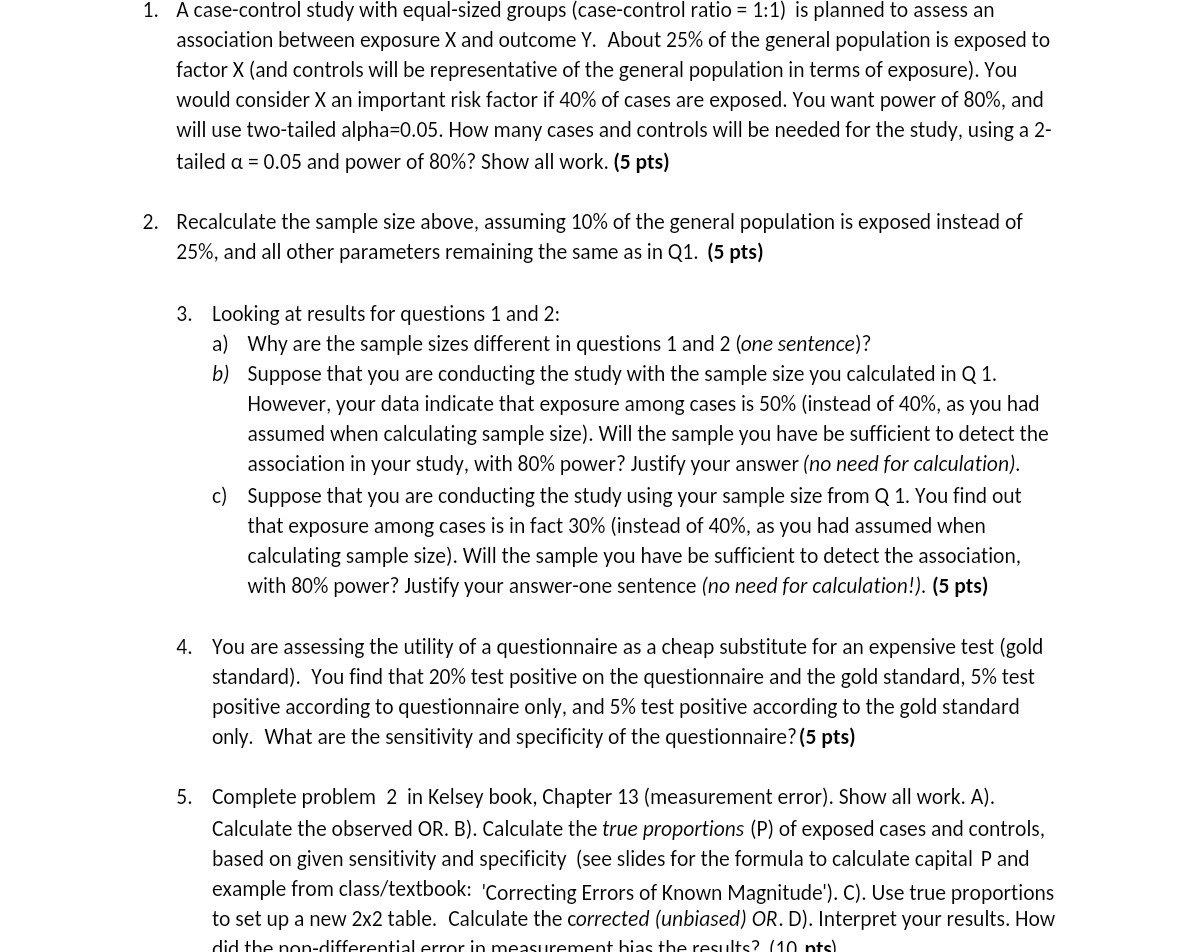
1. A case-control study with equal-sized groups (case-control ratio = 1:1) is planned to assess an association between exposure X and outcome Y. About 25% of the general population is exposed to factor X (and controls will be representative of the general population in terms of exposure). You would consider X an important risk factor if 40% of cases are exposed. You want power of 30%, and will use two-tailed alpha=0.05. How many cases and controls will be needed for the study, using a 2- tailed o = 0.05 and power of 80%? Show all work. {5 pts) 2. Recalculate the sample size above, assuming 10% of the general population is exposed instead of 25%, and all other parameters remaining the same as in Q1. (5 pts) 3. Looking at results for questions 1 and 2: a) Why are the sample sizes different in questions 1 and 2 (one sentence)? )3) Suppose that you are conducting the study with the sample size you calculated in Q 1. However, your data indicate that exposure among cases is 50% {instead of 40%, as you had assumed when calculating sample size). Will the sample you have be sufficient to detect the association in your study, with 80% power? Justify your answer (no need for calculation). c) Suppose that you are conducting the study using your sample size from Q 1. You find out that exposure among cases is in fact 30% (instead of 40%, as you had assumed when calculating sample size). Will the sample you have be sufficient to detect the association, with 80% power? Justify your answer-one sentence {no need for caicuiationl). (5 pts) 4. You are assessing the utility of a questionnaire as a cheap substitute for an expensive test (gold standard). You find that 20% test positive on the questionnaire and the gold standard, 5% test positive according to questionnaire only, and 5% test positive according to the gold standard only. What are the sensitivity and specificity of the questionnaire?[5 pts) 5. Complete problem 2 in Kelsey book, Chapter 13 (measurement error). Show all work. A). Calculate the observed OR. B). Calculate the true proportions {P} of exposed cases and controls, based on given sensitivity and specificity (see slides for the formula to calculate capital P and example from class/textbook: 'Correcting Errors of Known Magnitude'). C). Use true proportions to set up a new 2x2 table. Calculate the corrected (unbiased) 0R. D). Interpret your results. How rlirl Hm: nnn-rliffnrpni'inl nrrnr in mpncllrpmpnf hint: 'H-n: rtllli'tj Mn rife)
Step by Step Solution
There are 3 Steps involved in it

Get step-by-step solutions from verified subject matter experts
 Study Help