







Question: 1. A company has issued a long-term debt whose cost is 10% per annum. The tax rate is 25%. What is the cost of debt
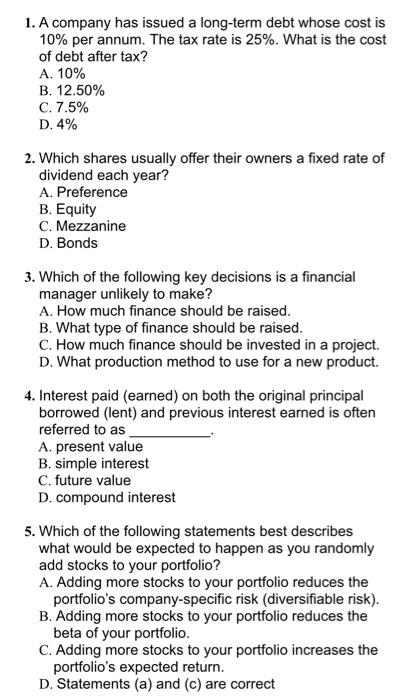
1. A company has issued a long-term debt whose cost is 10% per annum. The tax rate is 25%. What is the cost of debt after tax? A. 10% B. 12.50% C. 7.5% D. 4% 2. Which shares usually offer their owners a fixed rate of dividend each year? A. Preference B. Equity C. Mezzanine D. Bonds 3. Which of the following key decisions is a financial manager unlikely to make? A. How much finance should be raised. B. What type of finance should be raised. C. How much finance should be invested in a project. D. What production method to use for a new product. 4. Interest paid (earned) on both the original principal borrowed (lent) and previous interest earned is often referred to as A. present value B. simple interest C. future value D. compound interest 5. Which of the following statements best describes what would be expected to happen as you randomly add stocks to your portfolio? A. Adding more stocks to your portfolio reduces the portfolio's company-specific risk (diversifiable risk). B. Adding more stocks to your portfolio reduces the beta of your portfolio. C. Adding more stocks to your portfolio increases the portfolio's expected return. D. Statements (a) and (c) are correct
Step by Step Solution
There are 3 Steps involved in it

Get step-by-step solutions from verified subject matter experts
 Study Help