







Question: 1. (a) Compare interstitial and vacancy atomic mechanisms for diffusion. (b) Cite two reasons why interstitial diffusion is normally more rapid than vacancy diffusion. 2.
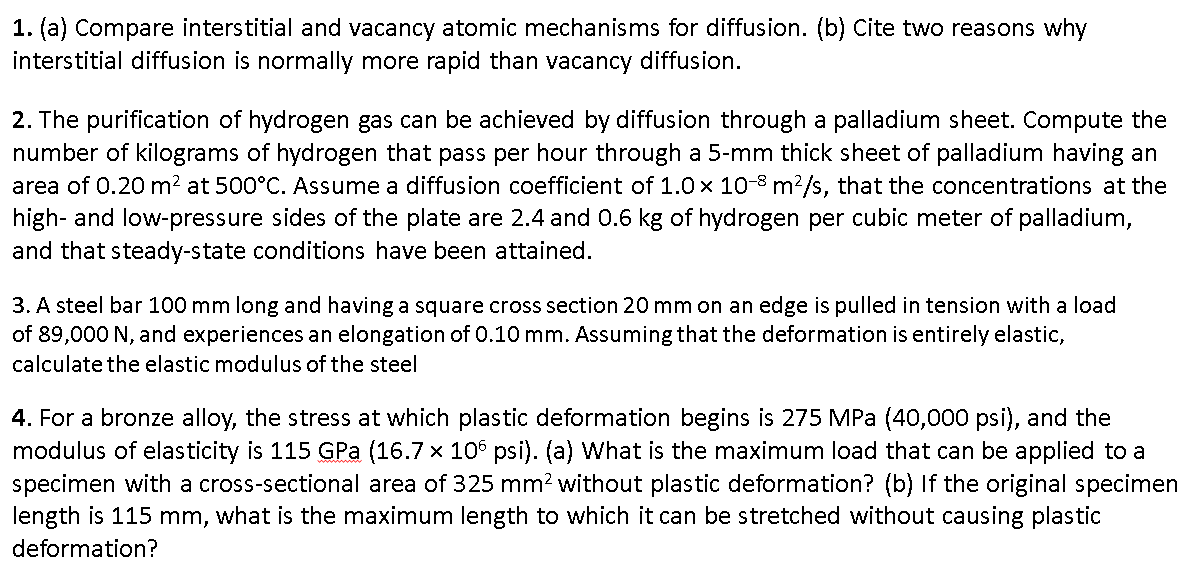
1. (a) Compare interstitial and vacancy atomic mechanisms for diffusion. (b) Cite two reasons why interstitial diffusion is normally more rapid than vacancy diffusion. 2. The purification of hydrogen gas can be achieved by diffusion through a palladium sheet. Compute the number of kilograms of hydrogen that pass per hour through a 5-mm thick sheet of palladium having an area of 0.20m2 at 500C. Assume a diffusion coefficient of 1.0108m2/s, that the concentrations at the high- and low-pressure sides of the plate are 2.4 and 0.6kg of hydrogen per cubic meter of palladium, and that steady-state conditions have been attained. 3. A steel bar 100mm long and having a square cross section 20mm on an edge is pulled in tension with a load of 89,000N, and experiences an elongation of 0.10mm. Assuming that the deformation is entirely elastic, calculate the elastic modulus of the steel 4. For a bronze alloy, the stress at which plastic deformation begins is 275MPa(40,000psi), and the modulus of elasticity is 115GPa(16.7106psi). (a) What is the maximum load that can be applied to a specimen with a cross-sectional area of 325mm2 without plastic deformation? (b) If the original specimer length is 115mm, what is the maximum length to which it can be stretched without causing plastic deformation
Step by Step Solution
There are 3 Steps involved in it

Get step-by-step solutions from verified subject matter experts
 Study Help