







Question: 1 . A convex single spherical surface which separates air from a material with an index of refraction 1.74, has a surface radius equal to
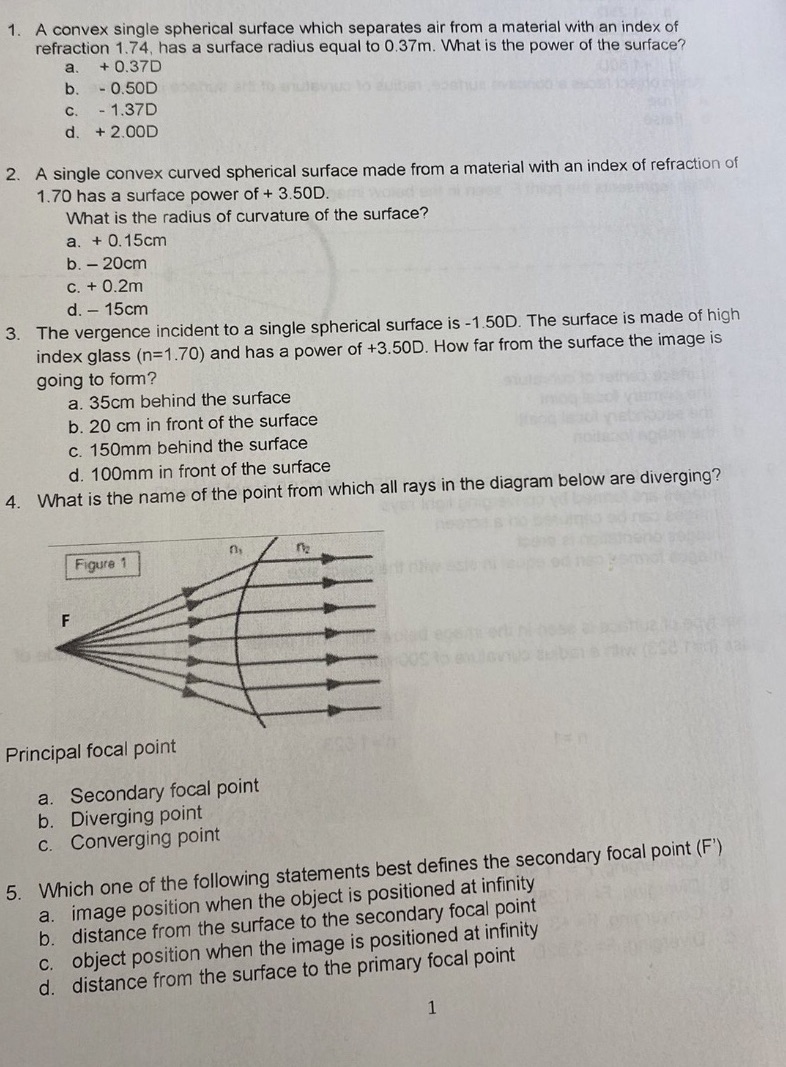
1 . A convex single spherical surface which separates air from a material with an index of refraction 1.74, has a surface radius equal to 0.37m. What is the power of the surface? a. + 0.37D b . - 0.50D C. - 1.37D d. + 2.00D 2. A single convex curved spherical surface made from a material with an index of refraction of 1.70 has a surface power of + 3.50D. What is the radius of curvature of the surface? a. + 0. 15cm b. - 20cm C. + 0.2m d. - 15cm 3. The vergence incident to a single spherical surface is -1.50D. The surface is made of high index glass (n=1.70) and has a power of +3.50D. How far from the surface the image is going to form? a. 35cm behind the surface b. 20 cm in front of the surface c. 150mm behind the surface d. 100mm in front of the surface 4. What is the name of the point from which all rays in the diagram below are diverging? Figure 1 Principal focal point a. Secondary focal point b. Diverging point c. Converging point 5. Which one of the following statements best defines the secondary focal point (F') a. image position when the object is positioned at infinity b. distance from the surface to the secondary focal point c. object position when the image is positioned at infinity d. distance from the surface to the primary focal point 1
Step by Step Solution
There are 3 Steps involved in it

Get step-by-step solutions from verified subject matter experts
 Study Help