







Question: 1. A cost that is traceable to a segment through activity-based costing may or may not be an avoidable cost for decision making. 2. Only
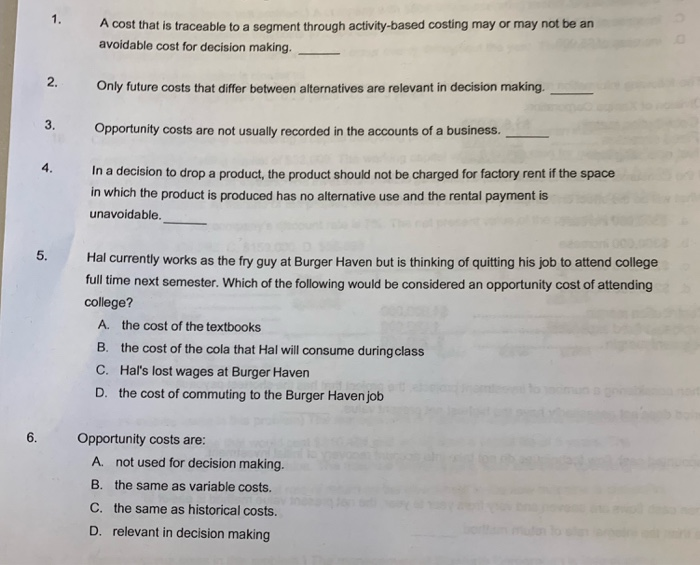
1. A cost that is traceable to a segment through activity-based costing may or may not be an avoidable cost for decision making. 2. Only future costs that differ between alternatives are relevant in decision making. 3.Opportunity costs are not usually recorded in the accounts of a business. 4. In a decision to drop a product, the product should not be charged for factory rent if the space in which the product is produced has no alternative use and the rental payment is unavoidable. 5. Hal currently works as the fry guy at Burger Haven but is thinking of quitting his job to attend college full time next semester. Which of the following would be considered an opportunity cost of attending college? A. the cost of the textbooks B. the cost of the cola that Hal will consume duringclass C. Hal's lost wages at Burger Haven D. the cost of commuting to the Burger Haven job 6. Opportunity costs are: A. not used for decision making. B. the same as variable costs. C. the same as historical costs D. relevant in decision making
Step by Step Solution
There are 3 Steps involved in it

Get step-by-step solutions from verified subject matter experts
 Study Help