







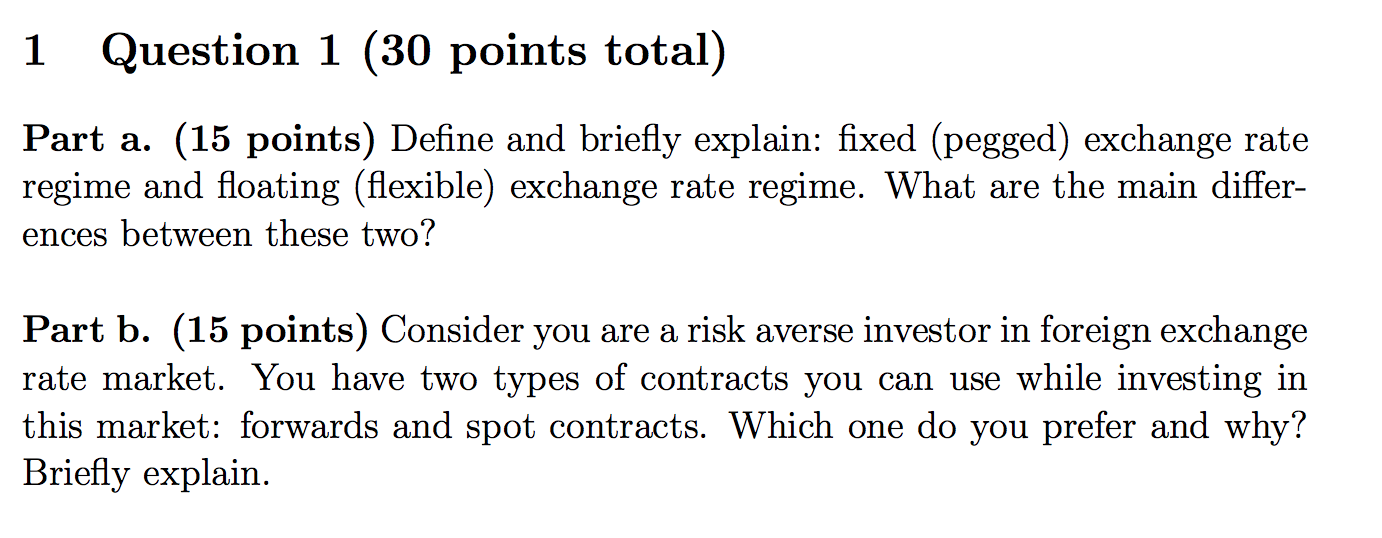
Question: 1. a) Define and briefly explain: fixed (pegged) exchange rate regime and floating (flexible) exchange rate regime. What are the main differences between these two?
1. a) Define and briefly explain: fixed (pegged) exchange rate regime and floating (flexible) exchange rate regime. What are the main differences between these two?
b) Consider you are a risk-averse investor in foreign exchange rate market. You have two types of contracts you can use while investing in this market: forwards and spot contracts. Which one do you prefer and why? Briefly explain.
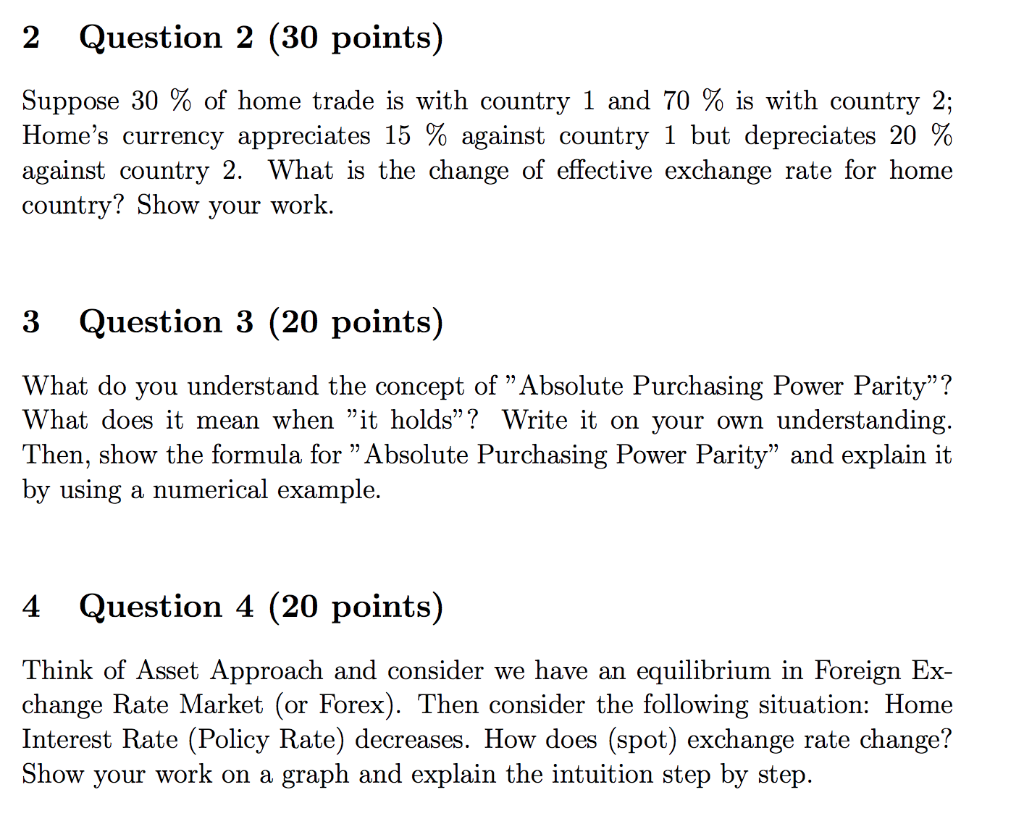
2. Suppose 30 % of home trade is with country 1 and 70 % is with country 2; Homes currency appreciates 15 % against country 1 but depreciates 20 % against country 2. What is the change of effective exchange rate for home country? Show your work.
3. What do you understand the concept of Absolute Purchasing Power Parity? What does it mean when it holds? Write it on your own understanding. Then, show the formula for Absolute Purchasing Power Parity and explain it by using a numerical example.
4. Think of Asset Approach and consider we have an equilibrium in Foreign Exchange Rate Market (or Forex). Then consider the following situation: Home Interest Rate (Policy Rate) decreases. How does (spot) exchange rate change? Show your work on a graph and explain the intuition step by step.
1 Question 1 (30 points total) Part a. (15 points) Define and briefly explain: fixed (pegged) exchange rate regime and floating (flexible) exchange rate regime. What are the main differ- ences between these two? Part b. (15 points) Consider you are a risk averse investor in foreign exchange rate market. You have two types of contracts you can use while investing in this market: forwards and spot contracts. Which one do you prefer and why? Briefly explain. 2 Question 2 (30 points) Suppose 30 % of home trade is with country 1 and 70 % is with country 2; Home's currency appreciates 15 % against country 1 but depreciates 20 % against country 2. What is the change of effective exchange rate for home country? Show your work. 3 Question 3 (20 points) What do you understand the concept of " Absolute Purchasing Power Parity? What does it mean when it holds? Write it on your own understanding. Then, show the formula for "Absolute Purchasing Power Parity and explain it by using a numerical example. 4 Question 4 (20 points) Think of Asset Approach and consider we have an equilibrium in Foreign Ex- change Rate Market (or Forex). Then consider the following situation: Home Interest Rate (Policy Rate) decreases. How does (spot) exchange rate change? Show your work on a graph and explain the intuition step by step. 1 Question 1 (30 points total) Part a. (15 points) Define and briefly explain: fixed (pegged) exchange rate regime and floating (flexible) exchange rate regime. What are the main differ- ences between these two? Part b. (15 points) Consider you are a risk averse investor in foreign exchange rate market. You have two types of contracts you can use while investing in this market: forwards and spot contracts. Which one do you prefer and why? Briefly explain. 2 Question 2 (30 points) Suppose 30 % of home trade is with country 1 and 70 % is with country 2; Home's currency appreciates 15 % against country 1 but depreciates 20 % against country 2. What is the change of effective exchange rate for home country? Show your work. 3 Question 3 (20 points) What do you understand the concept of " Absolute Purchasing Power Parity? What does it mean when it holds? Write it on your own understanding. Then, show the formula for "Absolute Purchasing Power Parity and explain it by using a numerical example. 4 Question 4 (20 points) Think of Asset Approach and consider we have an equilibrium in Foreign Ex- change Rate Market (or Forex). Then consider the following situation: Home Interest Rate (Policy Rate) decreases. How does (spot) exchange rate change? Show your work on a graph and explain the intuition step by step
Step by Step Solution
There are 3 Steps involved in it

Get step-by-step solutions from verified subject matter experts
 Study Help