







Question: 1. a) Define regular language. (Your definition should be in terms of sets and languages.) You may not mention deterministic finite automata (DFAs) or any
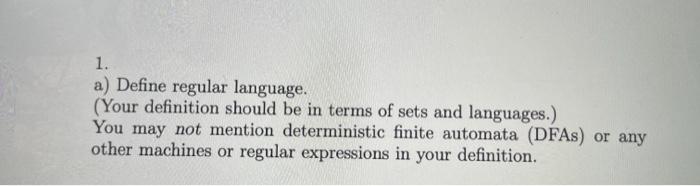
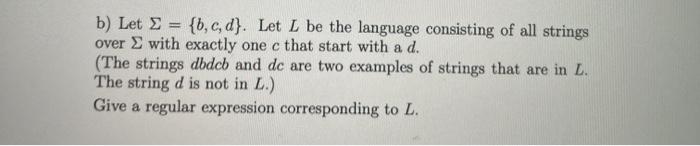
1. a) Define regular language. (Your definition should be in terms of sets and languages.) You may not mention deterministic finite automata (DFAs) or any other machines or regular expressions in your definition. b) Let {b,c,d}. Let L be the language consisting of all strings over with exactly one c that start with a d. (The strings dbdcb and dc are two examples of strings that are in L. The string d is not in L.) Give a regular expression corresponding to L
Step by Step Solution
There are 3 Steps involved in it
1 Expert Approved Answer
Step: 1 Unlock

Question Has Been Solved by an Expert!
Get step-by-step solutions from verified subject matter experts
Step: 2 Unlock
Step: 3 Unlock
 Study Help