



Question: 1. A differentiable function f(x, y) is called homogeneous of degree n means that for any scalar k, then f ( kx, ky) = knif(x,
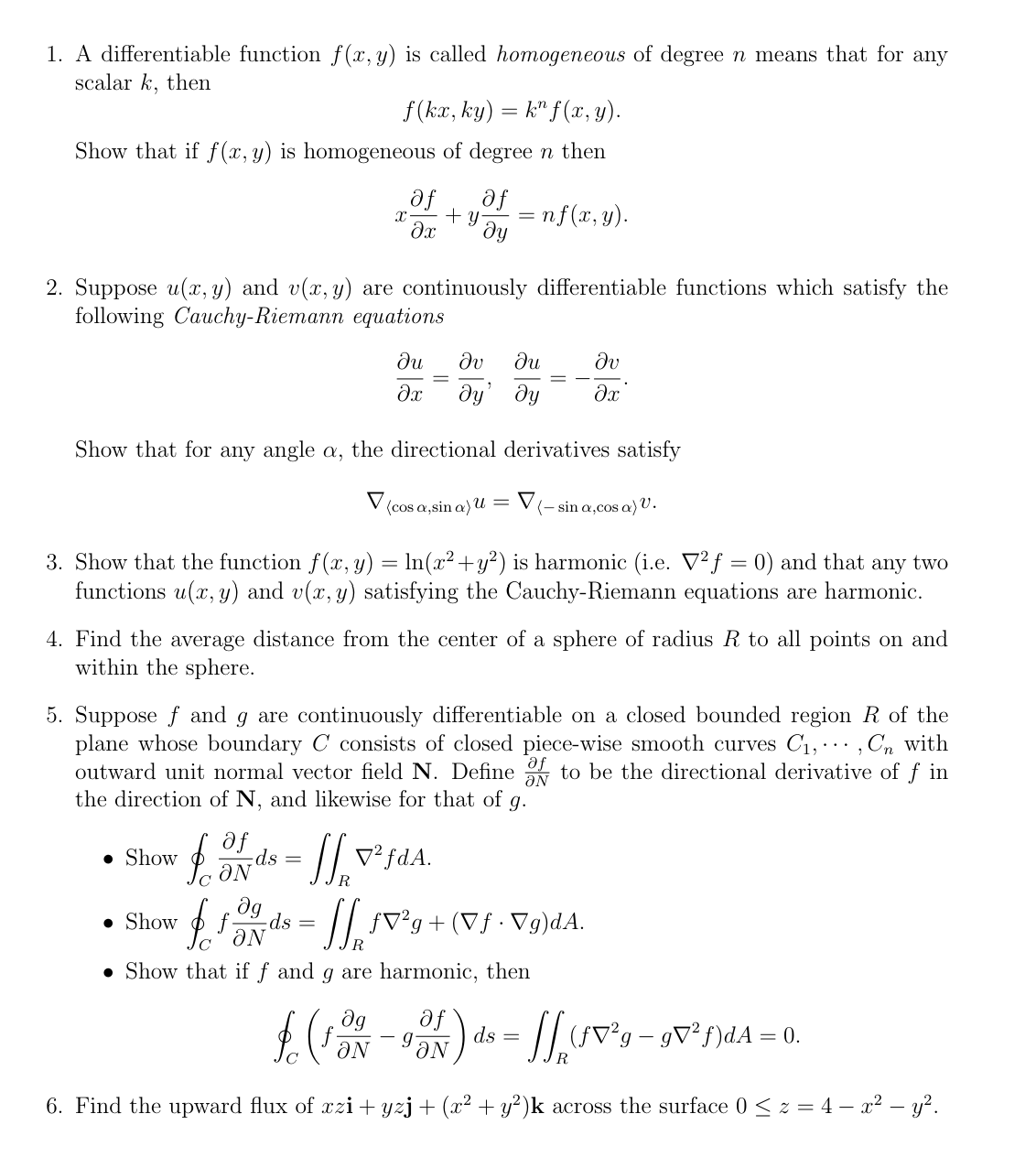
1. A differentiable function f(x, y) is called homogeneous of degree n means that for any scalar k, then f ( kx, ky) = knif(x, y). Show that if f(x, y) is homogeneous of degree n then of -+yay = nf (x, y). 2. Suppose u(x, y) and v(x, y) are continuously differentiable functions which satisfy the following Cauchy-Riemann equations du Ov av ax ay' dy ax Show that for any angle a, the directional derivatives satisfy V ( cos a, sina) u = V ( - sina, cosa ) U. 3. Show that the function f(x, y) = In(x2 +y2) is harmonic (i.e. V2 f =0) and that any two functions u(x, y) and v(x, y) satisfying the Cauchy-Riemann equations are harmonic. 4. Find the average distance from the center of a sphere of radius R to all points on and within the sphere. 5. Suppose f and g are continuously differentiable on a closed bounded region R of the plane whose boundary C consists of closed piece-wise smooth curves C1, . .., Cn with outward unit normal vector field N. Define on e of to be the directional derivative of f in the direction of N, and likewise for that of g. . Show . Show 1/ Avg + (Vf . Vg)dA. . Show that if f and g are harmonic, then 6. Find the upward flux of azi + yzj + (x2 + y?)k across the surface 0
Step by Step Solution
There are 3 Steps involved in it

Get step-by-step solutions from verified subject matter experts