







Question: 1. (a) Find the linear approximation to the function /(z) = v(r + 4] at a = 0. (b) Use this approximation to estimate the
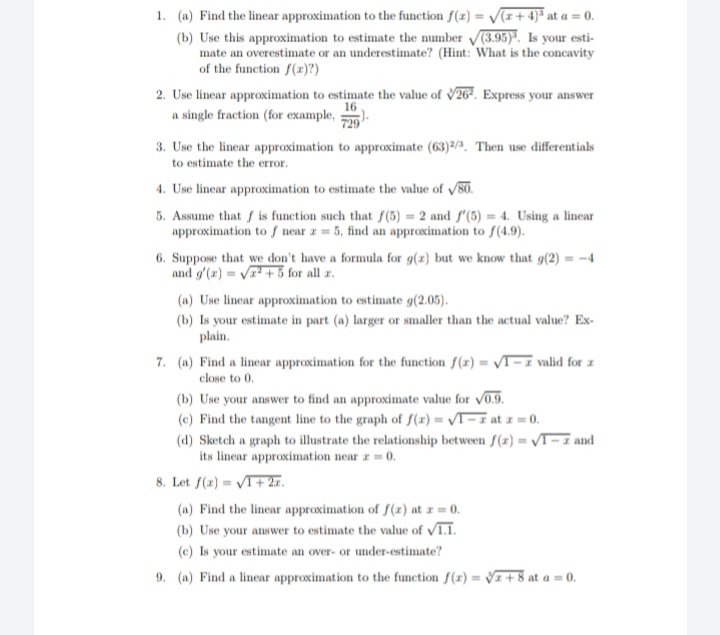
1. (a) Find the linear approximation to the function /(z) = v(r + 4] at a = 0. (b) Use this approximation to estimate the number v(3.95) . Is your esti- mate an overestimate or an underestimate? (Hint: What is the concavity of the function f(z)?) 2. Use linear approximation to estimate the value of V26-. Express your answer a single fraction (for example, 16 729 3. Use the linear approximation to approximate (63)3/3. Then use differentials to estimate the error. 4. Use linear approximation to estimate the value of v80. 5. Assume that f is function such that (5) = 2 and S'(5) = 4. Using a linear approximation to f near z = 5, find an approximation to f(4.9). 6. Suppose that we don't have a formula for g(x) but we know that g(2) = -4 and g'(x) = vx- + 5 for all r. (a) Use linear approximation to estimate g(2.05). (b) Is your estimate in part (a) larger or smaller than the actual value? Ex- plain. 7. (a) Find a linear approximation for the function f(x) = VI - a valid for a close to 0. (b) Use your answer to find an approximate value for vo.9. (c) Find the tangent line to the graph of f(x) = VI - z at s = 0. (d) Sketch a graph to illustrate the relationship between / (z) = VI - z and its linear approximation near z = 0. 8. Let / (a) = VI + 2x. (a) Find the linear approximation of f(z) at a = 0. (b) Use your answer to estimate the value of v1.I. (c) Is your estimate an over- or under-estimate? 9. (a) Find a linear approximation to the function f(r) = Vr + 8 at a = 0
Step by Step Solution
There are 3 Steps involved in it

Get step-by-step solutions from verified subject matter experts
 Study Help