







Question: 1. A graph-theoretic problem. The computer science department plans to schedule the classes Programming (P), Data Science (D), Arti cial Intelligence (A), Machine Learning (M),
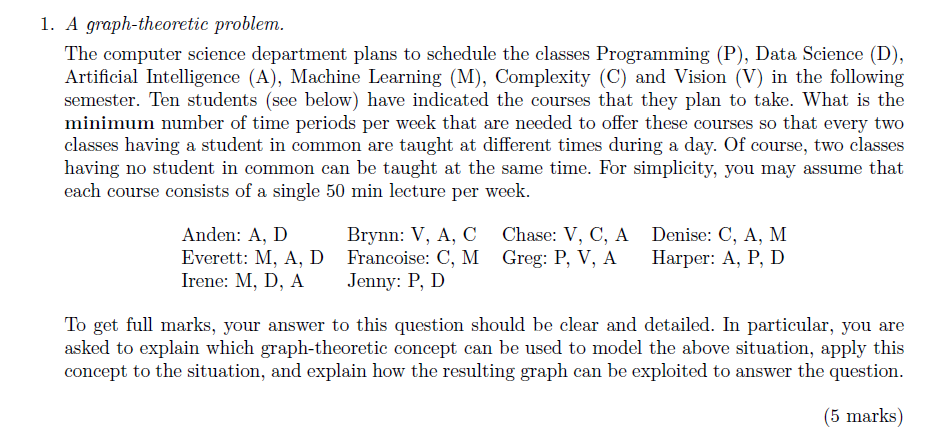
1. A graph-theoretic problem. The computer science department plans to schedule the classes Programming (P), Data Science (D), Arti cial Intelligence (A), Machine Learning (M), Complexity (C) and Vision (V) in the following semester. Ten students (see below) have indicated the courses that they plan to take. What is the minimum number of time periods per week that are needed to o er these courses so that every two classes having a student in common are taught at di erent times during a day. Of course, two classes having no student in common can be taught at the same time. For simplicity, you may assume that each course consists of a single 50 min lecture per week. Anden: A, D Brynn: V, A, C Chase: V, C, A Denise: C, A, M Everett: M, A, D Francoise: C, M Greg: P, V, A Harper: A, P, D Irene: M, D, A Jenny: P, D To get full marks, your answer to this question should be clear and detailed. In particular, you are asked to explain which graph-theoretic concept can be used to model the above situation, apply this concept to the situation, and explain how the resulting graph can be exploited to answer the question.
1. A graph-theoretic problem. The computer science department plans to schedule the classes Programming (P), Data Science (D), Artificial Intelligence (A), Machine Learning (M), Complexity (C) and Vision (V) in the following semester. Ten students (see below) have indicated the courses that they plan to take. What is the minimum number of time periods per week that are needed to offer these courses so that every two classes having a student in common are taught at different times during a day. Of course, two classes having no student in common can be taught at the same time. For simplicity, you may assume that each course consists of a single 50 min lecture per week. Anden: A, D Brynn: V, A, C Chase: V, C, A Denise: C, A, M Everett: M, A, D Francoise: C, M Greg: P, V, A Harper: A, P, D Irene: M, D, A Jenny: P, D To get full marks, your answer to this question should be clear and detailed. In particular, you are asked to explain which graph-theoretic concept can be used to model the above situation, apply this concept to the situation, and explain how the resulting graph can be exploited to answer the question. (5 marks) 1. A graph-theoretic problem. The computer science department plans to schedule the classes Programming (P), Data Science (D), Artificial Intelligence (A), Machine Learning (M), Complexity (C) and Vision (V) in the following semester. Ten students (see below) have indicated the courses that they plan to take. What is the minimum number of time periods per week that are needed to offer these courses so that every two classes having a student in common are taught at different times during a day. Of course, two classes having no student in common can be taught at the same time. For simplicity, you may assume that each course consists of a single 50 min lecture per week. Anden: A, D Brynn: V, A, C Chase: V, C, A Denise: C, A, M Everett: M, A, D Francoise: C, M Greg: P, V, A Harper: A, P, D Irene: M, D, A Jenny: P, D To get full marks, your answer to this question should be clear and detailed. In particular, you are asked to explain which graph-theoretic concept can be used to model the above situation, apply this concept to the situation, and explain how the resulting graph can be exploited to answer the
Step by Step Solution
There are 3 Steps involved in it

Get step-by-step solutions from verified subject matter experts
 Study Help